

Finance and German (5 years), MA
Introduction
Finance and German at Aberdeen brings the strong competitive advantage of a major European language and culture to your powerful understanding of the principles of finance and wider business skills. You will be an extremely sought-after graduate across industry, public and other sectors, with opportunities expected to grow further with growing internationalisation and innovations in the financial world.
Study Information
At a Glance
- Learning Mode
- On Campus Learning
- Degree Qualification
- MA
- Duration
- 60 months
- Study Mode
- Full Time
- Start Month
- September
- UCAS Code
- NR32
In Finance, you will explore financial management, corporate and personal finance, financial institutions, derivatives and the stock market. You will analyse and evaluate financial problems and gain the practical skills to understand and use information from financial newspapers and documents.
Your knowledge will grow in the dynamic, international environment of our Business School of over 40 nationalities, inspired by staff who are leaders in business practice and theory, in small classes with real-life scenarios, the input of employers and the support of dedicated careers advisers.
You will also benefit from professional training facilities, such as our Bloomberg finance lab, used by major financial services companies across the world and integrating real activity in financial markets directly into students’ courses.
German at Aberdeen has an outstanding reputation with the highest possible rating of ‘Excellent’ in the last national Teaching Quality Assessment. You will gain a broad understanding of Germany’s complex history and culture in today’s German-speaking countries and enjoy many opportunities to practise your developing language skills informally including our German Society and Drama Group.
As an integral part of your 5-year programme, you will spend the whole of year three taking your language and cultural skills to a very high level as a teaching assistant or visiting student in Germany or Austria.
You will have many advantages to offer employers operating in multinational companies in Europe, and also the European Commission, in addition to other international organisations.
Aberdeen Global Scholarship
The University of Aberdeen is delighted to offer eligible self-funded international on-campus undergraduate students a £6,000 scholarship for every year of their programme.
View the Aberdeen Global ScholarshipWhat You'll Study
- Year 1
-
Compulsory Courses
- Academic Writing for Business (AW1003)
-
This compulsory evaluation is designed to find out if your academic writing is of a sufficient standard to enable you to succeed at university and, if you need it, to provide support to improve. It is completed on-line via MyAberdeen with clear instructions to guide you through it. If you pass the evaluation at the first assessment it will not take much of your time. If you do not, you will be provided with resources to help you improve. This evaluation does not carry credits but if you do not complete it this will be recorded on your degree transcript.
- Getting Started at the University of Aberdeen (PD1002)
-
This course, which is prescribed for level 1 undergraduate students and articulating students who are in their first year at the University, is studied entirely online, takes approximately 2-3 hours to complete and can be taken in one sitting, or spread across the first 4 weeks of term.
Topics include University orientation overview, equality & diversity, MySkills, health, safety and cyber security, and academic integrity.
Successful completion of this course will be recorded on your Transcript as ‘Achieved’.
- The Economics of Business and Society (EC1006)
-
15 Credit Points
This course is an introductory course in microeconomics where we study the decision making of individual actors (consumers, employees, firms, governments, etc.) in an economy. Actors must make decisions about behaviours because they face scarce resources, but often they find that trading with other actors in markets can increase the wellbeing of all parties. This course models and examines the nature of these interactions, highlighting when they work well and when they fail to increase wellbeing and what might be the solution to these failures.
- Finance 1: Finance, Risk and Investment (FI1004)
-
15 Credit Points
The module considers the nature and operation of investment markets, focusing on three asset classes; shares, bonds and real estate. It looks at the characteristics of these investment options in terms of their risks and returns. The module introduces basic financial mathematics: time value of money, calculation of present values and investment rates of return. Finally, it considers the role of financial institutions and regulatory bodies in personal finance, where consumers and financial markets interact.
- Accounting and Entrepreneurship (AC1517)
-
15 Credit Points
The course provides an understanding of how organisations, particularly small businesses, capture, create and use accounting information both to guide their own activities and to communicate their financial performance and financial position to parties external to themselves. It develops knowledge and understanding of accounting, accounting techniques and accounting information, so that students become informed users of accounting data and information, not creators of that data and information.
- The Global Economy (EC1506)
-
15 Credit Points
This course is an introductory course in macroeconomics where we study the behaviour of the economy as a whole. Whereas microeconomics focuses on individual markets, macroeconomics addresses the “big issues” such as unemployment, inflation, economic growth, and financial crises. Macroeconomics is a lively subject, full of discussion and debate, as economists and policymakers take different views on macroeconomic issues, their causes and appropriate policy responses. Issues such as: Is the economy growing? What causes unemployment and how can we reduce it? How can we avoid recessions? When is inflation a problem? Are banks lending too much?
Optional Courses
Select one of the following options:
Beginner – for absolute beginners and those who have studied German for up to 3 years
- German for Beginners 1 (GM1054)
- German for Beginners 2 (GM1554)
- Background to German Beginners 1 (GM1049) AND/OR The Global City (LA1501)
Advanced – for post-Higher candidates and those who have studied German for more than 4 years
- German Language 1 (GM1050)
- German Language 2 (GM1550)
- Modern German Culture 1 (GM1052) AND/OR The Global City (LA1501)
Plus select further credit points from courses of choice to reach 120 credit points.
- German for Beginners 1 (GM1054)
-
15 Credit Points
This interactive language course provides students with a foundation in German. It enables students to understand the gist of authentic spoken and written German and to speak and write about everyday topics with a degree of accuracy and fluency.
No previous knowledge of German is required, but this course can also be taken by students who took German at school before, on any level lower than Higher or A-level.
With 3 Language Classes and 1 Language Practical per week this course provides students with ample opportunities to develop their language skills in class, as well as supporting them to refine their personal self-study strategies.
After completion of German for Beginners 1, students can continue with German for Beginners 2 in the second term of each year.
Upon registration for this course, you are asked to complete a short online language placement to ensure that you are registered for the most appropriate course for your language ability.
It is recommended (subject to individual placement results) that:• Students who have no experience of German register for GM1054: German for Beginners 1• Students who have studied German to National 5/ GCSE level (or equivalent) typically register for GM1054: German for Beginners 1• Students who have studied German to Higher level (or equivalent) register for GM1050 German Language 1
- German for Beginners 2 (GM1554)
-
15 Credit Points
This interactive language course provides students with a sound foundation in German. It is designed for students who completed GM1054 (German for Beginners 1) during term 1.
The course enables students to understand the gist of authentic written and spoken German and to speak and write about everyday topics with a degree of accuracy and fluency.
No previous knowledge of German is required, but this course can also be taken by students who took German at school before, on any level lower than Higher or A-level. With 3 Language Classes and 1 Language Practical per week this course provides students with ample opportunities to develop their language skills in class, as well as supporting them to refine their personal self-study strategies.
- Background to German for Beginners 1 (GM1049)
-
15 Credit Points
Students will gain detailed knowledge and understanding of the fascinating political and cultural developments and historical events in 20th century Germany.
They will be introduced in weekly lectures and tutorials to a variety of texts and contemporary films.
This course is taught in English and normally taken in conjunction with GM1054 German for Beginners 1. It is specifically recommended to students with the intention to proceed with German Studies beyond level one.
No pre-requisites are required.
- The Global City in Text and Film (LA1501)
-
15 Credit Points
Focusing on major cities in Europe and the Americas, this course unit uses a range of texts, including films, poetry and fiction, to investigate urban spaces as sites of promise, power and loss. Representations of global cities, and experiences of urban dwellers, highlight themes such as empire, identity, leisure, labour and love. Set amid glittering facades and gritty back streets, the texts studied in this course explore the many meanings of the urban experience across place and time. These urban encounters also provide a way of understanding key social, political and cultural moments in the past and present.
- German Language 1 (GM1050)
-
15 Credit Points
This interactive, skill-based course is designed for students with prior knowledge of German. It builds on previously acquired German communication skills to further develop students’ reading, writing, listening, and speaking abilities in German. Additionally, the course provides a deeper understanding of various cultural aspects of German-speaking countries.
Students who are considering applying for entry to German Honours must take this course.
Upon registration for this course, you are asked to complete a short online language placement to ensure that you are registered for the most appropriate course for your language ability.
• Students who have no experience of German register for GM1054: German for Beginners 1• Students who have studied German to National 5/GCSE level (or equivalent) typically register for GM1054: German for Beginners 1• Students who have studied German to Higher (or equivalent) register for GM1050 German Language 1
- German Language 2 (GM1550)
-
15 Credit Points
The course is designed for students who successfully completed GM1050 (semester 1)The course builds on previously acquired German communication skills to further develop students’ reading, writing, listening, and speaking abilities in German. Additionally, the course provides a deeper understanding of various cultural aspects of German-speaking countries.
Students who are considering applying for entry to German Honours must take this course
- Modern German Culture 1 (GM1052)
-
15 Credit Points
Learn more about German 20th-century literature, dealing with the events that shaped German and European history. As in all good literature, we will discuss universal themes and topics covering all of the most important aspects of modern life.
- Year 2
-
Compulsory Courses
- Finance 2: Business Finance (FI2004)
-
15 Credit Points
The main aim of this course is to develop a sound understanding of fundamental principles underlying the theory and practice of finance, thereby providing a strong basis for further study of advanced finance theory and cognate disciplines. The course introduces students to important concepts in finance: principles of assets pricing, concept of risk and return, theory of interest rates and pricing fixed income securities, evaluation of investment project with a focus on embedded real options. It equips students with good analytical skills in order to understand the implications of financial decisions by understanding the fundamentals that govern them.
- Financial Markets and Regulation (FI2501)
-
15 Credit Points
This course provides students with an understanding of the financial system, primarily from a UK perspective, introducing students to the reasons for, and nature of, financial markets and institutions before moving on to explore the need and importance of financial regulation, and investigating the causes and consequences of the recent global financial crisis. The course will introduce students to a variety of topics including the role of wholesale and retail banks, non-bank financial institutions, the debt and equity markets, and the derivative markets; market efficiency, UK and international regulation, consumer protection and market abuse.
- Understanding Statistics (PO2508)
-
15 Credit Points
This course aims to provide students with an understanding of statistical concepts and methods relevant to accounting, management, finance, real estate and economics. The course is intended to enable students
i) To understand the principles of descriptive statistics, index construction, statistical inference, correlation, regression and time series analysis
ii) To apply statistical techniques to the analysis of accounting, business and economic issues and interpret findings
iii) To identify important sources of data in accounting, business and economics
- Building Skills and Experience for Career Success (PD2002)
-
This course, which is designed for level 2 students and above, is studied entirely online. Topics include career planning, finding work experience and articulating your skills and experiences in applications and interviews. Successful completion of this course will be recorded on your Enhanced Transcript as ‘Achieved’. The course takes approximately 5-6 hours to complete and can be taken in one sitting, or spread across a number of weeks.
- Modern German Culture 3 (GM2043)
-
15 Credit Points
Learn more about modern German history and culture while also extending your skills in reading German texts.
- The Global City in Text and Film (LA1501)
-
15 Credit Points
Focusing on major cities in Europe and the Americas, this course unit uses a range of texts, including films, poetry and fiction, to investigate urban spaces as sites of promise, power and loss. Representations of global cities, and experiences of urban dwellers, highlight themes such as empire, identity, leisure, labour and love. Set amid glittering facades and gritty back streets, the texts studied in this course explore the many meanings of the urban experience across place and time. These urban encounters also provide a way of understanding key social, political and cultural moments in the past and present.
Optional Courses
Select one of the following options:
Beginner
- German Language (Advanced Introductory) 1 (GM2040)
- German Language (Advanced Introductory) 2 (GM2540)
Intermediate-Advanced
- German Language 3 (GM2042)
- German Language 4 (GM2542)
Plus select 15 credit points from courses of choice.
- German Language (Advanced Introductory) 1 (GM2040)
-
15 Credit Points
The course consists of language classes leading to advanced communicative competence in German and it will include the analysis of contemporary texts drawn from a variety of contexts. This course may be taken only by students who have completed the German for Beginners courses.
- German Language (Advanced Introductory) 2 (GM2540)
-
15 Credit Points
The intention of the course is to extend and reinforce further students' command of German grammar, vocabulary and syntactic structures, and to introduce various styles of written and spoken German. The course builds on the work done in GM2040 and is intended only for continuing beginners.
- German Language 3 (GM2042)
-
15 Credit Points
This level two language course will build on and extend students' fluency and written skills in German.
- German Language 4 (GM2542)
-
15 Credit Points
Building on work done in GM 2042, the course will develop further language skills.
- Year 3
-
Compulsory Courses
Academic year spent in German-speaking country.
- Year 4
-
Compulsory Courses
- German Junior Honours Language Study (GM3069)
-
15 Credit Points
This junior honours language course will build on and extend students' written skills and fluency in German.
- Applied Corporate Finance (FI3008)
-
15 Credit Points
Applied Corporate Finance provides students with the knowledge about the fundamental theories and emerging issues in corporate finance. The course introduces the issues facing a corporate manager and equip students with the analytical skills necessary for evaluating corporate financial policies. Important issues covered by the course such as cost of capital, value of debt and its associated risks, leasing, credit risk analysis, management of working capital, will be explored from both theoretical and practical perspectives.
- Corporate Financial Theory (FI3009)
-
15 Credit Points
This course is designed to equip students with a thorough understanding of corporate finance theory, enabling them to grasp the implications of corporate finance decisions comprehensively. It aims to deepen students' knowledge of the fundamental theories underpinning corporate finance while enhancing their intellectual capabilities. Through the course, students will gain insights into corporate financing choices and their interaction with financial markets, thereby solidifying their theoretical foundation for analysing and understanding corporate behaviour and performance.
Optional Courses
Plus a further 30 credit points from level 3 courses in Finance.
- Year 5
-
Compulsory Courses
- German Language Study for Senior Honours (GM4099)
-
30 Credit Points
Building on the skills gained during the Junior Honours language course and before, this module expands and refines German language expertise in writing, reading, speaking and listening, to an advanced level, for their final exit written and oral exam in German.
Optional Courses
Select one of the following dissertation options:
- Dissertation in German (GM4052)
- Dissertation in Finance (FI4501)
Plus select one of the following:
- Empirical Methods in Finance (FI4003)
- Financial Strategy and Investment Management (FI4002)
Plus select further credit points from level 4 courses in Finance and German to gain a total of 60 credits in each discipline.
- Dissertation in German (GM4052)
-
15 Credit Points
Students engage in their first larger project of independent research.
- Dissertation in Finance (FI4501)
-
30 Credit Points
All Accountancy and Finance students must undertake a dissertation. Students taking a joint degree may undertake the dissertation in either discipline, but not both. It is designed to show that you are able to:
Carry out a substantial piece of research on a chosen subject without close supervision
Critically analyse and evaluate work carried out by others
Reach your own conclusions based upon your analysis and evaluation of relevant evidence, whether this is prior research only or prior research coupled with your own research.
Write-up the results of your work in a clear, coherent and logical way.
- Empirical Methods in Finance (FI4003)
-
30 Credit Points
This course aims to provide an overview of quantitative methods needed to conduct empirical research in finance and financial economics. The course is intended to enable students
i) To develop knowledge and understanding of the theoretical practical approaches to quantitative methods in finance.
ii) To develop the practical quantitative skills to equip students for dissertations in finance and for on-going work in the finance area.
iii) To develop intellectual skills by understanding of the appropriate use of statistical techniques for various financial problems.
iv) To develop the ability to write extended research reports on original topics in finance
- Financial Strategy and Investment Management (FI4002)
-
30 Credit Points
Covering the intellectually and commercially fertile ground at the accountancy/finance interface. Considering financial analysis from both theoretical and practical angles. Do you need to understand financial reporting to be an investor? How should we assess the success of an acquisition? Why do accountants think mergers don’t exist? How do companies decide on financing strategies? Does corporate governance and ethics really matter – do share prices react to it? These are some of the questions we will address alongside using DataStream and the ThomsonReuters Eikon system. The course might give you some ideas for your dissertation too.
We will endeavour to make all course options available. However, these may be subject to change - see our Student Terms and Conditions page. In exceptional circumstances there may be additional fees associated with specialist courses, for example field trips.
How You'll Study
Learning Methods
- Individual Projects
- Lectures
- Research
- Tutorials
Assessment Methods
Students are assessed by any combination of three assessment methods:
- Coursework such as essays and reports completed throughout the course;
- Practical assessments of the skills and competencies they learn on the course; and
- Written examinations at the end of each course.
The exact mix of these methods differs between subject areas, years of study and individual courses.
Honours projects are typically assessed on the basis of a written dissertation.
Why Study Finance and German?
- An excellent teaching environment, committed to the needs of industry, which integrates research into teaching, enables transferable skills and develops intellectual skills on a range of contemporary economic problems.
- ACREEF (the Aberdeen Centre for Research in Energy Economics and Finance) headed by leading international petroleum economist Professor Alex Kemp, adviser to the Scottish Government.
- CELMR (the Centre for European Labour Market Research) leading research in education, skills and labour markets so topical today.
- Benefit from professional training facilities such as the Bloomberg finance lab which is used by major financial services companies across the world and integrating real activity in financial markets directly into our students’ courses.
- A vibrant international community on campus and across the region, with many German-speaking students, staff and activities to get involved in and practise your language skills.
- German Society open to all students interested in German and the German-speaking countries, organising drama performances and other events such as Kaffee and Kuchen, a German Stammtisch, film showings, and visits by German speakers and writers.
- German Drama Group providing a great opportunity to produce an annual play, widen your language skills and meet other German students studying in Aberdeen. Previous years included works of 20th century dramatists Dürrenmatt, Borchert and Horvath.
- Opportunities to study the rich literature and culture of Austria and Switzerland in addition to Germany.
Entry Requirements
Qualifications
The information below is provided as a guide only and does not guarantee entry to the University of Aberdeen.
General Entry Requirements
- 2025 Entry
-
SQA Highers
Standard: BBBB
Applicants who have achieved BBBB (or better), are encouraged to apply and will be considered. Good performance in additional Highers/ Advanced Highers may be required.
Minimum: BBC
Applicants who have achieved BBC at Higher and meet one of the widening participation criteria above are encouraged to apply and are guaranteed an unconditional offer for MA, BSc and BEng degrees.
Adjusted: BB
Applicants who have achieved BB at Higher, and who meet one of the widening participation criteria above are encouraged to apply and are guaranteed an adjusted conditional offer for MA, BSc and BEng degrees.
We would expect to issue a conditional offer asking for one additional C grade at Higher.
Foundation Apprenticeship: One FA is equivalent to a Higher at A. It cannot replace any required subjects.
More information on our definition of Standard, Minimum and Adjusted entry qualifications.
A LEVELS
Standard: BBC
Minimum: BCC
Adjusted: CCC
More information on our definition of Standard, Minimum and Adjusted entry qualifications.
International Baccalaureate
32 points, including 5, 5, 5 at HL.
Irish Leaving Certificate
5H with 3 at H2 AND 2 at H3.
PLEASE NOTE: National 5/ Standard Grade/ GCSE (or equivalent) in Mathematics / Applications of Mathematics is required in addition to the requirements noted above.
Entry from College
Advanced entry to this degree may be possible from some HNC/HND qualifications, please see www.abdn.ac.uk/study/articulation for more details.
The information displayed in this section shows a shortened summary of our entry requirements. For more information, or for full entry requirements for Arts and Social Sciences degrees, see our detailed entry requirements section.
English Language Requirements
To study for an Undergraduate degree at the University of Aberdeen it is essential that you can speak, understand, read, and write English fluently. The minimum requirements for this degree are as follows:
IELTS Academic:
OVERALL - 6.0 with: Listening - 5.5; Reading - 5.5; Speaking - 5.5; Writing - 6.0
TOEFL iBT:
OVERALL - 78 with: Listening - 17; Reading - 18; Speaking - 20; Writing - 21
PTE Academic:
OVERALL - 59 with: Listening - 59; Reading - 59; Speaking - 59; Writing - 59
Cambridge English B2 First, C1 Advanced or C2 Proficiency:
OVERALL - 169 with: Listening - 162; Reading - 162; Speaking - 162; Writing - 169
Read more about specific English Language requirements here.
Fees and Funding
You will be classified as one of the fee categories below.
| Fee category | Cost |
|---|---|
| EU / International students | |
| Tuition Fees for 2026/27 Academic Year | £20,800 |
| Tuition Fees for 2026/27 Academic Year (Self-funded Students *) | £14,800 |
| Home Students | |
| Tuition Fees for 2026/27 Academic Year | £1,820 |
| England, Wales, Northern Ireland, and Republic of Ireland | |
| Tuition Fees for 2026/27 Academic Year | £9,790 |
Scholarships and Funding
UK Scholarship
Students from England, Wales and Northern Ireland, who pay tuition fees may be eligible for specific scholarships allowing them to receive additional funding. These are designed to provide assistance to help students support themselves during their time at Aberdeen.
Aberdeen Global Scholarship
The University of Aberdeen is delighted to offer eligible self-funded international on-campus undergraduate students a £6,000 scholarship for every year of their programme. More about this funding opportunity.Funding Database
View all funding options in our Funding Database.
Careers
Finance graduates are highly in demand by UK and overseas employers, and a degree in Finance is applicable to a number of industries, giving you additional flexibility in your career choices. The skills you will develop in risk assessment, strategic decision-making, analytics, and more are in high demand with many employers.
Germany has one of the largest economies in the world and is one of the world's most successful exporting nations. Learning a language spoken by more than 100 million people in the European Union can help improve your employability and develop your relationships with colleagues and across organisations.
Career Opportunities
- Business Administrator
- Business Consultant
- Commercial Analyst
- Data Consultant
- Economic Analyst
- Financial Manager
- International Banker
- International Business and Organisations
Our Experts
Information About Staff Changes
You will be taught by a range of experts including professors, lecturers, teaching fellows and postgraduate tutors. However, these may be subject to change - see our Student Terms and Conditions page.
Features

World-class facilities
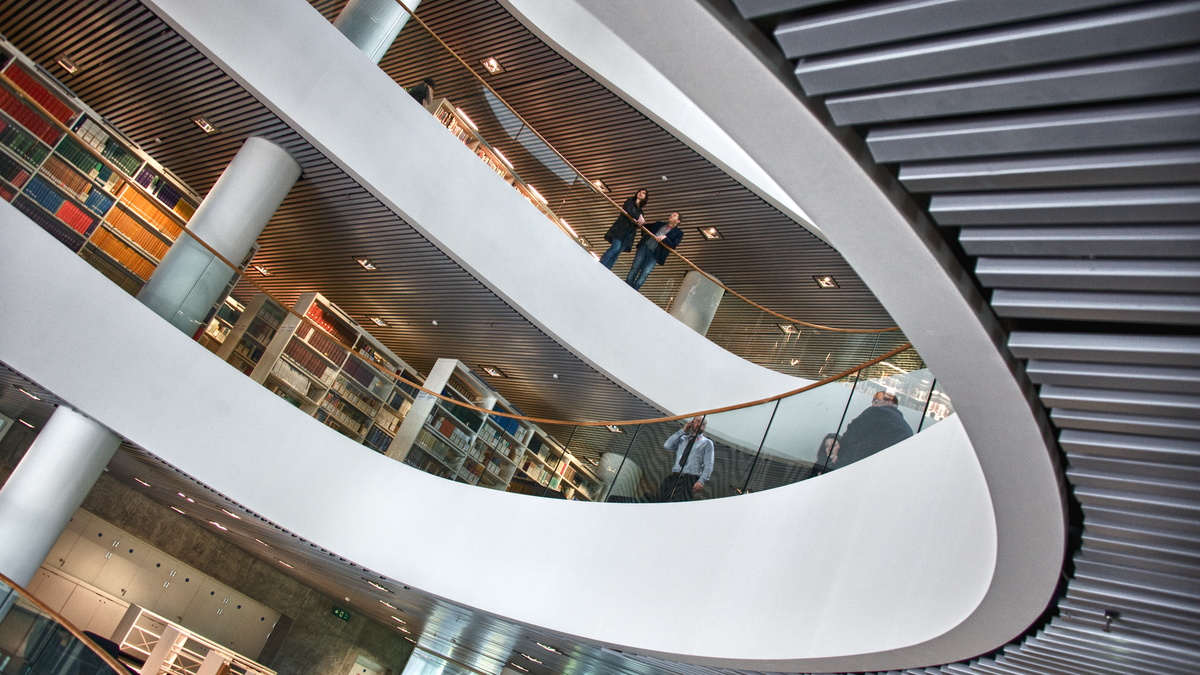
We invest heavily in our facilities and learning resources, ensuring our students have access to everything they need to help them succeed in their studies - from the stunning Sir Duncan Rice Library, to Aberdeen Sport Village, and beyond.
Find out moreBloomberg Finance Lab
Utilise professional training facilities including the Bloomberg finance lab, used by major financial services companies across the world and integrating real activity in financial markets directly into our students’ courses.

International community
We are a Scottish university that was founded with international connections. Our community of 3,600 staff and over 14,000 students includes more than 130 nationalities, which enriches our teaching, research, and students' experiences.
Discover Uni
Discover Uni draws together comparable information in areas students have identified as important in making decisions about what and where to study. You can compare these and other data for different degree programmes in which you are interested.
Get in Touch
Contact Details
- Address
-
Student Recruitment & Admissions
University of Aberdeen
University Office
Regent Walk
Aberdeen
AB24 3FX