Anthropology and English, MA
Introduction
Anthropology and English at Aberdeen is a great combination of subjects. This programme will add to your thorough grounding in what it means to ‘be human’ and offers in-depth studies of language – in all its glorious variety of expression. You will develop skills in critical thinking, communication and analysis through two highly-rated programmes at a recognised centre of excellence for both – which will appeal strongly to employers in business and many other fields.
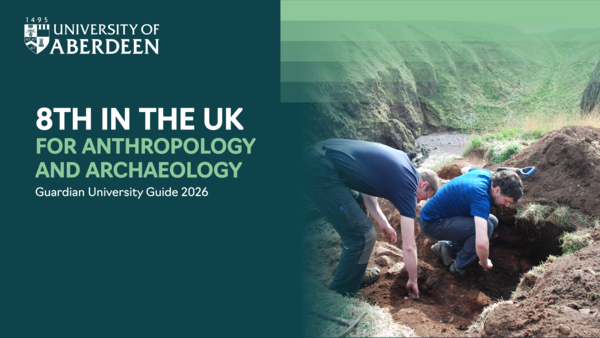
Aberdeen is ranked 3rd in the UK for Anthropology and Archaeology (Guardian University Guide 2025)
Study Information
At a Glance
- Learning Mode
- On Campus Learning
- Degree Qualification
- MA
- Duration
- 48 months
- Study Mode
- Full Time
- Start Month
- September
- UCAS Code
- LQ63
- Pathway Programme Available
- Undergraduate Foundation Programme

Anthropology will give you a thorough grounding in humanity, the differences in human cultures and communities and how they have developed. You will gain a unique insight into behaviours, beliefs and attitudes all over the world and find connections between aspects of life such as family, economics, politics and religion.
English at Aberdeen gives you the opportunity to learn in a creative hub, rated second in the UK for the quality of its research. You will be inspired by enthusiastic teachers and researchers, themselves acclaimed authors and poets and be encouraged to develop your own creative writing skills while studying every period from Chaucer, Shakespeare and Milton to contemporary English, Scottish, Irish, European and American writing. You will also learn about the cultural and critical impact of powerful and controversial modern works.
You will thrive in our dynamic international environment, at a historic university with an award-winning library, priceless literary treasures and in a region rich in tradition and heritage that also celebrates today's diverse cultures. You will gain the core writing, research, technical and presentation skills to open up a wide variety of careers as diverse as publishing, teaching, research, journalism, or any sector of business.
Aberdeen Global Scholarship
The University of Aberdeen is delighted to offer eligible self-funded international on-campus undergraduate students a £6,000 scholarship for every year of their programme.
View the Aberdeen Global ScholarshipWhat You'll Study
- Year 1
-
Compulsory Courses
- Getting Started at the University of Aberdeen (PD1002)
-
This course, which is prescribed for level 1 undergraduate students and articulating students who are in their first year at the University, is studied entirely online, is studied entirely online, takes approximately 2-3 hours to complete and can be taken in one sitting, or spread across the first 4 weeks of term.
Topics include University orientation overview, equality & diversity, MySkills, health, safety and cyber security, and academic integrity.Successful completion of this course will be recorded on your Transcript as ‘Achieved’.
- Introduction to Anthropology: Peoples of the World (AT1003)
-
15 Credit Points
Anthropology explores ways of life in societies and cultures around the world. Through fieldwork in the places people live, anthropologists connect global issues with everyday lives. In this course you’ll learn about the key topics of anthropology and its research methods. Lectures introduce anthropological research topics such as ritual, climate change and indigenous rights. Small group tutorials will allow you to debate the issues and share your perspectives.
- Acts of Reading (EL1009)
-
15 Credit Points
This course introduces students to the study of English by exploring the dynamic relationship between author, reader and text in a series of classic works of fiction and poetry. It covers a broad historical range (from Folk Tales and ballads to 21st century postmodernity) and offers a basic grounding in key elements of literary theory, literary history and the varieties of literary form.
- Introduction to Anthropology: Questions of Diversity (AT1502)
-
15 Credit Points
In this course students will be offered an extended introduction to social anthropology and will focus on topics: language and culture, belief and religion, gender and sex, kinship, and race. Students will develop and refine their understanding of major issues in the discipline of social anthropology through staff lectures, tutorials, and ethnographic films.
- Academic Writing for Social Sciences (AW1006)
-
This compulsory evaluation is designed to find out if your academic writing is of a sufficient standard to enable you to succeed at university and, if you need it, to provide support to improve. It is completed on-line via MyAberdeen with clear instructions to guide you through it. If you pass the evaluation at the first assessment it will not take much of your time. If you do not, you will be provided with resources to help you improve. This evaluation does not carry credits but if you do not complete it this will be recorded on your degree transcript.
Optional Courses
Select Controversial Classics (EL1513) AND/OR Rethinking Reading (EL1536)
Select a further 60 credit points from courses of choice
- Controversial Classics (EL1513)
-
15 Credit Points
Literature can provoke, offend and disturb as well as entertain. This course considers some of the most powerful and controversial works of modern literature. It examines the circumstances of publication, the nature of the controversy, and the cultural and critical impact of each work. The course shows how poems, plays and novels can raise searching questions about national, racial and personal identity, and looks at the methods used by writers to challenge their readers, as well the responses of readers to such challenges.
- Rethinking Reading (EL1536)
-
15 Credit Points
'Rethinking Reading' complements the module ‘Acts of Reading’. Intended primarily for students with degree intentions in English, this course introduces key areas in critical theory that inform the current work of staff at Aberdeen. It asks students to consider the history of English studies and its relationship to colonialism, and how this impacts on conceptions of literature and authorship, alongside topics such as gender and sexuality, and genre. Through a series of modules, the course introduces each area of theory alongside a literary text used as a case study. The course supports students in learning to read and use critical theory in your work, incorporating reflective learning and a practical focus on the techniques involved in critical writing.
- Year 2
-
Compulsory Courses
- Key Debates in Anthropology (AT2010)
-
30 Credit Points
This course explores some of the key questions that anthropologists have debated: what it is to be human, the nature of human interaction with other humans and with other species, the role language plays in thought and culture, and the different ways that people perceive the world and act within it. Themes that will be discussed in this course include rationality, language, species difference, race, and place and community.
- Encounters with Shakespeare (EL2011)
-
30 Credit Points
So you think you know Shakespeare? This course invites you to think again. Studying a range of plays we get behind the mythology of Shakespeare, and rediscover the dynamic inventiveness of the Elizabethan theatre. Shakespeare and his contemporaries were the principal players in a period of literary experimentation that reinvented the possibilities of literature. Encounters with Shakespeare is your chance to find out more.
- Reimagining Colonialism (AT2515)
-
30 Credit Points
This course will explore contemporary colonial expressions from an anthropological perspective. It will be split into two main themes: Material Histories; and Mediated Histories. Within these themes it will address topics such as the "capturing" of cultures in museums, kinship and politics, gendered colonialism, economic development, media, aboriginal rights and contemporary resistance movements.
Optional Courses
- Either EL 2512 The Tragedy of Knowledge
OR EL 2518 Power, Empire and Equality
- The Tragedy of Knowledge (EL2512)
-
30 Credit Points
This course traces the use of key Western myths from antiquity to the present to examine the way knowledge is often presented as both dangerous and compelling. As well as introducing students to a range of historical, social, and formal variations on the theme of knowledge, the course also highlights the role of storytelling and adaptation in the formation of knowledge and understanding.
- Power, Empire and Equality (EL2518)
-
30 Credit Points
This optional course in literature allows students at pre-Honours to learn about the impact of global colonialism through the writings of those who experienced it and its repercussions. It includes theorists of our time and texts like Daniel Defoe’s Robinson Crusoe and Buchi Emecheta’s Second Class Citizen. The texts on this course are necessarily concerned with enslavement and freedom, with how one encounters difference, and what it means to possess or claim territory. In examining these issues students will engage with issues of power and equality over centuries of writing about colonialism and empire.
- Year 3
-
Compulsory Courses
One Term 2 level 3 Anthropology course from the Anthropology Annexe
- Anthropological Theory (AT3027)
-
30 Credit Points
This course explores theoretical issues and key debates in contemporary anthropology. We begin with the questioning of the central concepts of culture and society in anthropology during the 1980s. Following this, we ask: how can anthropology proceed if the targets of its investigation can no longer be understood as objective entities? How can anthropology proceed if the anthropologist themselves is inevitably implicated in and part of those very targets? To look for possible answers, the course examines current anthropological interest in power and history, political economy and phenomenology, experience, embodiment and practice, ontology and things that speak.
Optional Courses
Select a total of two courses from the following groups, each from a different group:
Medieval/Renaissance
- Page and Stage: Renaissance Writings 1500-1640 (EL30CP)
- Knights, Virgins and Viragos: Chaucer and Medieval Writing (EL35DQ)
Romantic/Victorian
- Romanticism (EL35XR)
- Britain and the Nineteenth-Century World (EL35SB)
- Sympathy for the Devil: Scottish Short Stories (EL30QA)
- Fallen Women and Self-Made Men (EL30VC)
Contemporary/Modern
- Modernism: Make it New (EL30FF)
- American Voices: Self and Society 1850-1930 (EL30RD)
- Haunted Texts (EL35KN)
- Art and Atrocity: Representations of Violence and Trauma (EL35UT)
Plus, select a further 30 credit points from Level 3 courses in Anthropology
- Page and Stage: Renaissance Writings 1500 - 1640 (EL30CP)
-
30 Credit Points
This course explores the poetry, drama and prose of a period often referred to as the golden age of English literature. A period which saw Shakespeare and his contemporaries produce innovative new literary works in which the language of desire took centre stage.
- Knights, Virgins and Viragos: Chaucer and Medieval Writing (EL35DQ)
-
30 Credit Points
Knights, Virgins, and Viragos offers an introduction to the variety of medieval literature and culture. Turning a critical eye on the role misconceptions of the Middle Ages play in present day white supremacy, the course highlights genres from medieval drama to life writing, with attention to the medieval history of race making and modern responses to medieval texts.
- Sympathy for the Devil: Scottish Short Stories (EL30QA)
-
30 Credit Points
While the short story is often said to have developed in America, nineteenth-century Scottish writing is in fact instrumental in the emergence of the form. Often drawing on oral and folk traditions Scottish writers in the nineteenth and early twentieth centuries employ the supernatural, or our fear of it, to explore subjects such as guilt, fear, remorse and the extent to which we can control our own destinies. This course will explore the ways in which the short story in Scotland develops from the early nineteenth century until the beginning of the twentieth. It will include writers such as Walter Scott, James Hogg, John Galt, Margaret Oliphant, Robert Louis Stevenson, Arthur Conan Doyle and Jane Findlater.
- Britain and the Nineteenth - Century World (EL35SB)
-
30 Credit Points
The Romantic (1782-1832) and Victorian (1832-1901) periods were ones of remarkable activity for British citizens abroad. Imperial expansion, increasing international trade, major conflicts and growing mass migration all drew more British citizens than ever into contact with the wider world. This course explores the footprints left by these interactions in nineteenth-century literature. Writers covered may include Henry Derozio, Jane Austen, Mary Prince, Robert Louis Stevenson and Arthur Conan Doyle.
- Romanticism (EL30XR)
-
30 Credit Points
The Romantic movement swept Europe in the late eighteenth and early nineteenth centuries and produced some of the most innovative and exciting literature that has ever been seen. This rule breaking art helped shape the way that we consider art today and underpins many of our ideas about imagination, originality, creativity and self-expression. This course will explore the ways in which the Romantic movement manifested itself across Britain and Ireland and will consider writers such as Blake, Wordsworth, Coleridge, Scott, Austen and Byron.
- Fallen Women and Self - Made Men (EL35VC)
-
30 Credit Points
The Victorian period is often seen as a time of sexual repression and rigid gender roles, in which men and women were expected to perform in accordance with established codes of behaviour that were based on assumptions about innate masculinity and femininity. While this perception of Victorian attitudes may be true to some extent, many Victorians were well aware of the dangers of gender stereotyping, and wrote fiction in order to interrogate and challenge these expectations. Focussing mainly on the novel, but including some poetry and drama, this module explores how Victorian writers engaged with gender stereotypes, and considers the literary tactics that authors used to re-examine, overthrow and sometimes reaffirm them. We will also consider how these stereotypes changed during the nineteenth century in response to public controversies and campaigns that kept questions of gender at the forefront of public consciousness. Figures such as the Fallen Woman, the Self-Made man and the Angel in the House will be explored in texts by authors including Emily Brontë, Christina Rossetti, Robert Louis Stevenson and Thomas Hardy.
- Modernism: Make IT New (EL30FF)
-
30 Credit Points
The early twentieth century was a time of great literary experimentation as literary modernists rose to the challenge to make it new. We will explore modernism’s stylistic experimentation while also considering the social contexts and changes that shaped this literature. The course will examine a range of writers, genres, movements and locations which prompt us to consider what, when and where was modernism.
- Haunted Texts (EL35KN)
-
30 Credit Points
This course offers an overview of a wide range of twentieth-century Scottish literature, focusing on themes of haunting, death, and place. Including novels, short stories, poetry, and drama, the course explores questions of the relationship between self and society, the legacy of the past, and the formation of gendered and regional identities. There are lots of ghosts.
- American Voices: Self and Society, 1850 - 1930 (EL30RD)
-
30 Credit Points
This course examines an important and diverse period in the development of American literature, lasting from the mid-nineteenth century until the 1930s. During the course we will be analysing works by a variety of American writers from this period in their historical, social and political contexts as well as considering the ways in which they pioneered innovative literary forms and techniques.
- Art and Atrocity: Representations of Violence and Trauma (EL35UT)
-
30 Credit Points
How is the artist to respond when the virtual becomes the real and when words cannot carry the weight of trauma? How can an author avoid the accusations of voyeuristic prurience or crass opportunism when he or she attempts to re-present events of public violence? This multi-disciplinary course examines work from a wide range of modes, including fiction, poetry, film and graphic art, and looks at the difficulties of inscribing trauma and the ethics and praxis of remembrance. Key events covered include the Holocaust, the Sabra and Shatila massacre, 9-11, the Gulf War and the conflict in the Balkans.
- Year 4
-
Optional Courses
You must choose one of the following dissertation courses:
- Joint Honours Dissertation in Anthropology (AT4047) and One Term 2 level 4 Anthropology course from the table below
- OR English Dissertation (EL4502), One Term 1 level 4 Anthropology course from the Anthropology Annexe and One Term 2 level 4 Anthropology course from the Anthropology Annexe
Plus further courses of Level 4 English to gain 60 credits in the discipline.
- Joint Honours Dissertation in Anthropology (AT4047)
-
30 Credit Points
This course is open to joint honours students in anthropology. Having chosen a topic for their study, students will be allocated a supervisor and carry out readings, research and writing under the guidance of their supervisor. Students will write a 10,000-word dissertation based on library research.
- English Dissertation (EL4502)
-
30 Credit Points
Students will have the opportunity to write a dissertation on a topic of their choosing within English literature.
We will endeavour to make all course options available. However, these may be subject to change - see our Student Terms and Conditions page. In exceptional circumstances there may be additional fees associated with specialist courses, for example field trips.
How You'll Study
Learning Methods
- Individual Projects
- Lectures
- Research
- Tutorials
Assessment Methods
Students are assessed by any combination of three assessment methods:
- Coursework such as essays and reports completed throughout the course.
- Practical assessments of the skills and competencies they learn on the course.
- Written examinations at the end of each course.
The exact mix of these methods differs between subject areas, years of study and individual courses.
Honours projects are typically assessed on the basis of a written dissertation.
Why Study Anthropology and English?
- Aberdeen is one of the fastest-growing Anthropology departments in the UK - our core staff specialise in regions as diverse as Canada, the Central Asian Republics, Iceland and Scandinavia, Siberia, Scotland and the UK, South America, Tibet and the Himalayas
- Study at a nationally and internationally renowned university for Anthropology. The University of Aberdeen is ranked 3rd in the UK for Anthropology and Archaeology (Guardian University Guide 2025) and in the Global Top 100 for Anthropology (QS World University Rankings by Subject 2025)
- We offer innovative ideas and a fresh vision of the subject, with an emphasis throughout on work at the cutting-edge of the discipline and research
- A vibrant student anthropology society regularly organizes academic and social events bringing together undergraduate and postgraduate students with staff outside the classroom
- Attractive, in-depth courses covering all periods of English literature plus Scottish, Irish and American literature, and creative writing with our prize-winning and published creative writing team
- Friendly and committed teaching staff at the forefront of research in their field
- Excellent library resources built up over 500 years and located in the Sir Duncan Rice Library, combined with state-of-the-art IT facilities
- A range of teaching methods, from lectures and seminars to small-group tutorials and individual supervision
Entry Requirements
Qualifications
The information below is provided as a guide only and does not guarantee entry to the University of Aberdeen.
General Entry Requirements
- 2025 Entry
-
SQA Highers
Standard: BBBB
Applicants who have achieved BBBB (or better), are encouraged to apply and will be considered. Good performance in additional Highers/ Advanced Highers may be required.
Minimum: BBC
Applicants who have achieved BBC at Higher and meet one of the widening participation criteria above are encouraged to apply and are guaranteed an unconditional offer for MA, BSc and BEng degrees.
Adjusted: BB
Applicants who have achieved BB at Higher, and who meet one of the widening participation criteria above are encouraged to apply and are guaranteed an adjusted conditional offer for MA, BSc and BEng degrees.
We would expect to issue a conditional offer asking for one additional C grade at Higher.
Foundation Apprenticeship: One FA is equivalent to a Higher at A. It cannot replace any required subjects.
More information on our definition of Standard, Minimum and Adjusted entry qualifications.
A LEVELS
Standard: BBC
Minimum: BCC
Adjusted: CCC
More information on our definition of Standard, Minimum and Adjusted entry qualifications.
International Baccalaureate
32 points, including 5, 5, 5 at HL.
Irish Leaving Certificate
5H with 3 at H2 AND 2 at H3.
Entry from College
Advanced entry to this degree may be possible from some HNC/HND qualifications, please see www.abdn.ac.uk/study/articulation for more details.
- 2026 Entry
-
SQA Highers
Standard: BBBB
Applicants that present with BBBB will usually receive an unconditional offer.
Where we have more applicants than places we may need to ask for more than the minimum so continued engagement in school is recommended.
Widening Access: BBC
Applicants who meet one or more of our widening access metrics and present with BBC, are guaranteed an unconditional offer.
Foundation Apprenticeship: One FA is equivalent to a Higher at A. It cannot replace any required subjects.
Note: We do not double count a Higher and Advanced Higher in the same subject, but we do consider that a B grade at Advanced Higher is equivalent to an A grade at Higher.
National 5 English (or equivalent) is required at Grade C or above.
A LEVELS
Standard: BBC
Widening Access: CCC
GCSE English (or equivalent) is required at Grade C/4 or above.
BTEC LEVEL 3 EXTENDED DIPLOMA
DMM in related subjects.
Note: BTEC Level 3 Extended Certificate (Subsidiary Diploma) achieved at Distinction level, is normally acceptable in lieu of one A Level at grade B.)
GCSE English (or equivalent) is required at Grade C/4 or above. GCSE Mathematics at Grade C/4 is also required for Accountancy, Economics and Finance programmes.
IRISH LEAVING CERTIFICATE
Five subjects at Higher at H3.
INTERNATIONAL BACCALAUREATE
32 points including 5, 5, 5 at HL.
SL in English is also required.
The information displayed in this section shows a shortened summary of our entry requirements. For more information, or for full entry requirements for Arts and Social Sciences degrees, see our detailed entry requirements section.
English Language Requirements
To study for an Undergraduate degree at the University of Aberdeen it is essential that you can speak, understand, read, and write English fluently. The minimum requirements for this degree are as follows:
IELTS Academic:
OVERALL - 6.0 with: Listening - 5.5; Reading - 5.5; Speaking - 5.5; Writing - 6.0
TOEFL iBT:
OVERALL - 78 with: Listening - 17; Reading - 18; Speaking - 20; Writing - 21
PTE Academic:
OVERALL - 59 with: Listening - 59; Reading - 59; Speaking - 59; Writing - 59
Cambridge English B2 First, C1 Advanced or C2 Proficiency:
OVERALL - 169 with: Listening - 162; Reading - 162; Speaking - 162; Writing - 169
Read more about specific English Language requirements here.
International Applicants who do not meet the Entry Requirements
The University of Aberdeen International Study Centre offers preparation programmes for international students who do not meet the direct entry requirements for undergraduate study. Discover your foundation pathway here.
Fees and Funding
You will be classified as one of the fee categories below.
| Fee category | Cost |
|---|---|
| EU / International students | |
| Tuition Fees for 2026/27 Academic Year | £20,800 |
| Tuition Fees for 2026/27 Academic Year (Self-funded Students *) | £14,800 |
| Home Students | |
| Tuition Fees for 2026/27 Academic Year | £1,820 |
| England, Wales, Northern Ireland, and Republic of Ireland | |
| Tuition Fees for 2026/27 Academic Year | £9,790 |
Scholarships and Funding
UK Scholarship
Students from England, Wales and Northern Ireland, who pay tuition fees may be eligible for specific scholarships allowing them to receive additional funding. These are designed to provide assistance to help students support themselves during their time at Aberdeen.
Aberdeen Global Scholarship
The University of Aberdeen is delighted to offer eligible self-funded international on-campus undergraduate students a £6,000 scholarship for every year of their programme. More about this funding opportunity.Funding Database
View all funding options in our Funding Database.
Careers
The critical thinking and analysis skills that you develop from studying Anthropology and English at Aberdeen will enable you to work with people in a variety of contexts. Many of our graduates now work in research, teaching, media, and politics for private and public sector organisations. Other graduates have gone onto postgraduate study at Aberdeen and further afield.
Alongside support from the University Careers and Employability Service, the valuable skills you will learn at Aberdeen will give you a competitive advantage in the career marketplace.
Career Opportunities
- Curator
- Government Officer
- Heritage Advisor
- Media Communications
- Museum Researcher
- Outreach and Community Engagement Officer
- Public Relations

Our Experts
Information About Staff Changes
You will be taught by a range of experts including professors, lecturers, teaching fellows and postgraduate tutors. However, these may be subject to change - see our Student Terms and Conditions page.
Features
World-class facilities
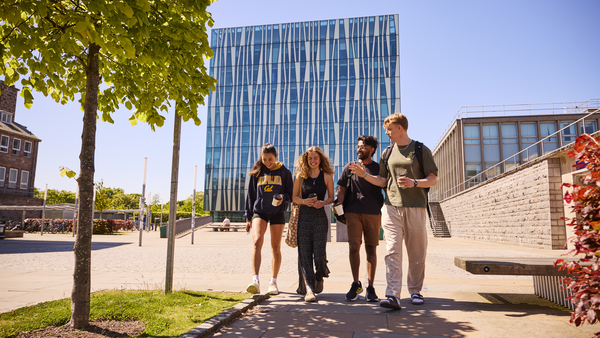
We invest heavily in our facilities and learning resources, ensuring our students have access to everything they need to help them succeed in their studies - from the stunning Sir Duncan Rice Library, to Aberdeen Sport Village, and beyond.
Find out more
Affordability
Aberdeen has been named the top UK city for affordability (QS Best Student Cities 2026). In 2024, StuRents reported the average price of a student private rental property in the Granite City was just over £96 a week.
Discover Uni
Discover Uni draws together comparable information in areas students have identified as important in making decisions about what and where to study. You can compare these and other data for different degree programmes in which you are interested.
Get in Touch
Contact Details
- Address
-
Student Recruitment & Admissions
University of Aberdeen
University Office
Regent Walk
Aberdeen
AB24 3FX