
Introduction
This page provides information on what you will study on the MA Psychology with German joint honours degree.
Study Information
At a Glance
- Learning Mode
- On Campus Learning
- Degree Qualification
- MA
- Duration
- 48 months
- Study Mode
- Full Time
- Start Month
- September
- UCAS Code
- C8RF

This page provides information on what you will study on the MA Psychology with German joint honours degree. For more detailed information about Psychology and/or German please visit the relevant single honours programme pages.
Aberdeen Global Scholarship
The University of Aberdeen is delighted to offer eligible self-funded international on-campus undergraduate students a £6,000 scholarship for every year of their programme.
View the Aberdeen Global ScholarshipWhat You'll Study
A degree in Psychology with German is taught via a selection of compulsory and optional courses to enhance your learning, preparing you for a future career or further study. In each year, you will take courses adding up to 120 credits. Depending on the number of compulsory and optional courses offered by your degree, you can also choose other eligible courses which fit your timetable.
- Year 1
-
Compulsory Courses
- Academic Writing for Language & Literature (AW1008)
-
This compulsory evaluation is designed to find out if your academic writing is of a sufficient standard to enable you to succeed at university and, if you need it, to provide support to improve. It is completed on-line via MyAberdeen with clear instructions to guide you through it. If you pass the evaluation at the first assessment it will not take much of your time. If you do not, you will be provided with resources to help you improve. This evaluation does not carry credits but if you do not complete it this will be recorded on your degree transcript.
- Getting Started at the University of Aberdeen (PD1002)
-
This course, which is prescribed for level 1 undergraduate students and articulating students who are in their first year at the University, is studied entirely online, is studied entirely online, takes approximately 2-3 hours to complete and can be taken in one sitting, or spread across the first 4 weeks of term.
Topics include University orientation overview, equality & diversity, MySkills, health, safety and cyber security, and academic integrity.Successful completion of this course will be recorded on your Transcript as ‘Achieved’.
- Introductory Psychology I: Concepts and Theory (PS1009)
-
15 Credit Points
PS1009 introduces you to major concepts and theories in psychology to provide you with a strong understanding of the human mind and behaviour. You will attend lectures on biological, social and cognitive psychology and participate in tutorials where you will work with peers to discuss topics related to the lecture materials. Studying psychology is beneficial to a wide range of careers including management, education, and counselling, to name a few.
- Introductory Psychology I: Methods and Applications (PS1011)
-
15 Credit Points
This course will help you learn the skills you need as a researcher in Psychology, including how to design a research project, how to treat participants ethically, how to present your data in visual format and how to write it all up in a report. The skills you learn will also be transferable to other domains so this course is a valuable addition to any degree.
- Introductory Psychology II: Concepts and Theory (PS1509)
-
15 Credit Points
PS1509 introduces you to major concepts and theories in psychology to provide you with a strong understanding of human mind and behaviour. You will attend lectures on evolution & emotion, lifespan development, and sensation & perception and participate in tutorials where you will work with peers to discuss topics related to the lecture materials. Studying psychology is beneficial to a wide range of careers including management, education, and counselling, to name a few.
- Introductory Psychology II: Methods and Applications (PS1511)
-
15 Credit Points
This course builds on from PS1511. It will help you hone the skills you need as a researcher in Psychology, including how to design a research project, how to treat participants ethically, how to present your data in visual format and how to write it all up in a report. The skills you learn will also be transferable to other domains so this course is a valuable addition to any degree. In addition, you will learn how to analyse your data with a statistical test – which is where this course builds on from PS1011.
Optional Courses
Select ONE of the following options:
Beginner
- German for Beginners 1 (GM1054)
- German for Beginners 2 (GM1554)
- Background to German Beginners 1 (GM1049) AND/OR The Global City (LA1501)
Intermediate / Advanced
- German Language 1 (GM1050)
- German Language 2 (GM1550)
- Modern German Culture 1 (GM1052) AND/OR The Global City (LA1501)
Plus select further credit points from courses of choice to reach 120 credit points.
- German for Beginners 1 (GM1054)
-
15 Credit Points
This language course provides students with a sound foundation in German (grammar and vocabulary). It enables students to understand the gist of authentic written and spoken German and to speak and write about familiar topics with a degree of accuracy and fluency.
No previous knowledge of German is required, but this course is also for students which took German at school before, on any level lower than Higher or A-level.
With 3 Language Classes and 1 Language Practical per week this course encourages and supports students to develop their personal self-study strategies.
This course involves intensive language study. Upon successful registration to this course, you are expected to complete a short online entry test on MyAberdeen to ensure that you are registered for the most appropriate course for your language ability. You will not be able to access the course site until you have completed this short test.
It is strongly recommended that you complete this test at the earliest opportunity as your timetable/course selections may be subject to change if your language ability would be better suited to an alternative course. You will be informed of this as soon as you complete the test.
The short entry test does not count toward your overall grade for this course.
It is recommended (subject to individual entry test results) that:
- Students who have no experience of German register for GM1054: German for Beginners 1
- Students who have studied German to National 5 level (or equivalent) register for GM1054: German for Beginners 1
- Students who have studied German to Higher level (or equivalent) register for GM1050 German Language 1
- German for Beginners 2 (GM1554)
-
15 Credit Points
This language course provides students with a sound foundation in German (grammar and vocabulary). It enables students to understand the gist of authentic written and spoken German and to speak and write about familiar topics with a degree of accuracy and fluency.
No previous knowledge of German is required, but this course is also for students which took German at school before, on any level lower than Higher or A-level.
With 3 Language Classes and 1 Language Practical per week this course encourages and supports students to develop their personal self-study strategies.
- Background to German for Beginners 1 (GM1049)
-
15 Credit Points
Students will gain detailed knowledge and understanding of the fascinating political and cultural developments and historical events in 20th century Germany.
They will be introduced in weekly lectures and tutorials to a variety of texts and contemporary films.
This course is taught in English and normally taken in conjunction with GM1054 German for Beginners 1. It is specifically recommended to students with the intention to proceed with German Studies beyond level one.
No pre-requisites are required.
- German Language 1 (GM1050)
-
15 Credit Points
This module is designed for students with an SCE H in German or equivalent. The course develops receptive and productive oral and written German language skills. Students who are considering applying for entry to German Honours must take this course.
This course involves intensive language study. Upon successful registration to this course, you are expected to complete a short online entry test on MyAberdeen to ensure that you are registered for the most appropriate course for your language ability. You will not be able to access the course site until you have completed this short test.
It is strongly recommended that you complete this test at the earliest opportunity as your timetable/course selections may be subject to change if your language ability would be better suited to an alternative course. You will be informed of this as soon as you complete the test.
The short entry test does not count toward your overall grade for this course.
It is recommended (subject to individual entry test results) that:
- Students who have no experience of German register for GM1054: German for Beginners 1
- Students who have studied German to National 5 level (or equivalent) register for GM1054: German for Beginners 1
Students who have studied German to Higher level (or equivalent) register for GM1050 German Language 1
- German Language 2 (GM1550)
-
15 Credit Points
This module is designed for students with an SCE H in German or equivalent. The course develops receptive and productive oral and written German language skills. Students who are considering applying for entry to German Honours must take this course. The course builds on GM1050.
- Modern German Culture 1 (GM1052)
-
15 Credit Points
Learn more about German 20th-century literature, dealing with the events that shaped German and European history. As in all good literature, we will discuss universal themes and topics covering all of the most important aspects of modern life.
- The Global City in Text and Film (LA1501)
-
15 Credit Points
Focusing on major cities in Europe and the Americas, this course unit uses a range of texts, including films, poetry and fiction, to investigate urban spaces as sites of promise, power and loss. Representations of global cities, and experiences of urban dwellers, highlight themes such as empire, identity, leisure, labour and love. Set amid glittering facades and gritty back streets, the texts studied in this course explore the many meanings of the urban experience across place and time. These urban encounters also provide a way of understanding key social, political and cultural moments in the past and present.
- Year 2
-
Compulsory Courses
Plus further courses of choice to make up 120 credit points.
- Advanced Psychology A - Concepts and Theory (PS2017)
-
15 Credit Points
This course builds on the material covered in the 1st-year courses, expanding on psychology’s concepts and theories. The course covers three core areas of psychology: language and cognition, perception, and individual differences.
- Advanced Psychology 1 - Methods and Applications (PS2018)
-
15 Credit Points
This course introduces students to fundamental concepts and methods in psychological research and data analysis. Lectures cover distributions and probability, null hypothesis significance testing, t-tests, chi-square tests, and correlations. Practical classes involve the application of these methods to research examples from different areas of psychology, using the statistical software package SPSS.
- Advanced Psychology B - Concepts and Theory (PS2517)
-
15 Credit Points
This course builds on the material covered in the 1st-year courses, expanding on psychology’s concepts and theories. The course covers four core areas of psychology: social psychology, behavioural neuroscience and developmental psychology.
- Advanced Psychology 2 - Methods and Applications (PS2518)
-
15 Credit Points
This course covers a broad range of data collection and analysis methods used in psychological research. Lectures cover survey and observational methods, regression analysis, ANOVA, and qualitative research methods. Practical classes involve the application of these methods to research examples from different areas of psychology.
Optional Courses
Select ONE of the following options:
Beginner
- German Language (Advanced Introductory) 1 (GM2040)
- German Language (Advanced Introductory) 2 (GM2540)
Intermediate / Advanced
- German Language 3 (GM2042)
- German Language 4 (GM2542)
Plus select further credit points from courses of choice to reach 120 credit points.
- German Language (Advanced Introductory) 1 (GM2040)
-
15 Credit Points
The course consists of language classes leading to advanced communicative competence in German and it will include the analysis of contemporary texts drawn from a variety of contexts. This course may be taken only by students who have completed the German for Beginners courses.
- German Language (Advanced Introductory) 2 (GM2540)
-
15 Credit Points
The intention of the course is to extend and reinforce further students' command of German grammar, vocabulary and syntactic structures, and to introduce various styles of written and spoken German. The course builds on the work done in GM2040 and is intended only for continuing beginners.
- German Language 3 (GM2042)
-
15 Credit Points
This level two language course will build on and extend students' fluency and written skills in German.
- German Language 4 (GM2542)
-
15 Credit Points
Building on work done in GM 2042, the course will develop further language skills.
- Year 3
-
Compulsory Courses
- Psychological Assessment (PS3011)
-
15 Credit Points
Psychological assessment is used by chartered psychologists in a number of areas, including clinical, occupational and forensic applications. The aim of this course is to introduce students to psychometric theory, real life applications of psychological assessment and the legal and ethical issues surrounding test administration.
Topics covered on this lecture based course include: IQ and mood assessment; clinical neuropsychological tests of cognitive dysfunction and memory; assessment of dementia and forensic aspects of assessment (legal malingering).
An ideal course for students intending to secure a career in applied psychology.
- Perception (PS3012)
-
15 Credit Points
Interaction with the world around us involves perceptual processing using our three main senses : visual (seeing), auditory (hearing) and haptic (touch). The aim of this course is to consider a range of approaches to human perception, from historical beginnings to recent innovative research.
Topics covered include: colour perception; face recognition; perception of pain and age related changes in perception. Students will also engage in guided debate with their peers regarding media portrayal of recent research findings.
This course is produced by academics that specialise in this field, ensuring the most up-to-date and relevant lecture material.
- Biological Psychology (PS3014)
-
15 Credit Points
This course aims to provide students with a good understanding of the biological basis of behaviour and cognition. The course is split into two sections, each featuring 5 lectures. Section 1 focuses on psychopharmacology, which is the investigation of the effect of medication on normal and abnormal brain function. Section 2 focuses on neuropsychology, examining what can be learnt about psychological processes from studying patients with brain damage.
Specific topics that will be covered include: neurotransmitters; drug effects; psychedelic drugs; impaired object and face recognition; amnesia; and disorders of motor control.
- Methodology A (PS3015)
-
15 Credit Points
The main aim of this course is to help students prepare, evaluate and run their own Psychological research. As such this is a ‘hands-on’ course, where students will have the opportunity to conduct a small qualitative research project and practice using SPSS for a variety of statistical analyses. The course provides a thorough grounding in qualitative and quantitative research methods through a lecture series. Specific topics covered in this course include: verification and falsification of results; ANOVA and qualitative research strategies.
- Developmental Psychology (PS3518)
-
15 Credit Points
The aim of this course is to consolidate and extend students’ knowledge of a number of core areas of developmental psychology, focusing on the age range of young children (3 years) to adolescence. This course will examine both historical and contemporary issues and findings in (1) cognitive development and (2) social-emotional development. In one half of the course students will evaluate how some main types of memory undergo developmental changes, and how cognitive plasticity develops. In the other half students will evaluate the development of aggression and its risk factors, and gain a deeper understanding of the role of play in typical and atypical development of social interaction with a focus on autism. There will also be opportunity to learn about some intervention programmes aimed at improving cognitive and socio-emotional skills in childhood. The broad range of developmental topics makes this an ideal course for anyone with interest in working with children.
- Memory and Language (PS3519)
-
15 Credit Points
The memory component of this course aims to introduce students to the main theoretical components of memory (working and autobiographical memory). Psychological theories of forgetting and eyewitness memory will also be discussed.
The second component of the course, language, will introduce students to the key issues in psycholinguistics. This will include assessment of sentence processing, analysis of the processes underlying language production and factors that influence communication in different settings.
The assessment of multiple approaches within both research areas will provide all students with a good basis for developing critical thinking skills.
- Social Psychology (PS3520)
-
15 Credit Points
Social Psychologists explore the psychological factors that influence individual behaviours within social situations. As such, the aim of this course is to provide students with an introduction to the range of topics within experimental social psychology, with a defined focus on social cognition.
Topics covered within this lecture based course include: Stereotypes; social perception and action; self-control; consciousness and mimicry.
This course provides a scientific explanation for social phenomena, making it ideal for students with an interest in individual and group behaviour.
- Methodology B (PS3522)
-
15 Credit Points
This course builds on the skills already developed through participation in Methodology A. Similar to that course the aim is to help students prepare, evaluate and run their own Psychological research. As such this is a ‘hands-on’ course, where students will have a second opportunity to conduct a small research project and practice using SPSS for a variety of statistical analyses. The course also builds on the thorough grounding in qualitative and quantitative research methods provided in Methodology A through a second lecture course. This course also features workshops on employability, providing students with information on career planning, networking etc.
- Year 4
-
Compulsory Courses
- German Language Study 5 (GM3050)
-
30 Credit Points
This Level 3 course consists of a German language class, a composition class and an oral class. Students are encouraged to refine their oral and written German skills.
- Psychology Thesis (PS4019)
-
30 Credit Points
This course constitutes the final-year thesis for the single honours Psychology degree. The thesis is an empirical research project, where the student collects and analyses data in answer to a research question. The thesis itself begins in September and the final draft of the thesis is handed in for assessment at the end of the second term. The School has an international-level research culture and the final-year projects offer the students an opportunity to be involved in that culture. A number of student projects have contributed towards research publications.
Optional Courses
Plus select 60 credit points from Level 4 Psychology courses.
We will endeavour to make all course options available. However, these may be subject to change - see our Student Terms and Conditions page. In exceptional circumstances there may be additional fees associated with specialist courses, for example field trips.
How You'll Study
Teaching is by means of lectures, laboratory practicals, workshops and tutorials, with more extensive experimental projects at levels 3 and 4. Assessment is by means of examination and continuous assessment. Honours projects are typically assessed on the basis of a written dissertation.
Learning Methods
- Group Projects
- Individual Projects
- Lab Work
- Lectures
- Tutorials
Assessment Methods
Students are assessed by any combination of three assessment methods:
- Coursework such as essays and reports completed throughout the course.
- Practical assessments of the skills and competencies they learn on the course.
- Written examinations at the end of each course.
The exact mix of these methods differs between subject areas, years of study and individual courses.
Honours projects are typically assessed on the basis of a written dissertation.
Why Study Psychology with German?
Why German
- A vibrant international community on campus and across the region, with many German-speaking students, staff and activities to get involved in and practise your language skills.
- German Society open to all students interested in German and the German-speaking countries, organising drama performances and other events such as Kaffee and Kuchen, a German Stammtisch, film showings, and visits by German speakers and writers.
- German Drama Group providing a great opportunity to produce an annual play, widen your language skills and meet other German students studying in Aberdeen. Previous years included works of 20th century dramatists Dürrenmatt, Borchert and Horvath.
- Opportunities to study the rich literature and culture of Austria and Switzerland in addition to Germany.
- A packed campus programme of events, exhibitions, seminars, invited speakers and the popular annual WayWORD festival, welcoming international figures, experts, authors and scientists to campus.
- Your period abroad as a language assistant or visiting student - we have exchange scholarships with the Universities of Zurich, Kiel and Greifswald, and Erasmus partners including Leipzig, Cologne, Bonn, Trier and Graz in Austria.
- The spectacular, award-winning Sir Duncan Rice Library, with fabulous study facilities, state-of-the-art technology, and an extensive German collection to inspire your studies.
Why Psychology
- You will be introduced to state-of-the-art concepts and theories taught by award-winning teachers and world-class researchers, exposing you to the latest thinking in the field.
- You will benefit from the key strengths within the School of social psychology, neuroscience, language, perception and industrial psychology.
- We have a wide range of course options available in 4th Year to allow you to specialise in areas such as clinical, forensic, language and developmental psychology.
- You will have the opportunity to gain experience using specialised laboratories and equipment including those for brain imaging analysis, eye movement recording, movement analysis and visual neuroscience.
- To help you get a job we have an employability programme for our students which includes: internship opportunities, online resources, career talks and networking events.
- Psychology graduates are eligible for membership of the British Psychological Society, this is a first step towards becoming a professional Psychologist.
- In the final year students have the opportunity to do a unique research project to a professional level. A number of final year projects have gone on to be published in internationally renowned journals.
Entry Requirements
Qualifications
The information below is provided as a guide only and does not guarantee entry to the University of Aberdeen.
General Entry Requirements
- 2025 Entry
-
SQA Highers
Standard: BBBB
Applicants who have achieved BBBB (or better), are encouraged to apply and will be considered. Good performance in additional Highers/ Advanced Highers may be required.
Minimum: BBC
Applicants who have achieved BBC at Higher and meet one of the widening participation criteria above are encouraged to apply and are guaranteed an unconditional offer for MA, BSc and BEng degrees.
Adjusted: BB
Applicants who have achieved BB at Higher, and who meet one of the widening participation criteria above are encouraged to apply and are guaranteed an adjusted conditional offer for MA, BSc and BEng degrees.
We would expect to issue a conditional offer asking for one additional C grade at Higher.
Foundation Apprenticeship: One FA is equivalent to a Higher at A. It cannot replace any required subjects.
More information on our definition of Standard, Minimum and Adjusted entry qualifications.
A LEVELS
Standard: BBC
Minimum: BCC
Adjusted: CCC
More information on our definition of Standard, Minimum and Adjusted entry qualifications.
International Baccalaureate
32 points, including 5, 5, 5 at HL.
Irish Leaving Certificate
5H with 3 at H2 AND 2 at H3.
Entry from College
Advanced entry to this degree may be possible from some HNC/HND qualifications, please see www.abdn.ac.uk/study/articulation for more details.
- 2026 Entry
-
SQA Highers
Standard: BBBB
Applicants that present with BBBB will usually receive an unconditional offer.
Where we have more applicants than places we may need to ask for more than the minimum so continued engagement in school is recommended.
Widening Access: BBC
Applicants who meet one or more of our widening access metrics and present with BBC, are guaranteed an unconditional offer.
Foundation Apprenticeship: One FA is equivalent to a Higher at A. It cannot replace any required subjects.
Note: We do not double count a Higher and Advanced Higher in the same subject, but we do consider that a B grade at Advanced Higher is equivalent to an A grade at Higher.
National 5 English (or equivalent) is required at Grade C or above.
A LEVELS
Standard: BBC
Widening Access: CCC
GCSE English (or equivalent) is required at Grade C/4 or above.
BTEC LEVEL 3 EXTENDED DIPLOMA
DMM in related subjects.
Note: BTEC Level 3 Extended Certificate (Subsidiary Diploma) achieved at Distinction level, is normally acceptable in lieu of one A Level at grade B.)
GCSE English (or equivalent) is required at Grade C/4 or above. GCSE Mathematics at Grade C/4 is also required for Accountancy, Economics and Finance programmes.
IRISH LEAVING CERTIFICATE
Five subjects at Higher at H3.
INTERNATIONAL BACCALAUREATE
32 points including 5, 5, 5 at HL.
SL in English is also required.
The information displayed in this section shows a shortened summary of our entry requirements. For more information, or for full entry requirements for Arts and Social Sciences degrees, see our detailed entry requirements section.
English Language Requirements
To study for an Undergraduate degree at the University of Aberdeen it is essential that you can speak, understand, read, and write English fluently. The minimum requirements for this degree are as follows:
IELTS Academic:
OVERALL - 6.0 with: Listening - 5.5; Reading - 5.5; Speaking - 5.5; Writing - 6.0
TOEFL iBT:
OVERALL - 78 with: Listening - 17; Reading - 18; Speaking - 20; Writing - 21
PTE Academic:
OVERALL - 59 with: Listening - 59; Reading - 59; Speaking - 59; Writing - 59
Cambridge English B2 First, C1 Advanced or C2 Proficiency:
OVERALL - 169 with: Listening - 162; Reading - 162; Speaking - 162; Writing - 169
Read more about specific English Language requirements here.
Fees and Funding
You will be classified as one of the fee categories below.
| Fee category | Cost |
|---|---|
| EU / International students | |
| Tuition Fees for 2026/27 Academic Year | £20,800 |
| Tuition Fees for 2026/27 Academic Year (Self-funded Students *) | £14,800 |
| Home Students | |
| Tuition Fees for 2026/27 Academic Year | £1,820 |
| England, Wales, Northern Ireland, and Republic of Ireland | |
| Tuition Fees for 2026/27 Academic Year | £9,790 |
Scholarships and Funding
UK Scholarship
Students from England, Wales and Northern Ireland, who pay tuition fees may be eligible for specific scholarships allowing them to receive additional funding. These are designed to provide assistance to help students support themselves during their time at Aberdeen.
Aberdeen Global Scholarship
The University of Aberdeen is delighted to offer eligible self-funded international on-campus undergraduate students a £6,000 scholarship for every year of their programme. More about this funding opportunity.Funding Database
View all funding options in our Funding Database.
Careers
At the University of Aberdeen, we give you every opportunity to broaden your horizons and develop the professional and personal skills and attributes you will need to build a successful career. The high quality of our degrees combined with our strong focus on employability opens up a wide range of career options, which is demonstrated by our consistently high rate of graduate employment.
Accreditation
This degree holds accreditation from

Our Experts
The School of Psychology provides an exciting and vibrant research environment. Our degrees are taught by a range of experts across our 3 research themes: Cognition, Perception and Attention and Social Cognition.
- Director of Undergraduate Teaching
- Dr Helen Knight
Information About Staff Changes
You will be taught by a range of experts including professors, lecturers, teaching fellows and postgraduate tutors. However, these may be subject to change - see our Student Terms and Conditions page.
World Class Facilities
There is a range of specialised laboratories including those for brain imaging analysis, eye movement recording, movement analysis and visual neuroscience.

Sir Duncan Rice Library
The University’s award winning Sir Duncan Rice Library is listed in the “Top 20 spellbinding University libraries in the World”. It contains over a million volumes, more than 300,000 e-books and 21,000 journals.
Find out more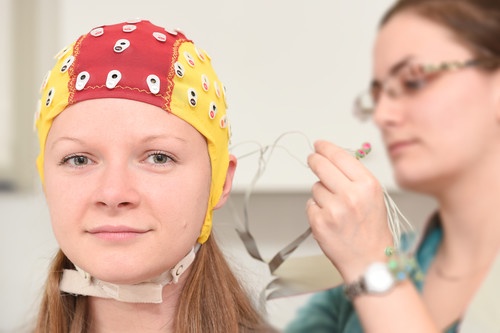
Psychophysiology Centre
This facility consists of several spacious rooms that house electroencephalographic (EEG) equipment and sound-attenuated, shielded testing booths.

Eye Tracking Facilities
The School of Psychology has four in-house eye trackers. The Eyelink 1000 system allows the recording of eye gaze at a sampling rate of 1000 Hz.
Discover Uni
Discover Uni draws together comparable information in areas students have identified as important in making decisions about what and where to study. You can compare these and other data for different degree programmes in which you are interested.
Get in Touch
Contact Details
- Address
-
Student Recruitment & Admissions
University of Aberdeen
University Office
Regent Walk
Aberdeen
AB24 3FX