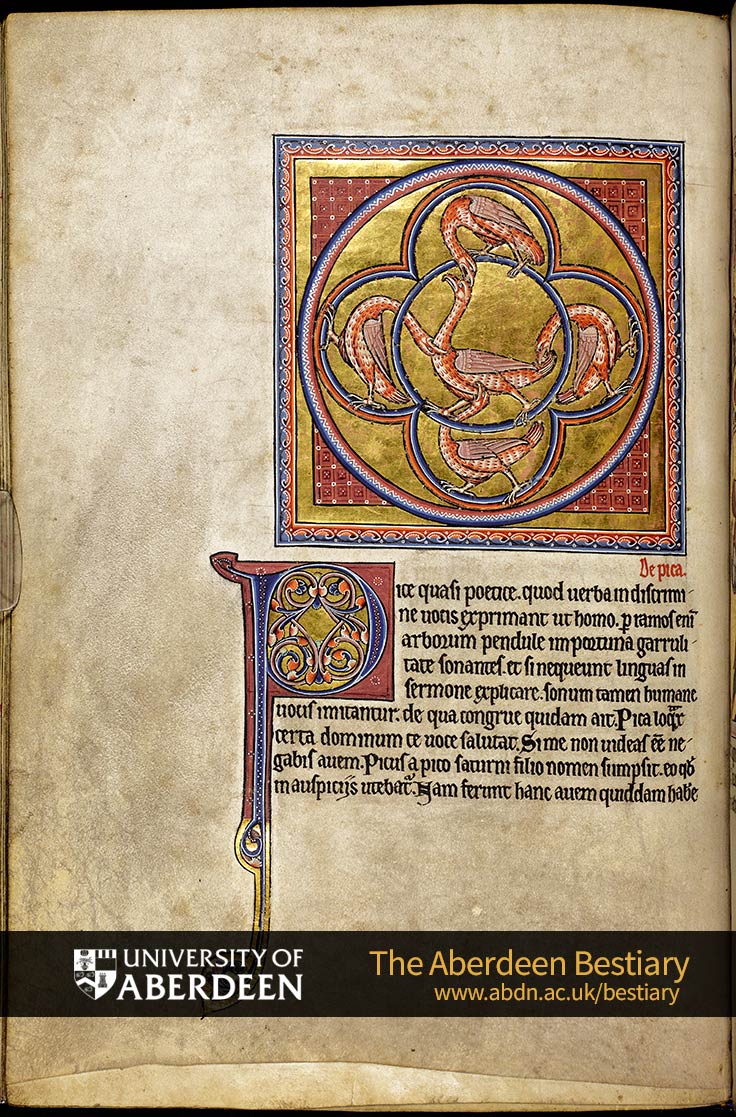
Folio 36v - De pica; the magpie.
Of the magpie
Magpies are like poets, because they utter words, with a distinct sound, like men; hanging in the branches of trees, they chatter rudely, and even if they cannot get their tongues round words, they nevertheless imitate human speech. On this subject someone aptly said: 'The chattering magpie, firm of voice, greets you as lord. If you do not see me, you will deny that I am a bird' (Martial, Epigrams, 14: 76).
The woodpecker, picus, gets its name from Picus son of Saturn, because he used it for taking auguries. For they say that this bird has something
- Commentary
-
Commentary
Text
The magpie. Magpies chatter, sounding like humans. The woodpecker.
Illustration
Four young hoopoe, rhythmically placed in a roundel, clean the eyes and pluck the feathers of their ageing parent.
Comment
The illustration is pricked for pouncing. The splendid initial 'P' is type 3, introducing pica. This page is particularly dirty on the lower left margin, indicating frequent use. A possible sketch in the margin. Initial indicator 'P' at bottom left of illustration.
Folio Attributes
- Transcription and Translation
-
Transcription
De pica\ Pice quasi poetice, quod verba in discrimi\ne vocis exprimant ut homo, per ramos enim\ arborum pendule importuna garruli\tate sonantes, et si nequeunt linguas in\ sermone explicare, sonum tamen humane\ vocis imitantur, de qua congrue quidam ait: Pica loquax\ certa dominum te voce salutat. Si me non videas esse ne\gabis avem. Picus a Pico Saturni filio nomen sumpsit, eo quod\ in auspiciis utebatur. Nam ferunt hanc avem quiddam habere\Translation
Of the magpie Magpies are like poets, because they utter words, with a distinct sound, like men; hanging in the branches of trees, they chatter rudely, and even if they cannot get their tongues round words, they nevertheless imitate human speech. On this subject someone aptly said: 'The chattering magpie, firm of voice, greets you as lord. If you do not see me, you will deny that I am a bird' (Martial, Epigrams, 14: 76). The woodpecker, picus, gets its name from Picus son of Saturn, because he used it for taking auguries. For they say that this bird has something