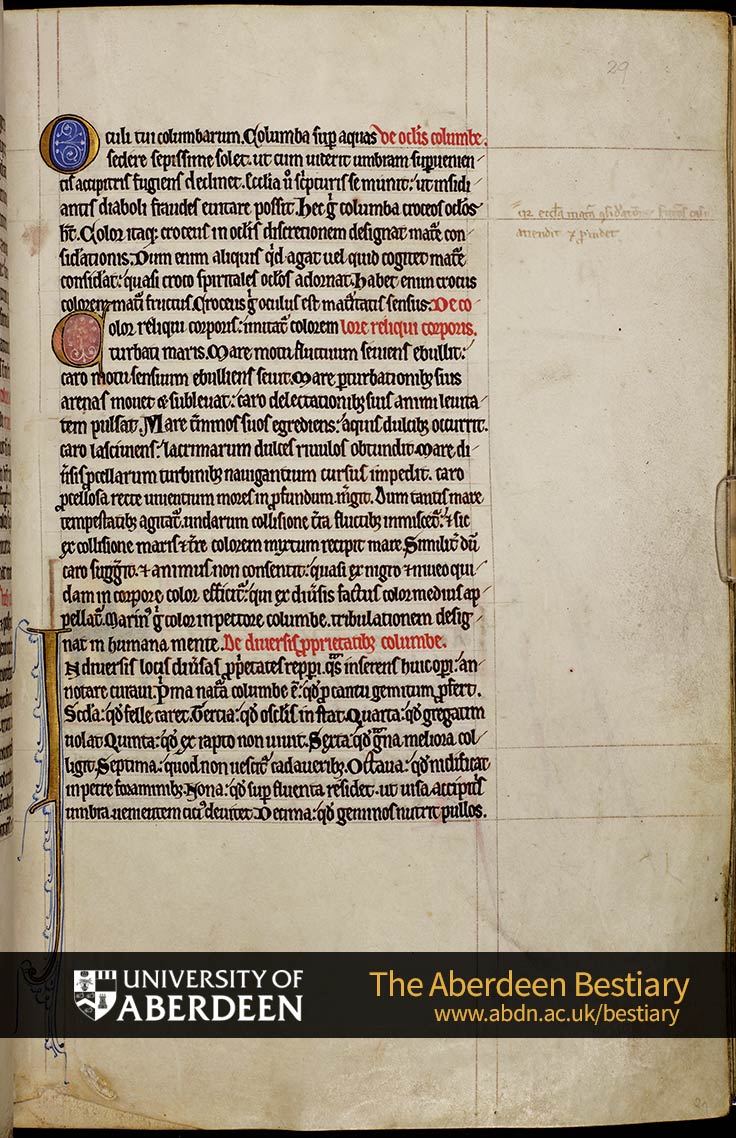
Folio 29r - De oculis columbe; Of the eyes of the dove. De colore reliqui corporis; Of the colour of the rest of the dove's body. De diversis proprietatibus columbe; Of the different characteristics of the dove.
Of the eyes of the dove
'Thou hast doves' eyes' (Song of Solomon, 1:15). The dove spends much of its time sitting on water, so that if it sees the shadow of a hawk that is flying overhead, it can avoid it by fleeing. The Church protects itself with the scriptures, in order to escape the deceits of the Devil who plots against it.
The dove, therefore, has saffron-coloured eyes. The colour of saffron in the eyes, therefore, signifies the discernment that comes with mature reflection. For when anyone considers deliberately what he should do or think, it is as if he adorns the eyes of the spirit with saffron. Saffron has the colour of ripe fruit. Therefore a saffron-coloured eye signifies the perceptivity that comes with maturity.
Of the colour of the rest of the dove's body
The rest of the dove's body matches the colour of a wild sea. The sea, raging with the motion of the waves, boils; the flesh, boiling with the motion of the senses, rages. The sea, in its wildness, shifts and uplifts the sands; the flesh, with its carnal pleasures, beats upon the frail soul. The sea, flowing beyond its bounds, rushes to meet quiet waters; the flesh, lusting, pounds against quiet streams of tears. The sea, with stormy winds from different directions, hampers the passage of vessels; the tempests of the flesh send to the bottom the principles of righteous living.
When the sea is whipped up by storms of such force, earth is mixed with the water under the impact of the waves; and thus from the violent intermingling of sea and land, the sea acquires a mixed hue. Likewise, when the spirit will not condone the impulses of the flesh, this creates a certain colour in the body, like black mixed with white; formed from opposites, this colour is called neutral. The sea-like colour of the dove's breast, therefore, signifies the distressed state of the human mind.
Of the different characteristics of the dove
I have found various references to its different characteristics, which I have included in this work, and on which I have made it my business to Commentary.
The first characteristic of the dove is that instead of song it brings forth a lament. The second, is that it lacks bile; the third, it likes to kiss; the fourth, it flies in flocks; the fifth, it does not live by theft; the sixth, it gathers better-quality grain; the seventh, it does not feed on corpses; the eighth, it nests in holes in rocks; the ninth, it rests on flowing water so that if it catches sight of the shadow of a hawk, it can more swiftly avoid its approach; the tenth, it rears twin chicks.
- Commentary
-
Commentary
Text
The eyes of a dove, body colour and its characteristics.
Comment
Initials type 2, and textual comment in right margin.
Folio Attributes
- Transcription and Translation
-
Transcription
De oculis columbe \ Oculi tui columbarum. Columba super aquas \sedere sepissime solet, ut cum viderit umbram supervenien\tis accipitris fugiens declinet. Ecclesia vero scripturis se munit, ut insidi\antis diaboli fraudes evitare possit. Hec igitur columba croceos oculos \habet. Color itaque croceus in oculis discretionem designat mature con\siderationis. Dum enim aliquis quid agat vel quid cogitet mature \considerat, quasi croco spiritales oculos adornat. Habet enim crocus \colorem maturi fructus. Croceus igitur oculus est maturitatis sensus. \ De colore reliqui corporis \ Color reliqui corporis, imitatur colorem \turbati maris. Mare motu fluctuum seviens ebullit, \caro motu sensium ebulliens sevit. Mare perturbationibus suis \arenas movet et sublevat, caro delectationibus suis animi levita\tem pulsat. Mare terminos suos egrediens, aquis dulcibus occurrit, \caro lasciviens, lacrimarum dulces rivulos obtundit. Mare di\versis procellarum turbinibus navigantium cursus impedit, caro \procellosa recte viventium mores in profundum mergit. Dum tantis mare \tempestatibus agitatur, undarum collisione terra fluctibus inmiscetur, et sic \ex collisione maris et terre colorem mixtum recipit mare. Similiter dum \caro suggerit, et animus non consentit, quasi ex nigro et niveo qui\dam in corpore color efficitur, qui ex diversis factus color medius ap\pellatur. Marinus igitur color in pectore columbe, tribulationem desig\nat in humana mente. \ De diversis proprietatibus columbe \ In diversis locis diversas proprietates repperi, quas inserens huic operi, an\notare curavi. Prima natura columbe est, quod pro cantu gemitum profert. \Secunda, quod felle caret. Tercia, quod osculis instat. Quarta, quod gregatim \volat. Quinta, quod ex rapto non vivit. Sexta, quod grana meliora col\ligit. Septima, quod non vescitur cadaveribus. Octava, quod nidificat \in petre foraminibus. Nona, quod super fluenta residet, ut visa accipitris \umbra, venientem cicius devitet. Decima, quod geminos nutrit pullos. \Translation
Of the eyes of the dove 'Thou hast doves' eyes' (Song of Solomon, 1:15). The dove spends much of its time sitting on water, so that if it sees the shadow of a hawk that is flying overhead, it can avoid it by fleeing. The Church protects itself with the scriptures, in order to escape the deceits of the Devil who plots against it. The dove, therefore, has saffron-coloured eyes. The colour of saffron in the eyes, therefore, signifies the discernment that comes with mature reflection. For when anyone considers deliberately what he should do or think, it is as if he adorns the eyes of the spirit with saffron. Saffron has the colour of ripe fruit. Therefore a saffron-coloured eye signifies the perceptivity that comes with maturity. Of the colour of the rest of the dove's body The rest of the dove's body matches the colour of a wild sea. The sea, raging with the motion of the waves, boils; the flesh, boiling with the motion of the senses, rages. The sea, in its wildness, shifts and uplifts the sands; the flesh, with its carnal pleasures, beats upon the frail soul. The sea, flowing beyond its bounds, rushes to meet quiet waters; the flesh, lusting, pounds against quiet streams of tears. The sea, with stormy winds from different directions, hampers the passage of vessels; the tempests of the flesh send to the bottom the principles of righteous living. When the sea is whipped up by storms of such force, earth is mixed with the water under the impact of the waves; and thus from the violent intermingling of sea and land, the sea acquires a mixed hue. Likewise, when the spirit will not condone the impulses of the flesh, this creates a certain colour in the body, like black mixed with white; formed from opposites, this colour is called neutral. The sea-like colour of the dove's breast, therefore, signifies the distressed state of the human mind. Of the different characteristics of the dove I have found various references to its different characteristics, which I have included in this work, and on which I have made it my business to Commentary. The first characteristic of the dove is that instead of song it brings forth a lament. The second, is that it lacks bile; the third, it likes to kiss; the fourth, it flies in flocks; the fifth, it does not live by theft; the sixth, it gathers better-quality grain; the seventh, it does not feed on corpses; the eighth, it nests in holes in rocks; the ninth, it rests on flowing water so that if it catches sight of the shadow of a hawk, it can more swiftly avoid its approach; the tenth, it rears twin chicks.