- Commentary
-
Commentary
Text
Dogs, their habits. The text here describes the missing illustrations of the dog detecting his master's murderer.
Illustration
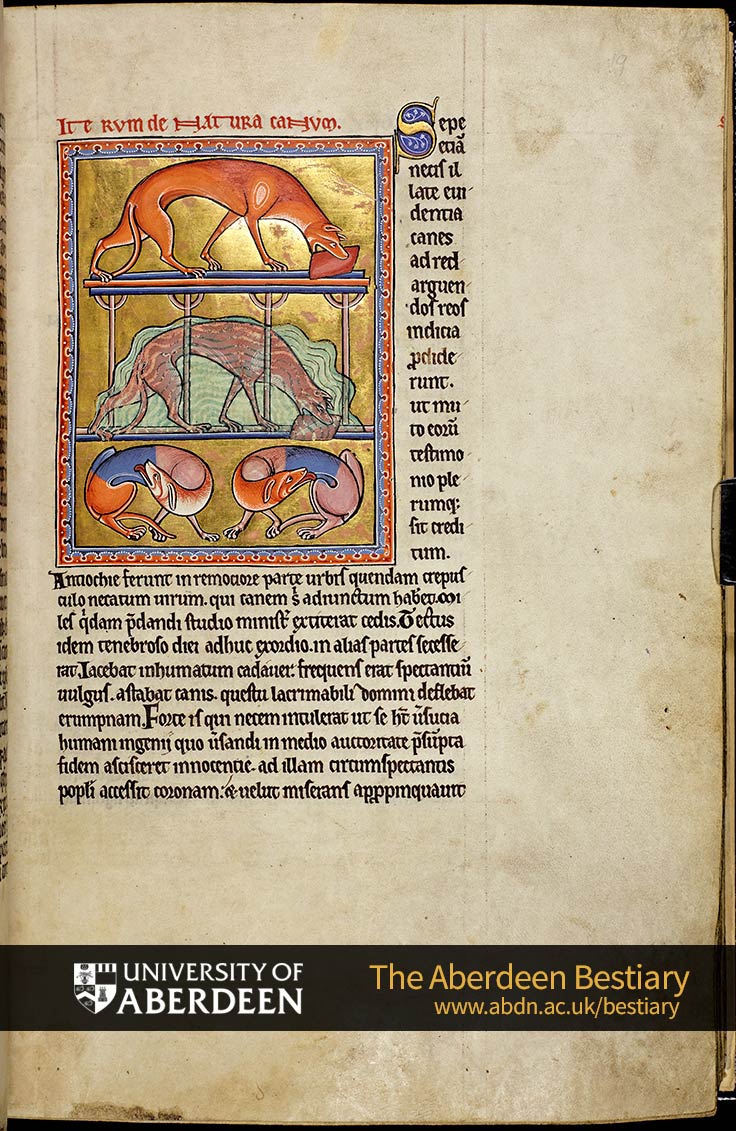
The illustration refers to the stories overleaf on f.19v.It is divided into three panels, the top two referring to the dog who carries some meat over a bridge and seeing its own reflection in the water, drops the meat to seize the reflection. Below are two dogs licking their wounds with their healing tongues.
Comment
The text on f.19v deals with these two episodes in the opposite order. Initial indicator 's' in red in right margin, and a quire mark (d) at the bottom. There is significant paint flaking of black stripes on the middle dog. Clark (2006, 223) detects a change of scribal hand 'somewhat more compact and rounded' starting on this page. Initial type 2.
Folio Attributes
- Transcription and Translation
-
Transcription
Iterum de natura canum \Sepe \etiam \necis il\late evi\dentia canes \ad red\arguen\dos reos\indicia \prodiderunt, \ut mu\to eorum \testimo\nio ple\rumque \sitcredi\tum. \Antiochie ferunt in remociore parte urbis quendam crepus\culonecatum virum, qui canem sibi adiunctum haberet. Mi\les quidam predandistudio minister extiterat cedis. Tectus \idem tenebroso diei adhucexordio, in alias partes secesse\rat. Iacebat inhumatum cadaver, frequens erat spectantium \vulgus, astabat canis, questu lacrimabilidomini deflebat \erumpnam. Forte is qui necem intulerat ut se habetversucia \humani ingenii quo versandi in medio auctoritate presumpta\fidem ascisceret innocentie, ad illam circumspectantis \populiaccessit coronam, et velut miserans appropinquavit \Translation
Again on the nature of dogs Often, also, when a murder has been committed, dogs have produced clear evidence of the guilt of the accused, with the result that their unspoken testimony is for the most part believed. They say that at Antioch, in a distant quarter of the city at dusk, a man was murdered, who had his dog with him on a lead. A soldier had been the perpetrator of the deed, with robbery as his motive. Undercover of the growing darkness, he fled elsewhere. The corpse lay unburied; the crowd of onlookers was large; the dog stayed at its master's side, howling over his sad fate. It happened that the man who had committed the crime, acting confidently in order to convince people of his innocence - such is the cunning way in which men think- joined the circle of onlookers and, feigning grief, approached