Museums Fill in Our Past to Create Our Future
Museums enable people to explore collections for inspiration, learning and enjoyment by understanding the past and how it created our present and how it influences our future.
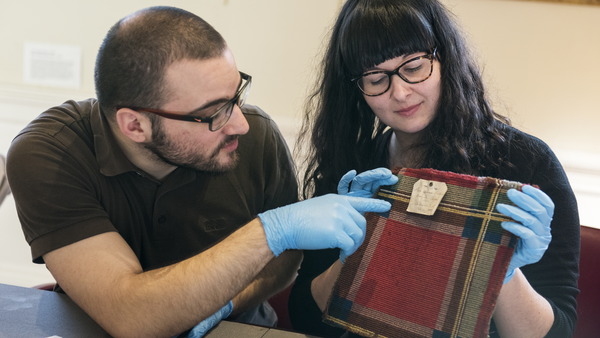
The one-year Museum Studies master's programme draws on the University’s extensive museum collections to enable you to explore critical approaches to museum theory while also studying the application of museum practice and research at first hand.
This course has both January and September start dates. Apply Now
Explore the latest digital exhibition curated by MLitt Museum Studies Students: "Toxic Relationships: The Dose Makes the Poison"
The University of Aberdeen is one of the very few UK universities to have international-quality museum collections relating to the natural and cultural worlds. Our collections are among the oldest, largest and most significant in the country.
The Museum Studies programme makes significant use of these collections to enable you to study the historical and contemporary roles of museums in society and develop skills in public engagement with research while gaining practical experience of museum work.
You will gain foundational curatorial skills and an appreciation of contemporary issues museums face. With a range of optional courses available to supplement our core courses that address museum professional practice, career planning, and collections-based research skills, you can customise your degree to specific areas of interest. Optional courses include Museums and the Digital World, which involves designing a digital intervention for the University Collections, and Decolonising Museums, which tackles one of the most pressing issues facing the sector today.
Alongside developing an understanding of museum theory, you will hone the practical skills utilised in the heritage sector including curation practice, grant application writing, and interpreting academic and specialist knowledge for the wider public.
During the summer three options are normally available: ‘Curating an Exhibition’ involves working with museum staff to design an online exhibition using the University’s collections with associated display cases around campus. You may prefer to research a topic in depth through writing a Museum Studies dissertation, a route recommended for those aiming to continue to the PhD in Museum Studies. There are many opportunities to work directly with the collections if this route appeals. Finally, the Museum Studies Placement option allows students to put their skills into practice by carrying out a project with a partner museum.
University of Aberdeen graduates are eligible for the Alumni Postgraduate Scholarship, reducing tuition fees to £7,000 - matching the current SAAS tuition loan - See full terms and conditions
University of Aberdeen graduates are eligible for the Alumni Postgraduate Scholarship, reducing tuition fees to £7,000 - matching the current SAAS tuition loan - See full terms and conditions
The above fee includes the £8,000 Aberdeen Global Scholarship provided to self-funded international students. Full terms and conditions apply.
The above fee includes the £8,000 Aberdeen Global Scholarship provided to self-funded international students. Full terms and conditions apply.
We will endeavour to make all course options available. However, these may be subject to change - see our Student Terms and Conditions page. In exceptional circumstances there may be additional fees associated with specialist courses, for example field trips.
All eligible self-funded international Postgraduate Masters students will receive an £8,000 scholarship. Learn more about this Aberdeen Global Scholarship here.
To see our full range of scholarships, visit our Funding Database.
An important feature of the Museum Studies programme is its extensive use of the University’s museums and collections and involvement of both academic staff in a range of related disciplines such as Anthropology, Archaeology, Education and Art History and the professional staff of the University’s museums.
Teaching of the Museum Studies courses is in small groups, with one-to one supervision for the final project.
Assessments will combine practical skills and academic writing. These include developing a career portfolio, report writing, drafting mock grant applications, writing for a public audience etc. All the assignments are designed to provide students with experience of the kind of writing required for a career in the heritage sector.
The information below is provided as a guide only and does not guarantee entry to the University of Aberdeen.
2:2 UK Honours degree, or an Honours degree from a non-UK institution which is judged by the University to be of equivalent worth, in a relevant discipline such as (but not limited to) anthropology, history, art history, media studies, cultural studies, digital heritage, archaeology, geography, environmental sciences, biology, ecology or science communication.
Applicants without this qualification may be admitted subject to having an alternative qualification, or an approved level of work experience appropriate to the field of study. Also taken into careful consideration is the trajectory of results, an applicant without an overall 2:2 but with 2:2 results in their final two years of study may be admitted.
Please enter your country or territory to view relevant entry requirements.
To study for a Postgraduate Taught degree at the University of Aberdeen it is essential that you can speak, understand, read, and write English fluently. The minimum requirements for this degree are as follows:
IELTS Academic:
OVERALL - 6.5 with: Listening - 5.5; Reading - 6.0; Speaking - 5.5; Writing - 6.0
TOEFL iBT:
OVERALL - 90 with: Listening - 17; Reading - 21; Speaking - 20; Writing - 21
PTE Academic:
OVERALL - 62 with: Listening - 59; Reading - 59; Speaking - 59; Writing - 59
Cambridge English B2 First, C1 Advanced or C2 Proficiency:
OVERALL - 176 with: Listening - 162; Reading - 169; Speaking - 162; Writing - 169
Read more about specific English Language requirements here.
You will be required to supply the following documentation with your application as proof you meet the entry requirements of this degree programme. If you have not yet completed your current programme of study, then you can still apply and you can provide your Degree Certificate at a later date.
This degree provides suitable preparation for working in museums, galleries and heritage institutions, for those who wish to conduct further research in Museum Studies, and for an academic role in a variety of associated fields. It is also a valuable degree for those who are interested in developing ways of communicating academic work to the public.
The programme is geared towards both vocational study for work in the sector, and those wishing to pursue an academic career. It offers students the opportunity to engage in a number of transferable skills, such as project management, teamwork and research which are required across a broad range of roles and sectors.
Graduates of this programme have gone on to work at institutions including the British Museum, the Royal Collection Trust, the National Trust, Juneau Douglas City Museum, and the Gordon Highlanders Museum. Career prospects include work in collections management, curation, exhibition development, programme management, museum research, and more.
Museums enable people to explore collections for inspiration, learning and enjoyment by understanding the past and how it created our present and how it influences our future.
You will be taught by a range of experts including professors, lecturers, teaching fellows and postgraduate tutors. However, these may be subject to change - see our Student Terms and Conditions page.
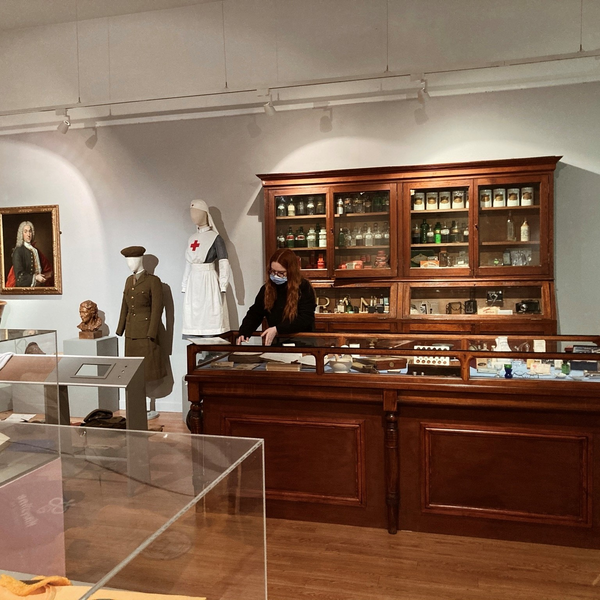
As well as academic facilities, you will work within the University’s museums, including: