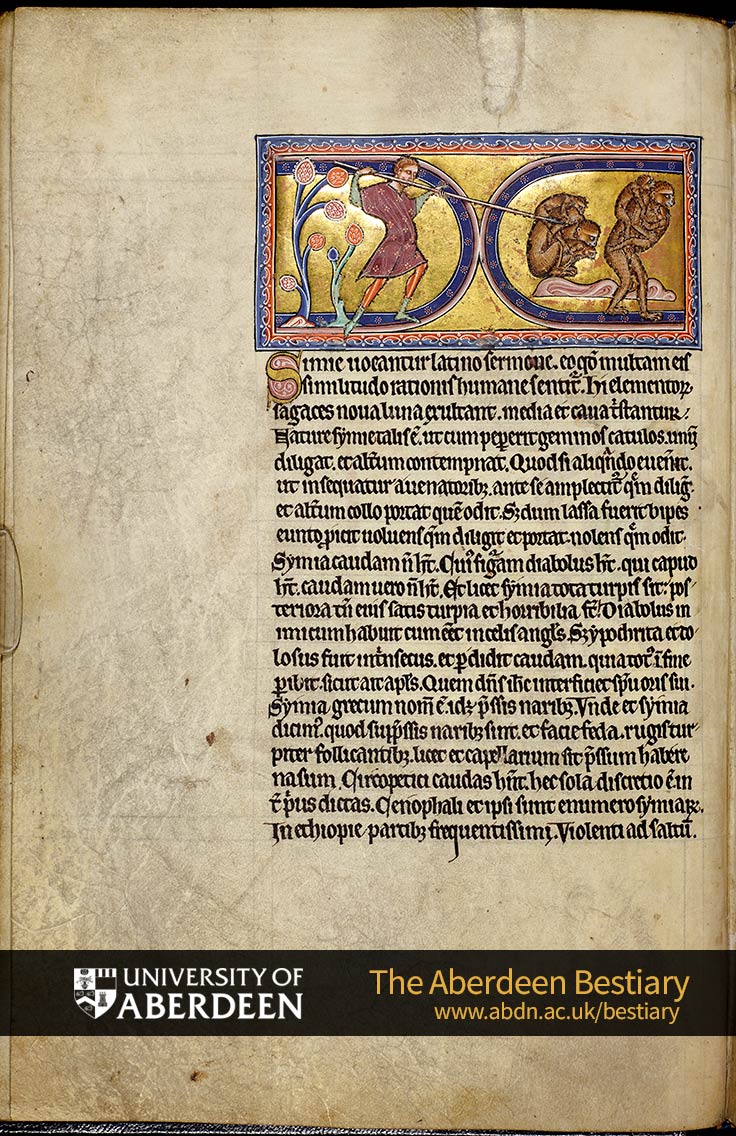
Folio 12v - Simie vocantur...; apes.
Apes are called simie in Latin because the similarity between their mentality and that of humans is felt to be great. Apes are keenly aware of the elements; they rejoice when the moon is new and are sad when it wanes. A characteristic of the ape is that when a mother bears twins, she loves one and despises the other. If it ever happens that she is pursued by hunters, she carries the one she loves before her in her arms and the one she detests on her shoulders. But when she is tired of going upright, she deliberately drops the one she loves and reluctantly carries the one she hates. The ape does not have a tail. The Devil has the form of an ape, with a head but no tail. Although every part of the ape is foul, its rear parts are disgusting and horrid enough. The Devil began as an angel in heaven. But inside he was a hypocrite and a deceiver, and he lost his tail, because he will perish totally at the end, just as the apostle says: 'The Lord shall consume him with the spirit of his mouth.' (2 Thessalonians, 2:8) The name symia is Greek, meaning, 'flattened nostrils'. Hence we call the ape symia because they have compressed nostrils and a hideous face, its creases foully expanding and contracting like a bellows; although she-goats also have a flattened nose. The apes called circopetici have tails. This alone distinguishes them from the apes mentioned earlier. Cenophali are numbered among the apes. They occur in great numbers in parts of Ethiopia. They leap wildly and
- Commentary
-
Commentary
Text
Apes.
Illustration
The female monkey gives birth to twins, loving one and hating the other. When hunted, she carries the loved one in her arms while the other clings to her back. Eventually she tires, drops the favoured baby and the other one is saved. The ape does not have a tail.
Comment
Pricking and margins are visible. Initial indicator 's' in left margin. Initial type 2. Prick marks for pouncing are visible all around the image. There is a faint sketch of a dog facing right, in the bottom right margin. It is the same type of animal as on f.5r.
Folio Attributes
- Transcription and Translation
-
Transcription
Simie vocantur latino sermone, eo quod multam eis\ similitudo rationis humane sentitur. Hi elementorum\ sagaces nova luna exultant, media et cava tristantur.\ Nature symie talis est, ut cum peperit geminos catulos, unum\ diligat, et alterum contempnat. Quod si aliquando evenerit\ ut insequatur a venatoribus, ante se amplectitur quem diligit\ et alterum collo portat quem odit. Sed dum lassa fuerit bipes\ eunto proicit voluens quem diligit et portat nolens quem odit.\ Symia caudam non habet. Cuius figuram diabolus habet, qui capud\ habet, caudam vero non habet. Et licet symia tota turpis sit, pos\teriora tamen eius satis turpia et horribilia sunt. Diabolus in\imicum [A: initium] habuit cum esset in celis angelus. Sed ypochrita et do\losus fuit intrinsecus, et perdidit caudam, quia totus in fine\ peribit, sicut ait apostolus: Quem dominus Iesus interficiet spiritu oris sui.\ Symia grecum nomen est, id est, pressis naribus. Unde et symia\ dicimus, quod suppressis naribus sint, et facie feda, rugis tur\piter follicantibus, licet et capellarium [A: capellarum] sit pressum habere\ nasum. Circopetici caudas habent. Hec sola discretio est in\ter prius dictas. Cenophali et ipsi sunt e numero symiarum.\ In Ethiope partibus frequentissimi. Violenti ad saltum\Translation
Apes are called simie in Latin because the similarity between their mentality and that of humans is felt to be great. Apes are keenly aware of the elements; they rejoice when the moon is new and are sad when it wanes. A characteristic of the ape is that when a mother bears twins, she loves one and despises the other. If it ever happens that she is pursued by hunters, she carries the one she loves before her in her arms and the one she detests on her shoulders. But when she is tired of going upright, she deliberately drops the one she loves and reluctantly carries the one she hates. The ape does not have a tail. The Devil has the form of an ape, with a head but no tail. Although every part of the ape is foul, its rear parts are disgusting and horrid enough. The Devil began as an angel in heaven. But inside he was a hypocrite and a deceiver, and he lost his tail, because he will perish totally at the end, just as the apostle says: 'The Lord shall consume him with the spirit of his mouth.' (2 Thessalonians, 2:8) The name symia is Greek, meaning, 'flattened nostrils'. Hence we call the ape symia because they have compressed nostrils and a hideous face, its creases foully expanding and contracting like a bellows; although she-goats also have a flattened nose. The apes called circopetici have tails. This alone distinguishes them from the apes mentioned earlier. Cenophali are numbered among the apes. They occur in great numbers in parts of Ethiopia. They leap wildly and