
Aberdeen looks to the stars with first new observatory in more than 200 years
While many may lament the end of summer, for Aberdeen astrophysicist Dr Charles Wang, the long winter nights can’t come soon enough.
On 30 September the ribbon will be cut on the city’s first new observatory for more than 200 years and Aberdeen’s short day-length and colder temperatures make it the perfect place to view stars and galaxies.
The Anne H Cruickshank Observatory will build on the University of Aberdeen’s 400-year tradition of astronomical discovery.
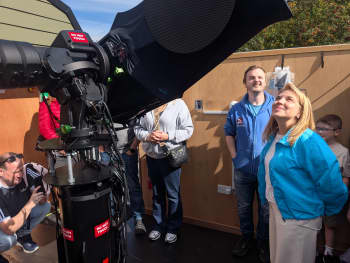
Constructed thanks to a legacy gifted to the University, it houses the 16-inch John Cruickshank telescope equipped with advanced imaging technology and an AI. controller.
The observatory will support teaching and research in astrophysics, as well as interdisciplinary work involving areas including artificial intelligence and data science. It will also provide opportunities for schools, community groups and other members of the public to engage with astronomy.
An observatory anyone can use
For Dr Wang, one of the most exciting features of the new observatory is that it removes some of the barriers traditionally associated with using a telescope.
“Cruickshank Observatory is unique in being fully AI controlled,” he says. “Both the roof and telescope can be operated using AI voice controls. You can look at a sky chart and simply ask it to point to an object you want to see - for example, ‘point the telescope to the star Sirius’.”
The system can go further than simply following instructions. Users can ask the AI to suggest what would be interesting to observe under the conditions at that particular time.
“It means anyone can use and enjoy the telescope without needing prior knowledge of astronomy,” Dr Wang says. “At the same time, its
powerful capabilities make it an exciting tool for students and professionals.”
This combination of accessibility and sophistication is central to the observatory’s purpose. It is intended to support teaching and research at the University, while also creating opportunities for schools, community groups and members of the public to engage with modern astronomy.
The telescope is capable of producing detailed astronomical images of galaxies and other celestial objects, giving students the chance to move beyond learning astronomy from textbooks and into practical observation.
The observatory will be used to advance interdisciplinary knowledge of how 21st-century astronomy and astrophysics work.
“Students have the opportunity for hands-on learning with advanced equipment,” says Dr Wang.
“This is a very widely connected area of science. It brings together AI and data science with physics and astronomy.
“That interdisciplinary aspect is increasingly important. Modern astronomy is no longer confined to observing objects through a telescope. Huge volumes of data, sophisticated imaging systems, artificial intelligence and computational techniques are now integral to understanding the universe.”

Built for Aberdeen’s long winter nights
One of the greatest advantages of the new observatory is Aberdeen’s weather and geography.
Winter brings longer periods of darkness, giving astronomers more time to observe the night sky. The city’s colder temperatures can also help create conditions that are particularly favourable for high-quality astronomical imaging.
“At night you can see the stars and galaxies on camera, and winter is the best time,” Dr Wang says. “Aberdeen is an ideal location for astronomical observation because of the long nights and low temperatures.”
Cold, stable air can reduce atmospheric turbulence, helping telescopes produce sharper images. With the right equipment, that can make high-quality observation possible even in an urban environment.
“Provided you have a good quality telescope - which we do - the conditions can help produce crystal-clear images even in the city,” he says. “I’m looking forward to the winter nights coming.”
Why put a telescope in the middle of a city?
Making the most of those winter nights requires more than simply opening the roof and pointing the telescope upwards.
The observatory has its own weather station, with sensors monitoring conditions including wind speed, humidity and atmospheric pressure.
Temperature is also monitored using infrared technology, helping the team determine whether it is safe to operate the equipment.
The facility also has a light pollution sensor, allowing the team to monitor another of the biggest challenges facing urban astronomy.
That technology is particularly important because it addresses the question Dr Wang says he is asked most frequently - why build a brand new observatory in the middle of a city?
But the location within Cruickshank Botanic Garden was carefully assessed before the decision was made.
“The location is ideal in terms of land access and accessibility and so we carefully assessed light pollution to see if it was viable,” Dr Wang says.
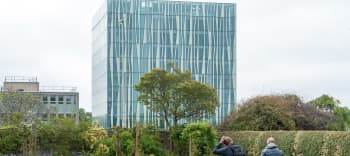
“With the gardens surrounding it and the position of the trees, despite our city-centre location we are well shielded from light. We are far enough from neighbouring buildings to avoid major light pollution, and we have mitigated it further using advanced technology.”
Artificial intelligence plays a role here too. The system can help identify when observing conditions are most favourable, taking account of environmental conditions and levels of light pollution. It can also assist with processing the resulting images.
During the daytime, the telescope can also be used for demonstrations and simulations. One of its more advanced feature allows users to simulate switching off sunlight, revealing the distribution of stars in real time.
Its location is also fitting given the history of the garden. The Anne H Cruickshank Observatory inherits the legacy of John Cruickshank (1787–1875) who was not only Professor of Mathematics at Marischal College, but also responsible for maintaining telescopes that are now in University of Aberdeen Collections.
He was an active astronomer, publicising a number of planetary observations. His daughter, Anne Cruickshank (1820–1911), generously donated land, buildings and funds for the establishment of the Cruickshank Botanic Garden in 1898.
On her death, she bequeathed her whole wealth via a special trust to the University of Aberdeen and founded the Cruickshank Lectureship in Astronomy in honour of her father.
The observatory is funded primarily through donations, in particular through the Miss Anne H Cruickshank’s Special Trust and the Dr C Allan Young and Mrs Norma Young Fund.

A 400-year astronomical legacy
The new observatory also forms part of a much longer Aberdeen story.
The University has played a significant role in astronomy and the development of astronomical telescopes for more than 400 years, with figures associated with the city contributing to the development of astronomy, mathematics and observational science.
Among them was Duncan Liddel, who graduated from King’s College in the late 16th century and became an important figure in the teaching of modern astronomy. He built networks with astronomers across Europe and donated important astronomical works to the University, including a copy of Nicolaus Copernicus’s De Revolutionibus.
James Gregory, who graduated from Marischal College, was a pioneering mathematician and astronomer whose work on reflecting telescopes helped lay foundations for technologies that remain fundamental to astronomical observation today.
And James Clerk Maxwell, who worked at Marischal College between 1856 and 1860, made fundamental contributions to physics during his time in Aberdeen, including work connected to planetary physics, statistical mechanics and colour photography.
The city has also had a succession of observatories.
Scotland’s first publicly funded observatory, and the first observatory built by the University, was established at Castlehill in Aberdeen in 1781 by Professor Patrick Copland of Marischal College. It was used for telescope observations until 1796, when the land was requisitioned by the Government.
It was followed by the Marischal College Observatory on the roof of the College building. As well as producing high-quality observations, the observatory contributed to positional astronomy and helped establish the precise latitude and longitude of Aberdeen.
That observatory closed in 1838 as the old Marischal College building was demolished and replaced by the present building. Some of its telescope equipment survives in the University Collections.
Then, in 1826, came the Cromwell Tower Observatory in the King’s College quadrangle.
For generations, it served as a centre for teaching, research and public engagement in astronomy and meteorology. But although the historic tower remains, the observatory has not been in practical use since around 2002. Its limited accessibility and lack of space made it unsuitable for installing a larger modern telescope

Duncal Liddel
Duncal Liddel

James Gregory
James Gregory

James Clerk Maxwell
James Clerk Maxwell
 Built with Shorthand