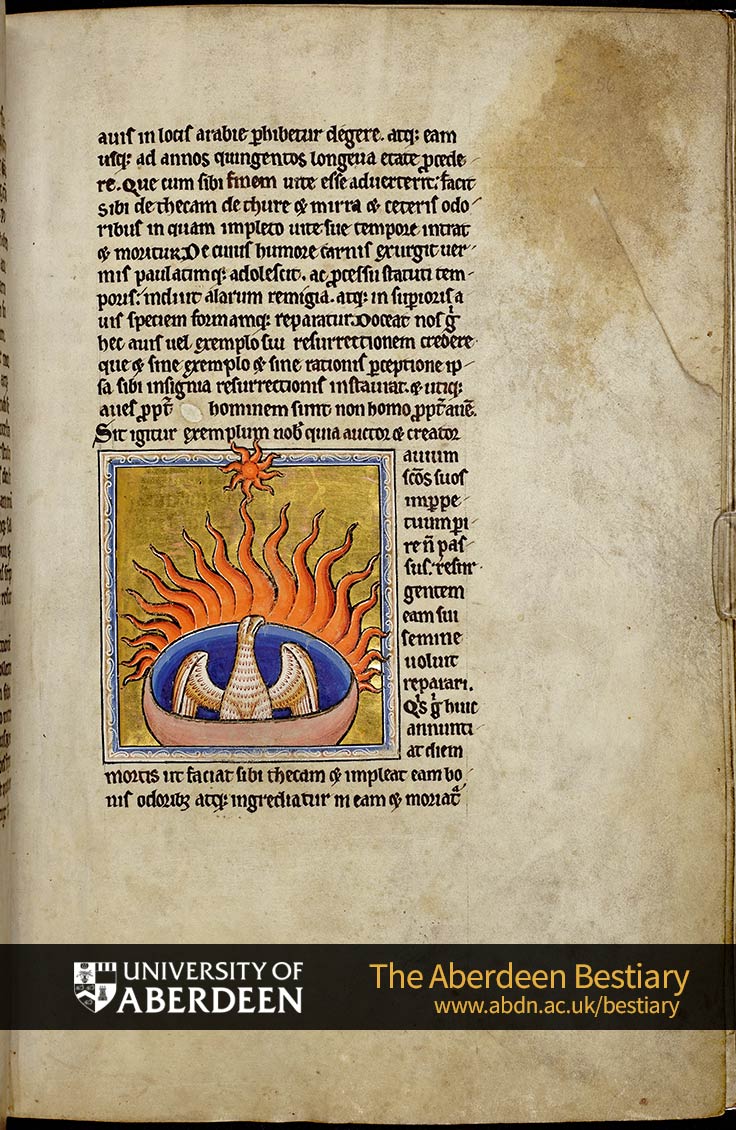
Folio 56r - the phoenix, continued.
is said to live in places in Arabia and to reach the great age of five hundred years. When it observes that the end of its life is at hand, it makes a container for itself out of frankincense and myrrh and other aromatic substances; when its time is come, it enters the covering and dies. From the fluid of its flesh a worm arises and gradually grows to maturity; when the appropriate time has come, it acquires wings to fly, and regains its Previous appearance and form.
Let this bird teach us, therefore, by its own example to believe in the resurrection of the body; lacking both an example to follow and any sense of reason, it reinvests itself with the very signs of resurrection, showing without doubt that birds exist as an example to man, not man as an example to the birds.
Let it be, therefore, an example to us that as the maker and creator of birds does not suffer his saints to to perish forever, he wishes the bird, rising again, to be restored with its own seed. Who, but he, tells the phoenix that the day of its death has come, in order that it might make its covering, fill it with perfumes, enter it and die
- Commentary
-
Commentary
Text
The phoenix. The bird makes a container for its ashes and rises again from the dead in its old form.
Illustration
The phoenix turns to face the sun, beats its wings to fan the flames and is consumed. The image may equally show the bird rising from its own ashes, a symbol of the resurrection.
Comment
There is some pouncing around the bird and flames. This was probably done while the manuscript was being made because it is concealed by the back of f.56r being stuck to another sheet. Thus f. 56r and 56v are actually two sheets stuck back to back. The glued backing to this sheet conceals the hole in its vellum.
Folio Attributes
- Transcription and Translation
-
Transcription
avis in locis Arabie perhibetur degere, atque eam\ usque ad annos quingentos longeva etate procede\ re. Que cum sibi finem vite esse adverterit, facit\ sibi [de] thecam de thure et mirra et ceteris odo\ ribus in quam impleto vite sue tempore intrat\ et moritur. De cuius humore carnis exurgit ver\ mis paulatimque adolescit, ac processu statuti tem\ poris, induit alarum remigia, atque in superioris a\ vis speciem formamque reparatur. Doceat nos igitur\ hec avis vel exemplo sui resurrectionem credere\ que et sine exemplo et sine rationis perceptione ip\ sa sibi insignia resurrectionis instaurat, et utique\ aves propter hominem sunt non homo propter avem.\ Sit igitur exemplum nobis quia auctor et creator\ avium\ sanctos suos\ imperpe\ tuum peri\ re non pas\ sus, resur\ gentem\ eam sui\ semine\ voluit\ reparari.\ Quis igitur huic\ annunti\ at diem\ mortis ut faciat sibi thecam et impleat eam bo\ nis odoribus atqe ingrediatur in eam et moriaturTranslation
is said to live in places in Arabia and to reach the great age of five hundred years. When it observes that the end of its life is at hand, it makes a container for itself out of frankincense and myrrh and other aromatic substances; when its time is come, it enters the covering and dies. From the fluid of its flesh a worm arises and gradually grows to maturity; when the appropriate time has come, it acquires wings to fly, and regains its Previous appearance and form. Let this bird teach us, therefore, by its own example to believe in the resurrection of the body; lacking both an example to follow and any sense of reason, it reinvests itself with the very signs of resurrection, showing without doubt that birds exist as an example to man, not man as an example to the birds. Let it be, therefore, an example to us that as the maker and creator of birds does not suffer his saints to to perish forever, he wishes the bird, rising again, to be restored with its own seed. Who, but he, tells the phoenix that the day of its death has come, in order that it might make its covering, fill it with perfumes, enter it and die