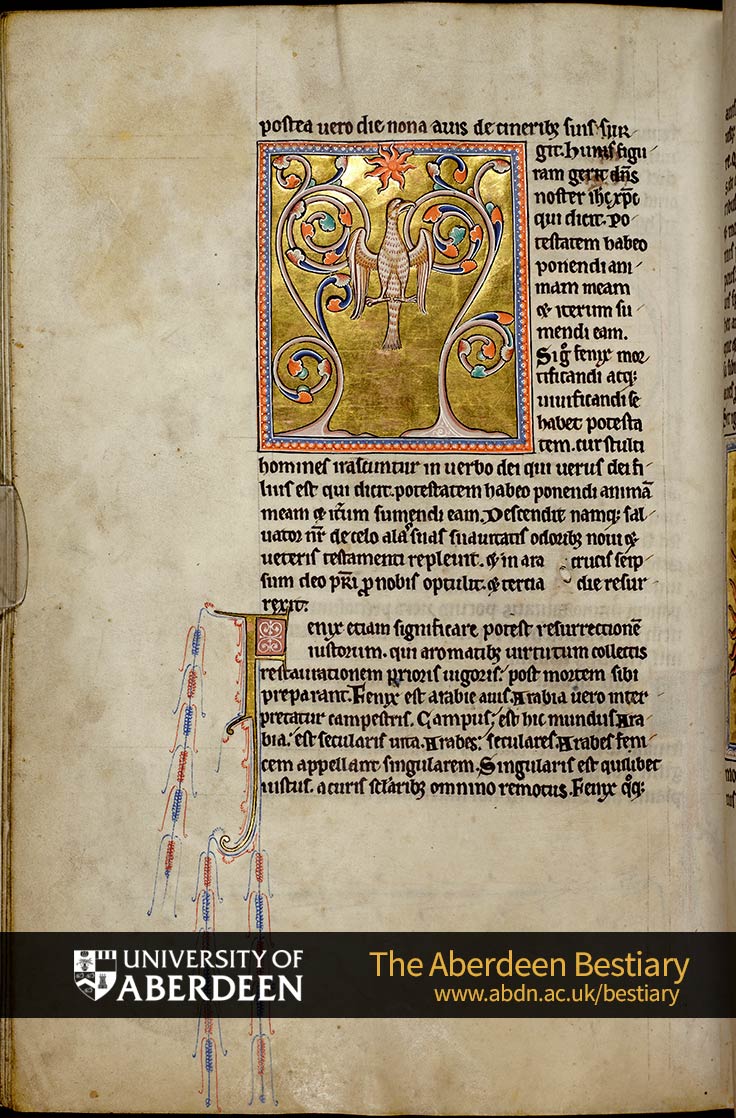
Folio 55v - the phoenix, continued.
But on the ninth day after that, the bird rises from its own ashes.
Our Lord Jesus Christ displays the features of this bird, saying: 'I have the power to lay down my life and to take it again' (see John, 10:18). If, therefore, the phoenix has the power to destroy and revive itself, why do fools grow angry at the word of God, who is the true son of God, who says: 'I have the power to lay down my life and to take it again'?
For it is a fact that our Saviour descended from heaven; he filled his wings with the fragrance of the Old and New Testaments; he offered himself to God his father for our sake on the altar of the cross; and on the third he day he rose again.
The phoenix can also signify the resurrection of the righteous who, gathering the aromatic plants of virtue, prepare for the renewal of their former energy after death.
The phoenix is a bird of Arabia. Arabia can be understood as a plain, flat land. The plain is this world; Arabia is worldly life; Arabs, those who are of this world. The Arabs call a solitary man phoenix. Any righteous man is solitary, wholly removed from the cares of this world.
The phoenix also
- Commentary
-
Commentary
Text
The phoenix. The bird turns to face the sun, beats its wings to fan the flames which will incinerate it. It rises from its ashes, a sign of the Resurrection.
Illustration
A ventral view of the bird between two trees, with wings out stretched and head to one side, beating its wingsd and looking for the sun.
Comment
Possibly a faint sketch to left of initial F (type 2), in the margin. The rubric is missing. Initial type 2.
Folio Attributes
- Transcription and Translation
-
Transcription
postea vero die nona avis de cineribus suis sur\ git. Huius figu\ ram gerit dominus\ noster Jesus Christus qui dicit: Po\ testatem habeo\ ponendi ani\ mam meam et iterum su\ mendi eam.\ Si ergo fenix mor\ tificandi atque\ vivificandi se\ habet potesta\ tem, cur stulti\ homines irascuntur in verbo dei qui verus dei fi\ lius est qui dicit: Potestam habeo ponendi animam\ meam et iterum sumendi eam. Descendit namque sal\ vator noster de celo ala[s] suas suavitatis odoribus novi et\ veteris testamenti replevit, et in ara crucis seip\ sum deo patri pro nobis optulit, et tercia die resur\ rexit.\ Fenix etiam significare potest resurrectionem\ iustorum, qui aromatibus virtutum collectis\ restaurationem prioris vigoris, post mortem sibi\ preparant. Fenix est Arabie avis. Arabia vero inter\ pretatur campestris. Campus, est hic mundus, Ara\ bia, est secularis vita, Arabes, seculares. Arabes feni\ cem appellant singularem. Singularis est quilibet\ iustus, a curis secularibus omnino remotus. Fenix quoque\Translation
But on the ninth day after that, the bird rises from its own ashes. Our Lord Jesus Christ displays the features of this bird, saying: 'I have the power to lay down my life and to take it again' (see John, 10:18). If, therefore, the phoenix has the power to destroy and revive itself, why do fools grow angry at the word of God, who is the true son of God, who says: 'I have the power to lay down my life and to take it again'? For it is a fact that our Saviour descended from heaven; he filled his wings with the fragrance of the Old and New Testaments; he offered himself to God his father for our sake on the altar of the cross; and on the third he day he rose again. The phoenix can also signify the resurrection of the righteous who, gathering the aromatic plants of virtue, prepare for the renewal of their former energy after death. The phoenix is a bird of Arabia. Arabia can be understood as a plain, flat land. The plain is this world; Arabia is worldly life; Arabs, those who are of this world. The Arabs call a solitary man phoenix. Any righteous man is solitary, wholly removed from the cares of this world. The phoenix also