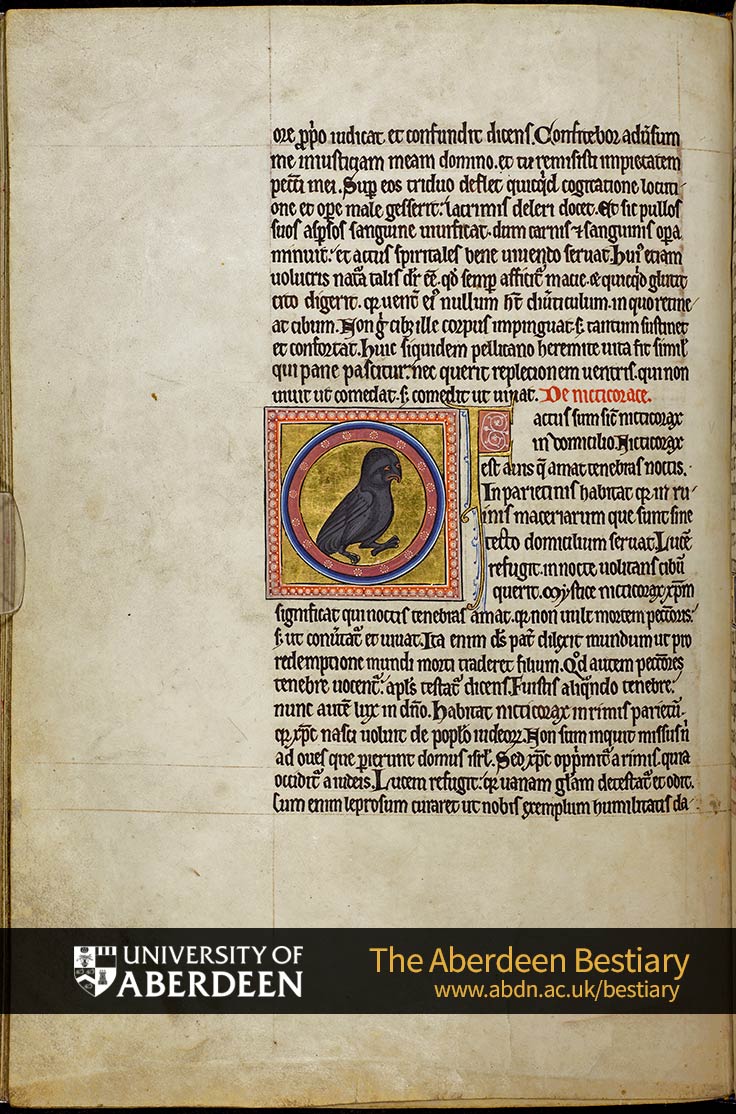
Folio 35v - the pelican, continued. De nicticorace; the night owl
out of his own mouth, saying: 'I said, I will confess my transgressions unto the Lord, and thou forgavest the iniquity of my sin' (Psalms, 32:5). It weeps for its young for three days: this teaches us that whatever we have done wrong by thought, word or deed, is expunged by tears. It revives its young by sprinkling them with its blood, as when we concern ourselves less with matters of flesh and blood and concentrate on spiritual acts, by conducting ourselves virtuously.
It is also a characteristic of this bird, they say, that it always suffers from thinness, and that whatever it swallows, it digests immediately, because its stomach has no separate pocket in which to retain food. Food does not fatten its body, therefore, but only sustains it and gives it strength. Indeed, the life of a hermit is modelled on the pelican, in that he lives on bread but does not seek to fill his stomach; he does not live to eat but eats to live.
Of the night-owl
'I am like the night-owl in its dwelling-place' (BSV, Psalmi, 101:7; NEB, Psalms, 102:6). The night-owl is a bird that loves the darkness of the night. It lives in decaying walls because it sets up house in the ruins of roofless dwellings. It shuns the light, flying at night in search of food.
In a mystic sense, the night-owl signifies Christ. Christ loves the darkness of night because he does not want sinners - who are represented by darkness - to die but to be converted and live (see Ezekiel, 18:32). For God the father so loved the world that he gave his son to death for the redemption of the world (see John, 3:16-17). That sinners are called 'darkness', is borne out by the apostle, saying: 'For ye were sometimes darkness, but now are ye light in the Lord' (Ephesians, 5:8).
The night-owl lives in the cracks in walls, as Christ wished to be born one of the Jewish people, saying: 'I am not sent but unto the lost sheep of the house of Israel' (Matthew, 15:24). But Christ is crushed in the cracks of the walls, because he is killed by the Jews.
Christ shuns the light in the sense that he detests and hates vainglory. For when he cared for a leper, in order to give us a lesson in humility,
- Commentary
-
Commentary
Text
Pelican continued; the night owl.
Illustration
The bird is illustrated by its portrait in a roundel.
Comment
The species is not clearly defined as the artist has tried to combine an owlish face and beak with the blackness of a crow. The barn owl, tawny owl and little owl may live in old buildings or ruins. Initial type 2.
Folio Attributes
- Transcription and Translation
-
Transcription
ore proprio iudicat et confundit dicens: Confitebor adversum\ me iniusticiam meam domino, et tu remisisti impietatem\ peccati mei. Super eos triduo deflet quicquid cogitatione locuti\one et opere male gesserit, lacrimis deleri docet. Et sic pullos\ suos aspersos sanguine vivificat, dum carnis et sanguinis opera\ minuit, et actus spiritales bene vivendo servat. Huius etiam\ volucris natura talis dicitur esse, quod semper afficitur macie et quicquid glutit\ cito digerit, quia venter eius nullum habet diverticulum in quo retine\at cibum. Non igitur cibus ille corpus impinguat, sed tantum sustinet\ et confortat. Huic siquidem pellicano heremite vita fit similis\ qui pane pascitur, nec querit replecionem ventris, qui non\ vivit ut comedat, sed comedit ut vivat.\ De nicticorace\ Factus sum sicut nicticorax\ in domicilio. Nicticorax\ est avis que amat tenebras noctis.\ In parietinis habitat quia in ru\inis maceriarum que sunt sine\ tecto domicilium servat. Lucem\ refugit, in nocte volitans cibum\ querit. Mystice nicticorax Christum\ significat qui noctis tenebras amat, quia non vult mortem peccatoris\ sed ut convertatur et vivat. Ita enim deus pater dilexit mundum ut pro\ redemptione mundi morti traderet filium. Quod autem peccatores\ tenebre vocentur, apostolous testatur dicens: Fuistis aliquando tenebre,\ nunc autem lux in domino. Habitat nicticorax in rimis parietum\ quia Christus nasci voluit de populo Judeorum: Non sum inquit missus nisi\ ad oves que perierunt domus Israel. Sed Christus opprimitur a rimis, quia\ occiditur a Judeis. Lucem refugit, quia vanam gloriam detestatur et odit.\ Cum enim leprosum curaret ut nobis exemplum humilitatis da\Translation
out of his own mouth, saying: 'I said, I will confess my transgressions unto the Lord, and thou forgavest the iniquity of my sin' (Psalms, 32:5). It weeps for its young for three days: this teaches us that whatever we have done wrong by thought, word or deed, is expunged by tears. It revives its young by sprinkling them with its blood, as when we concern ourselves less with matters of flesh and blood and concentrate on spiritual acts, by conducting ourselves virtuously. It is also a characteristic of this bird, they say, that it always suffers from thinness, and that whatever it swallows, it digests immediately, because its stomach has no separate pocket in which to retain food. Food does not fatten its body, therefore, but only sustains it and gives it strength. Indeed, the life of a hermit is modelled on the pelican, in that he lives on bread but does not seek to fill his stomach; he does not live to eat but eats to live. Of the night-owl 'I am like the night-owl in its dwelling-place' (BSV, Psalmi, 101:7; NEB, Psalms, 102:6). The night-owl is a bird that loves the darkness of the night. It lives in decaying walls because it sets up house in the ruins of roofless dwellings. It shuns the light, flying at night in search of food. In a mystic sense, the night-owl signifies Christ. Christ loves the darkness of night because he does not want sinners - who are represented by darkness - to die but to be converted and live (see Ezekiel, 18:32). For God the father so loved the world that he gave his son to death for the redemption of the world (see John, 3:16-17). That sinners are called 'darkness', is borne out by the apostle, saying: 'For ye were sometimes darkness, but now are ye light in the Lord' (Ephesians, 5:8). The night-owl lives in the cracks in walls, as Christ wished to be born one of the Jewish people, saying: 'I am not sent but unto the lost sheep of the house of Israel' (Matthew, 15:24). But Christ is crushed in the cracks of the walls, because he is killed by the Jews. Christ shuns the light in the sense that he detests and hates vainglory. For when he cared for a leper, in order to give us a lesson in humility,