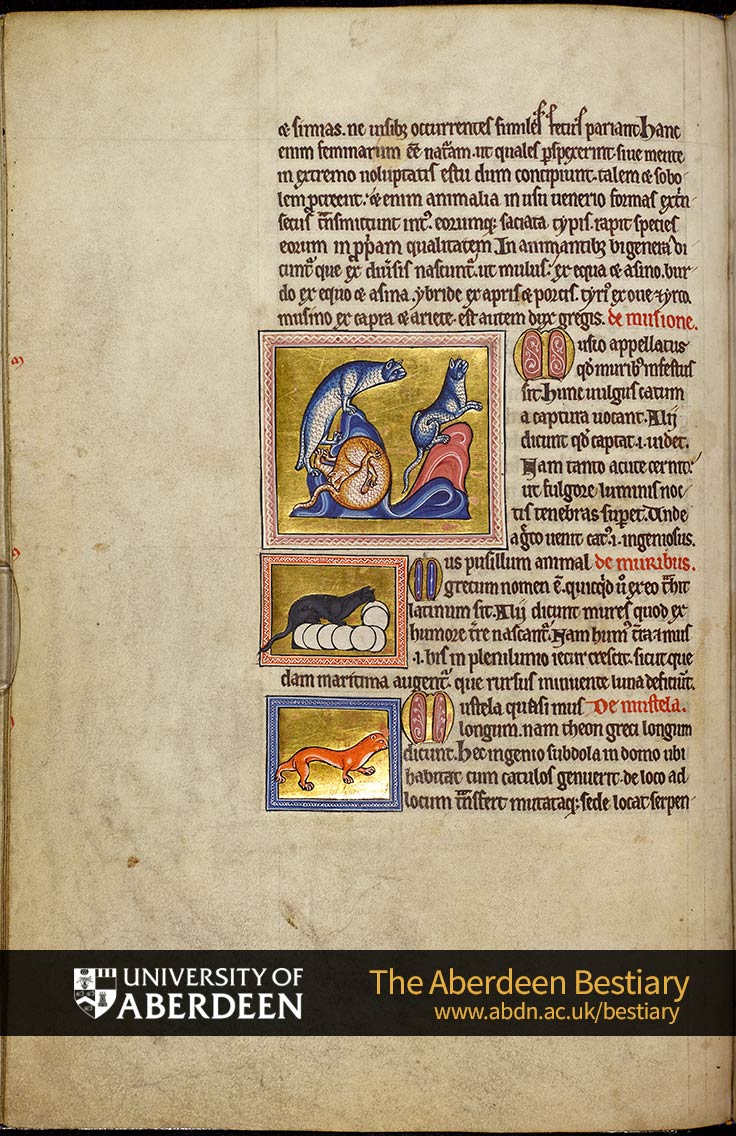
Folio 23v - the horse continued. De musione; the cat. De muribus; mice. De mustela; the weasel
or apes, lest they should bear children who look like the things they have seen. For it is said to be the nature of women that they produce as offspring whatever they see or imagine at the height of their ardour as they conceive; animals, indeed, when they are mating, transmit inwardly the forms they see outwardly and, imbued with these images, take on their appearance as their own.
Among living things the name 'hybrid' is given to those born from the mating of two different species, such as the mule from a mare and an ass, the hinny from a stallion and a she-ass, the hybrid from the wild boar and the sow, the animal called tyrius from the sheep and the he-goat, and the moufflon rom the she-goat and the ram; the moufflon is the leader of the flock.
Of the cat
The cat is called musio, mouse-catcher, because it is the enemy of mice. It is commonly called catus, cat, from captura, the act of catching. Others say it gets the name from capto, because it catches mice with its sharp eyes. For it has such piercing sight that it overcomes the dark of night with the gleam of light from its eyes. As a result, the Greek word catus means sharp, or cunning.
Of mice
The mouse is a puny animal; its name, mus, comes from the Greek, the Latin word deriving from it. Others say mures, mice, because they are produced ex humore, from the damp soil, of the earth; for humus means earth and from that comes mus, mouse. Their liver grows bigger at full moon, like the tides rise then fall with the waning of the moon.
Of the weasel
The weasel is called mustela, 'a long mouse', so to speak, for theon [telos] in Greek means 'long'. It is cunning by nature; when it has produced its offspring in its nest, it carries them from place to place, settling them in a series of different locations.
- Commentary
-
Commentary
Text
Hybrids continued. The cat, a catcher of mice, mouse; the weasel.
Illustration
The cats gambol and hunt. The mouse carries grain; portrait of weasel.
Comment
In the Ashmole Bestiary f.35v the central and right cat catch mice as described in the text. The mice are omitted in Aberdeen, changing the emphasis to anotehr section of the text where the cat's sharp sight is praised. The contorted cat licking its backside is shown in the Ashmole Bestiary. The mouse appears to be stealing grain, not mentioned in the text. The weasel is shown in a simple portrait. This page shows red initial indicator. Initials type 2.
Folio Attributes
- Transcription and Translation
-
Transcription
et simias, ne visibus occurrentes similes fetus pariant. Hanc \enim feminarum esse naturam, ut quales perspexerint, sive mente \in extremo voluptatis estu dum concipiunt, talem et sobo\lem procreent, et enim animalia in usu venerio formas extrin\secus transmittunt intus eorumque saciata typis rapit species \eorum in propriam qualitatem. In animantibus bigenera di\cuntur que ex diversis nascuntur, ut mulus, ex equa et asino, bur\do ex equo et asina, ybride ex apris et porcis, tyrius ex ove et yrco, \musino ex capra et ariete, est autem dux gregis. \ De musione \ Musio appellatus \quod muribus infestus \sit. Hunc vulgus catum \a captura vocant. Alii \dicunt quod captat, id est videt. \Nam tanto acute cernit, \ut fulgore luminis noc \tis tenebras superet. Unde \a Greco venit catus, id est ingeniosus. \ De muribus \ Mus pusillum animal \Grecum nomen est, quicquid vero ex eo trahit \Latinum sit. Alii dicunt mures quod ex \humore terre nascantur. Nam humus terra et mus, \id est his in plenilunio iecur crescit, sicut que\dam maritima augentur, que rursus minuente luna deficiunt. \ De mustela \ Mustela quasi mus \longum, nam theon Greci longum \dicunt. Hec ingenio subdola in domo ubi \habitat cum catulos genuerit, de loco ad \locum transfert mutataque sede locat serpen\Translation
or apes, lest they should bear children who look like the things they have seen. For it is said to be the nature of women that they produce as offspring whatever they see or imagine at the height of their ardour as they conceive; animals, indeed, when they are mating, transmit inwardly the forms they see outwardly and, imbued with these images, take on their appearance as their own. Among living things the name 'hybrid' is given to those born from the mating of two different species, such as the mule from a mare and an ass, the hinny from a stallion and a she-ass, the hybrid from the wild boar and the sow, the animal called tyrius from the sheep and the he-goat, and the moufflon rom the she-goat and the ram; the moufflon is the leader of the flock. Of the cat The cat is called musio, mouse-catcher, because it is the enemy of mice. It is commonly called catus, cat, from captura, the act of catching. Others say it gets the name from capto, because it catches mice with its sharp eyes. For it has such piercing sight that it overcomes the dark of night with the gleam of light from its eyes. As a result, the Greek word catus means sharp, or cunning. Of mice The mouse is a puny animal; its name, mus, comes from the Greek, the Latin word deriving from it. Others say mures, mice, because they are produced ex humore, from the damp soil, of the earth; for humus means earth and from that comes mus, mouse. Their liver grows bigger at full moon, like the tides rise then fall with the waning of the moon. Of the weasel The weasel is called mustela, 'a long mouse', so to speak, for theon [telos] in Greek means 'long'. It is cunning by nature; when it has produced its offspring in its nest, it carries them from place to place, settling them in a series of different locations.