- Commentary
-
Commentary
Text
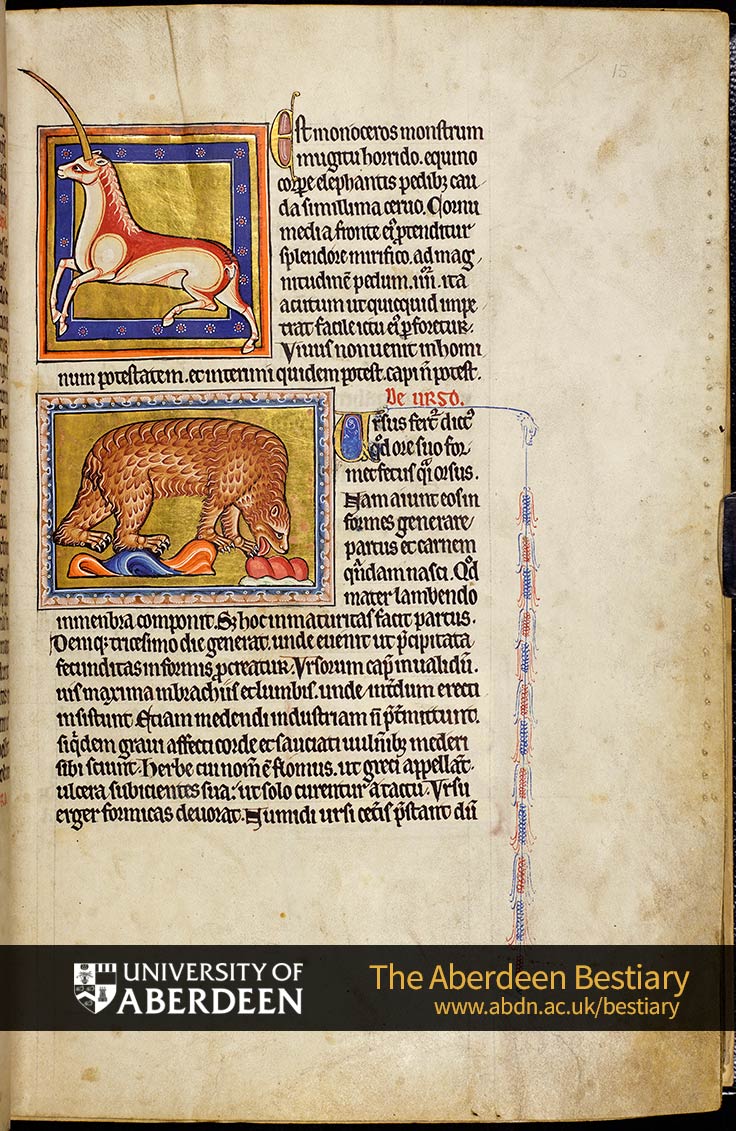
The monoceros. The bear.
Illustration
The monoceros has the head of a stag, the tail of a boar, elephant's feet and a horse's body. A horn four feet long projects from his head. This creature was derived from the Indian rhinoceros. The bear forms its offspring with its mouth. The female gives birth to a small eyeless piece of flesh which is gradually shaped in to a cub by licking. It is born head first resulting in a weak head supported by strong loins which allow the animal to stand on its hind legs. In the lower margin is a faint sketch of a man with beard and tight fitting cap, in profile. This is in a different style from the other illustrations and is probably later in date.
Comment
Single 'v' shape in top right margin, in faint ink. Pricking and ruling are visible. Initial indicator 'u' in right margin. Initial type 2.
Folio Attributes
- Transcription and Translation
-
Transcription
Est monoceros monstrum\ mugitu horrido, equino\ corpore elephantis pedibus, cau\da simillima cervo. Cornu\ media fronte eius protenditur\ splendore mirifico, ad mag\nitudinem pedum quatuor, ita\ acutum ut quicquid impe\trat [A: impetat] facile ictu eius foretur.\ Vivus non venit in homi\num potestatem, et interimi quidem potest, capi non potest.\ De urso\ Ursus fertur dictus\ quod ore suo for\met fetus quasi orsus.\ Nam aiunt eos in \ formes generare\ partus et carnem\ quandam nasci. Quod\ mater lambendo\ in membra componit. Sed hoc inmaturitas facit partus.\ Denique tricesimo die generat, unde evenit ut precipitata\ fecunditas informis procreatur. Ursorum caput invalidum,\ vis maxima in brachiis et lumbis, unde interdum erecti\ insistunt. Etiam medendi industriam non pretermittunt.\ Siquidem gravi affecti corde [A: caede] et sauciati vulneribus mederi\ sibi sciunt. Herbe cui nomen est flomus, ut greci appellant,\ ulcera subicientes sua, ut solo curentur a tactu. Ursu\ erger formicas devorat. Numidi ursi ceteris prestant dum\Translation
The monoceros is a monster with a horrible bellow, the body of a horse, the feet of an elephant and a tail very like that of a deer. A magnificent, marvellous horn projects from the middle of its forehead, four feet in length, so sharp that whatever it strikes is easily pierced with the blow. No living monoceros has ever come into man's hands, and while it can be killed, it cannot be captured. Of the bear The bear is said to get its name because the female shapes her new-born cub with her mouth, ore, giving it, so to speak, its beginning, orsus. For it is said that they produce a shapeless fetus and that a piece of flesh is born. The mother forms the parts of the body by licking it. The shapelessness of the cub is the result of its premature birth. It is born only thirty days after conception, and as a result of this rapid fertility it is born unformed. The bear's head is not strong; its greatest strength lies in its arms and loins; for this reason bears sometimes stand upright. Bears do not neglect the business of healing themselves. If they are afflicted by a mortal blow and injured by wounds, they know how to heal themselves. They expose their sores to the herb called mullein - flomus, the Greeks call it - and are healed by its touch alone. When sick, the bear eats ants. The bears of Numidia stand out from other bears