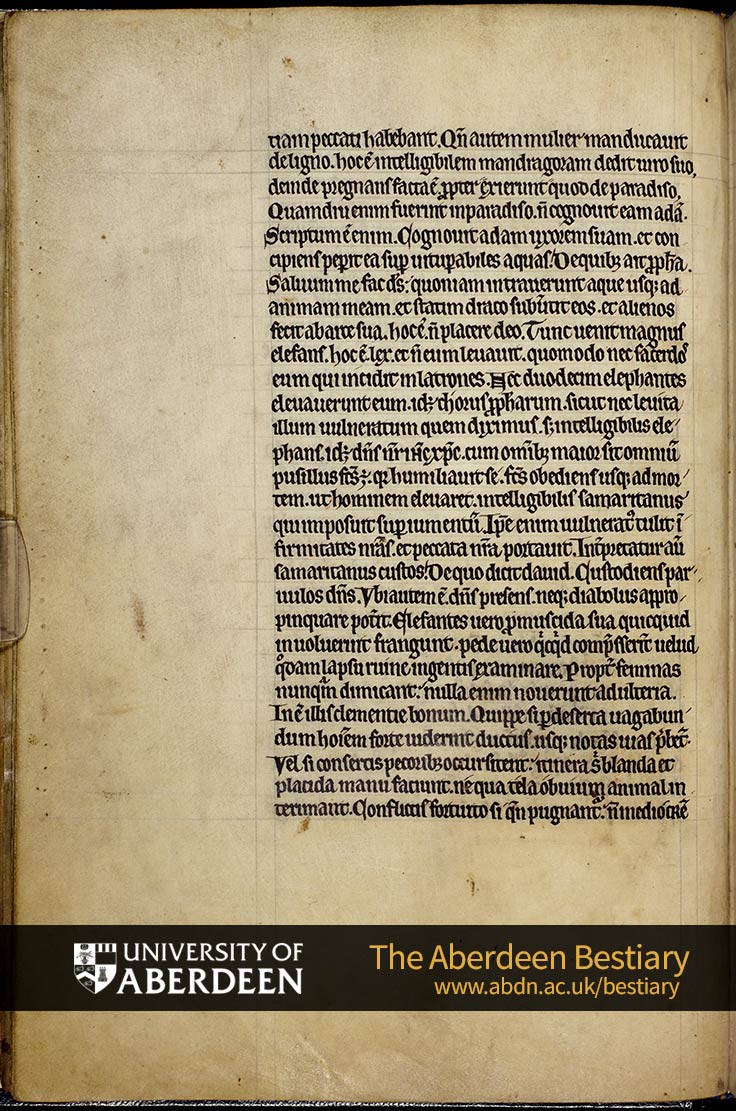
Folio 10v - Elephant, continued
of sin. But when the woman ate the fruit of the tree, that is to say, she gave her man the fruit of the mandrake, the tree of knowledge, then she became pregnant, and for that reason they left Paradise. For as long as they were in Paradise, Adam did not mate with Eve. For it is written: 'Adam knew his wife and she conceived', (Genesis, 4:1) and she gave birth on the waters of guilt. Of this, the prophet says: 'Save me, O God, for the waters are come in unto my soul.'(Psalms, 69:1). And at once the dragon seduced them and caused them to be outcasts from their citadel, that is, because they displeased God. Then came the big elephant, meaning the law, and did not raise up mankind, any more than the priest raised the man who fell among thieves. Nor did the twelve elephants, that is, the company of prophets, raise mankind, just as the Levite did not raise the wounded man we spoke of. But the elephant capable of understanding, that is our Lord Jesus Christ, who, although greater than all, became the smallest of all, because he humbled himself, becoming obedient unto death that he might raise up mankind. He is the Good Samaritan who set upon his own beast the man who had fallen among thieves. For Jesus himself was wounded yet bore our weakness and carried our sins. The Samaritan also symbolises a guardian. On this subject, David says: 'The Lord watching over the children...' [SOURCE] Where the Lord is present, the devil cannot draw near. Whatever elephants wrap their trunks around, they break; whatever they trample underfoot is crushed to death as if by the fall of a great ruin. They never fight over female elephants, for they know nothing of adultery. They possess the quality of mercy. If by chance they see a man wandering in the desert, they offer to lead him to familiar paths. Or if they encounter herds of cattle huddled together, they make their way carefully and peacably lest their tusks kill any animal in their way. If by chance they fight in battle, they have no mean
- Commentary
-
Commentary
Text
The elephant.
Comment
Pricking and ruling are visible.
Folio Attributes
- Transcription and Translation
-
Transcription
tiam peccati habebant. Quando autem mulier manducavit\ de ligno, hoc est intelligibilem mandragoram dedit viro suo,\ deinde pregnans facta est, propter quod exierunt [transposed] de paradiso.\ Quamdiu enim fuerint in Paradiso, non cognovit eam Adam.\ Scriptum est enim: Cognovit Adam uxorem suam, et con\cipiens peperit ea super vituperabiles aquas. De quibus ait propheta:\ Salvum me fac dominus, quoniam intraverunt aque usque ad\ animam meam. Et statim draco subvertit eos, et alienos\ fecit ab arce sua, hoc est non placere deo. Tunc venit magnus\ elefans, hoc est lex, et non eum levavit, quomodo nec sacerdos\ eum qui incidit in latrones. Nec duodecim elephantes\ elevaverunt eum, id est chorus prophetarum, sicut nec Levita\ illum vulneratum quem diximus, sed intelligibilis ele\phans, id est dominus noster Iesus Christus, cum omnibus maior sit omnium\ pusillus factus est, quia humiliavit se, factus obediens usque ad mor\tem, ut hominem elevaret, intelligibilis Samaritanus \ qui imposuit super iumentum. Ipse enim vulneratus tulit in\firmitates nostras, et peccata nostra portavit. Interpretatur autem\ Samaritanus custos. De quo dicit David: Custodiens par\vulos dominus. Ubi autem est dominus presens, neque diabolus appro\pinquare poterit. Elefantes vero promuscida sua quicquid\ involuerint frangunt, pede vero quicquid compresserint velud\ quodam lapsu ruine ingentis examinare [exanimare]. Propter feminas\ nunquam dimicant, nulla enim noverunt adulteria.\ In est illis clementie bonum. Quippe si per deserta vagabun\dum hominem forte viderint ductus usque notas vias prebent.\ Vel si confertis pecoribus occursitent, itinera sic blanda et\ placida manu faciunt, ne qua tela obvium animal in\terimant. Conflictis fortuito si quando pugnantur non mediocrem\Translation
of sin. But when the woman ate the fruit of the tree, that is to say, she gave her man the fruit of the mandrake, the tree of knowledge, then she became pregnant, and for that reason they left Paradise. For as long as they were in Paradise, Adam did not mate with Eve. For it is written: 'Adam knew his wife and she conceived', (Genesis, 4:1) and she gave birth on the waters of guilt. Of this, the prophet says: 'Save me, O God, for the waters are come in unto my soul.'(Psalms, 69:1). And at once the dragon seduced them and caused them to be outcasts from their citadel, that is, because they displeased God. Then came the big elephant, meaning the law, and did not raise up mankind, any more than the priest raised the man who fell among thieves. Nor did the twelve elephants, that is, the company of prophets, raise mankind, just as the Levite did not raise the wounded man we spoke of. But the elephant capable of understanding, that is our Lord Jesus Christ, who, although greater than all, became the smallest of all, because he humbled himself, becoming obedient unto death that he might raise up mankind. He is the Good Samaritan who set upon his own beast the man who had fallen among thieves. For Jesus himself was wounded yet bore our weakness and carried our sins. The Samaritan also symbolises a guardian. On this subject, David says: 'The Lord watching over the children...' [SOURCE] Where the Lord is present, the devil cannot draw near. Whatever elephants wrap their trunks around, they break; whatever they trample underfoot is crushed to death as if by the fall of a great ruin. They never fight over female elephants, for they know nothing of adultery. They possess the quality of mercy. If by chance they see a man wandering in the desert, they offer to lead him to familiar paths. Or if they encounter herds of cattle huddled together, they make their way carefully and peacably lest their tusks kill any animal in their way. If by chance they fight in battle, they have no mean