
Over 100 Years of Science
In 2013 the Rowett Institute celebrated its centenary. The Institute played a major role in establishing the link between diet and health in the first half of the 20th Century, and it continues to work on major diet-related health and food security problems at present.
It is true to say that a significant amount of the work that led to the modern science of nutrition as we know it today was carried out at the Rowett, both as far as human and animal nutrition are concerned. The Institute has shown itself to be a flexible and innovative organisation, responding to the changing times throughout its long and distinguished history.
More information on Rowett research through the decades can be found in this timeline . Achievements range from the UK's first major study of family diet and health, to the development of a feeding system for cattle and the mapping of where an obesity hormone acts on the brain.
Videos reflecting the views of Rowett staff, past and present.
- Founding the Rowett
-
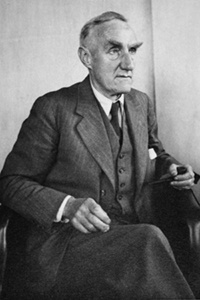
Before coming to Aberdeen Boyd Orr graduated in Arts from Glasgow University in 1903 and worked as a school teacher for three years. This was his first experience of the effect of poverty on the health of children.
Orr returned to Glasgow University and went on to qualify as a medical doctor, graduating MD in 1914 with a gold medal for his thesis which was on starvation, water and protein metabolism.He was offered the directorship of the Rowett Institute in 1913 and arrived in Aberdeen on April 1, 1914.
Following the outbreak of the First World War, Orr served as a medical officer in the trenches and received the Military Cross and Distinguished Service Order. He saw at first hand the poor health and physique of many of the army conscripts. In the last year of the war he also served with the Royal Navy.
Orr returned to Aberdeen after the war and with a staff of four, research started in the Craibstone laboratory.
He spearheaded a successful drive for funds to finance a full institute and the Rowett at Bucksburn was formally opened in 1922 by Queen Mary with a tree planting ceremony.
The subsequent development of the Institute, the building of the Reid Library, main laboratory block and Strathcona House, were all down to the eloquence, determination and persistence of Boyd Orr as he persuaded our many benefactors to part with considerable sums of money.
Orr's early research at the new Rowett Institute was concerned with the mineral content of pastures and the importance of vitamins and minerals in the diet of farm animals.
- Pre World War II
-

From 1926 onwards, Orr travelled widely and visited the Middle East, Africa, India, Australia, New Zealand and Canada. He reported on the state of agriculture and agricultural research in the different countries. Two teams of workers went to Kenya to determine the mineral composition of pastures, and to compare the health and diet of the Kikuyu and Masai tribes, who live side-by-side, but have very different dietsStudies on the nutritive value of milk in the diet of children were also undertaken. The results showed that addition of milk to the diet of schoolchildren resulted in a an increase in height and weight.
This subsequently led to legislation in Scotland to provide milk for children in Scottish schools and eventually England followed suit.
During the studies of milk for school children, a dietary survey of their families was carried out. Although not conclusive the results indicated that a large proportion of the diets were not sufficient to maintain optimum growth.
Orr continued to highlight the poor state of health and nutrition of the British people and to advocate a national food policy linked to an agricultural policy and which took account of the importance of adequate nutrition to health.
He was knighted in 1935 in recognition of his pioneering work on diet and health.
- The War Years
-
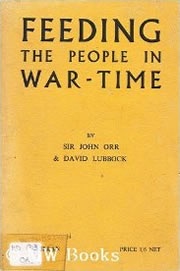
In the 1930s Boyd Orr conducted a desk study on 'Food health and Income', which classified the UK population into six groups according to income and then estimated the adequacy of the diet consumed in each of the groups.
The study showed that more than one third of the population were too poor to purchase an adequate selection of foods to maintain health.
So great was the interest in the 1936 study that the Carnegie Trust gave the Rowett a grant of £15,000 to carry out a more detailed study. More than a thousand families, including 3,000 children, took part across Scotland and England between 1937 and 39.
Detailed information was gathered on the socioeconomic status of each household and diet and analysis of data from the Carnegie survey was in progress at the Rowett when war broke out.
Lord Woolton, Minister for Food, used these results to develop his wartime food policy, which included special measures to safeguard the health of mothers and children.
Rowett research was also influential when it came to maximsing food production and Orr's research, together with that of another senior Rowett staff member, David Lubbock was published in 1940 in 'Feeding the people in war-time.
Orr also joined a committee advising the government on food policy and in 1941 became the first president of the Nutrition Society
Despite the acute food shortages, Orr's research and Woolton's policies meant that the women and children of the poorer classes were healthier at the end of the war than at the beginning of it.
- Post War Years
-
During the final years of the war Orr became well known as a broadcaster and contributed to several publications which looked forward to post-war Britain. He was involved in the Paul Rotha films 'World of plenty' (1943) and 'The World is Rich'.
Elected as an independent MP for the Scottish Universities, Orr's maiden speech to the House of Commons on 12 June 1945 was on `National Health'. He resigned in 1946.
He was invited to attend a conference in Quebec to establish the Food and Agriculture Organisation (FAO) that same year. His invitation to join the British delegation was made at the last minute as the British Government began to tire of Orr's prickly independence and he was permitted to attend only as an observer - not to speak.
Despite this, and the British delegation voting against him, Orr was overwhelmingly elected as the first Director general of the FAO during the conference, a post he held until 1948.
Once in post, Orr immediately set-up a temporary food-sharing organisation to alleviate the predicted shortages of the winter of 1946-47.
Encouraged by this success, Orr decided to push for a powerful, international 'World Food Board'.
Unfortunately the pace at which Orr worked baffled and disturbed the British civil servants. He was not getting any younger, and he sensed that the opportunity for international cooperation was fading.
The World Food Plan was discussed at a meeting in Copenhagen and was supported by the USA delegation. Orr believed that he was on track to establishing a World Food Board.
But the British Government was opposed to Orr's plan and considered it to be impractical with serious financial implications for the UK. At a conference in Geneva, the USA delegation was persuaded to withdraw its support, and at the final vote Orr's plan was rejected.
With his plan defeated, and the old isolationism beginning to return to world affairs, Orr resigned from the FAO and returned to his farm in Angus a disappointed man.
Despite this defeat, and the number of subsequent attempts, Orr's plan is acknowledged as the closest to international cooperation in food sharing ever achieved.
- Later Years
-
At the end of the 1940s Orr's achievements were formally recognised. In 1949 he became a Freeman of the City of Aberdeen and was elevated to the peerage as Baron Boyd-Orr, of Brechin Mearn in the County of Angus.
Later that year he was awarded the Nobel Peace Prize - his Nobel Prize Lecture was 'Science, Politics and Peace'. He donated the prize money to the National Peace Council and other similar organisations.
Orr took up many Directorships and was a member of 'The British Council for the Promotion of International Trade', which was considered to be a cover for 'fellow travellers' or communist sympathisers, but its aims were in line with Orr's views on world trade and peace.
He travelled widely in Europe and was an adviser on agricultural affairs to both the Indian and Pakistani governments. He was welcomed in both the USSR and China. Lady Orr was his constant companion as they met many international statesmen.
In 1953 is book `The White Man's Dilemma', which is published in many languages is a statement of his views on the concept of a 'World Food Board' and World Government and he campaigned for these ideals to the end of his life.
In 1958 Orr received honorary degrees from 12 universities in the UK and abroad, and was awarded many medals and marks of distinction.
His last public engagement came in 1970 when he opened a large extension to the Rowett's laboratory facilities.
Orr died on 25 June 1971 at his home in Brechin.
- The Early Years
-
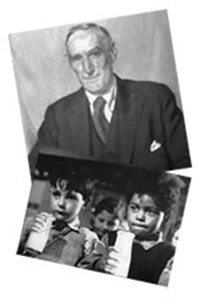
The Rowett Institute was founded in 1913 with the aim of furthering research in animal nutrition.
At the helm was John Boyd Orr, later to become Lord Boyd Orr, who moved from Glasgow to 'the wilds of Aberdeenshire' to become the Institute's first director.
When he arrived, there was no Institute building and he started work in a basement laboratory at the University of Aberdeen in Marischal College.
At the same time he committed the £5,000 which was available to the building of a granite laboratory block at Craibstone, not far from the present site of the Rowett Institute.
At the breakout of the Great War, Orr left the Institute, but returned in 1919 with a staff of four to begin work in a laboratory facility. Orr continued to push for a properly equipped new research institute and finally the Government agreed to pay half the costs but stipulated that the other half was to be found from other sources.
The extra money was donated by Dr John Quiller Rowett, a businessman and director of a wine and spirits merchants in London. Rowett's donation allowed the purchase of 41 acres of land at Bucksburn for the Institute to be built on.
Rowett also contributed £10,000 towards the cost of the buildings. The money was donated with one very important stipulation from Rowett - "if any work done at the Institute on animal nutrition were found to have a bearing on human nutrition, the Institute would be allowed to follow up this work."
- A Change of Direction
-
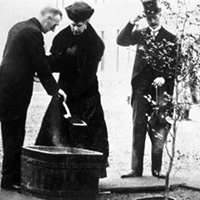
The Institute was formally opened in 1922 by Queen Mary with a tree planting ceremony.
Although Orr's early research at the new Rowett Institute was initially concerned with the mineral content of pastures and the importance of vitamins and minerals in the diet of farm animals, Rowett's words were soon to be realised and he quickly made major breakthroughs in human health.
Having served as a medical officer in the trenches during the First World War, he had seen first-hand the poor health and physique of many of the army conscripts.
In the late 1920s, Orr began to look at the relationship between poverty, food and optimal health. His research changed our understanding of the relationship between diet and health - he was the first scientist to show that there was a link between poverty, poor diet and ill-health.
He led a study looking at the importance of milk in the diet where he examined the effect on the growth of children. Orr observed that those who grew best had milk in their diets.
This ultimately led to the policy of giving children free milk in schools. But Orr's greatest contribution came in the late 1930s in the form of The Carnegie Survey, where he looked at the diet and health of over 1300 families across the UK.
The survey data was in the process of being analysed at the outbreak of World War II and the results were used to inform the development of UK food rationing policy, which for the first time was based on a greater understanding of nutritional needs, with special measures to safeguard the health of mothers and children.
So effective was this understanding of nutritional needs that the nation's health was said to be generally better at the end of WWII than it was at the beginning.
- Back to Basics
-
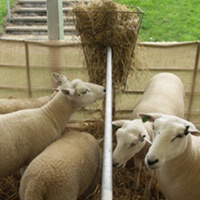
The advances in research continued throughout the post-war period when the Rowett led the way in improving the efficiency of animal production, establishing a global reputation for work in this area.
During this period, the Rowett was led first by David Cuthberton and subsequently by Kenneth Blaxter, respectively the second and third directors of the Rowett Institute.
The work of Kenneth Blaxter, in particular, had a major impact on practical rearing of farm animals, increasing both the efficiency and cost-effectiveness of livestock production.