
The Rhynie chert, examined from float blocks, trench and cored material exhibits a wide range of macro-textures (those large enough to be visible in hand specimen) and micro-textures (those clearly visible using optical microscope techniques). Studying both, together with the biota the individual beds contain, can help elucidate the different palaeoenvironments that were present in this hot spring complex at Rhynie 400 million years ago, useful comparisons can be made with modern hydrothermal deposits and settings ( see also the section on The ancient environment and modern analogues ). The following gives a brief summary of the textures observed within the chert beds together with some example images.
Macro-Textures
Five basic textures have been described from the chert beds ( Trewin 1994 ). However, within individual beds, particularly in composite beds of chert, more than one textural type may be present and there are often gradations between the textural types.
- Laminated Cherts
-
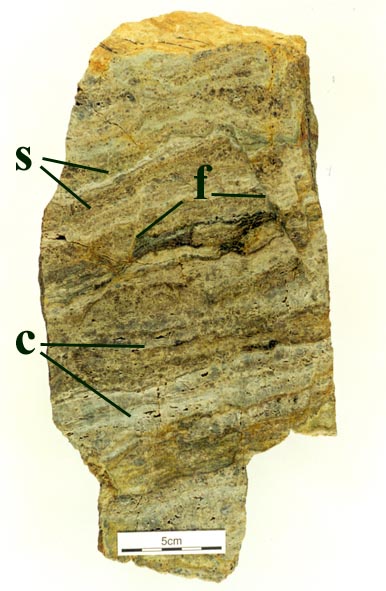
This particular texture most probably originated by deposition from successive inundations by silica-rich waters, with periods of silica precipitation occasionally interrupted by the influx of detrital material.
- Vuggy to Massive Cherts
-
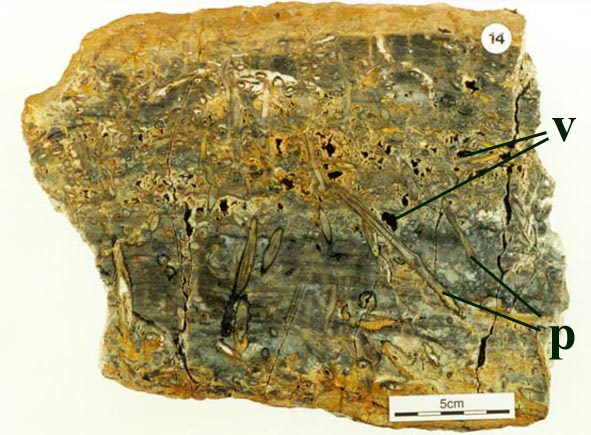
The mode of formation of these cherts is variable, but examining the micro-textures (see below) for further evidence may indicate silicification in areas of terrestrial plant growth, suddenly flooded by silica-rich waters, or silicification of the contents of small ponds.
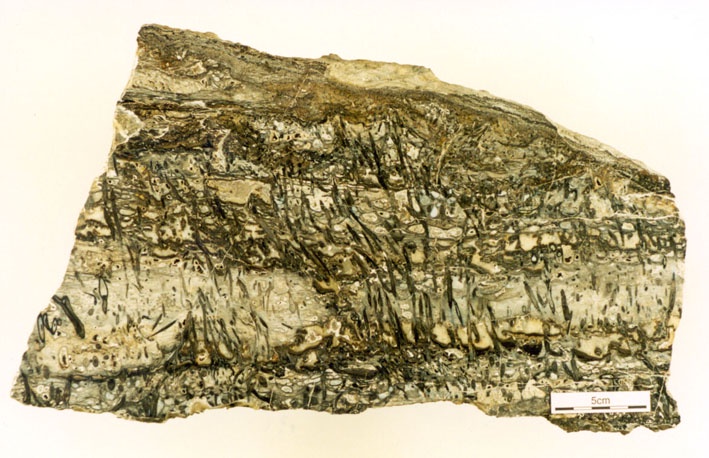
- Lenticular Cherts
-
Cherts comprising irregular, laterally discontinuous, dark, organic, often plant-rich lenses. These lenses display partings of carbonaceous cherty sandstone (see inset below). The cherty sandstones occasionally show organo-stylolites formed as a result of the compaction of plant material within the sediment. The centres of the chert lenses often grade into the massive texture described above (inset right). Lenticular cherts often occur in thick composite beds.
The patchy silicification of these plant-rich lenses and their gradation into cherty sandstone interbeds tends to suggest patchy and poor silicification just beneath the ground surface.
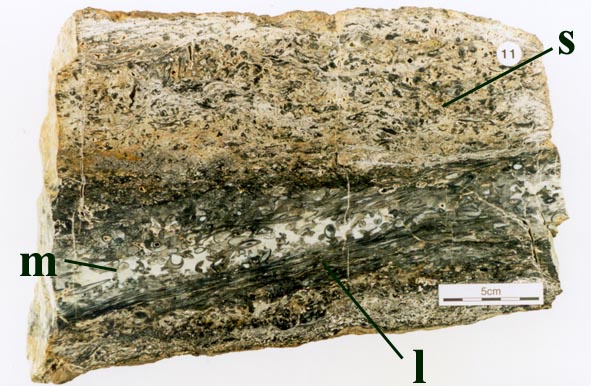
- Nodular Cherts
-
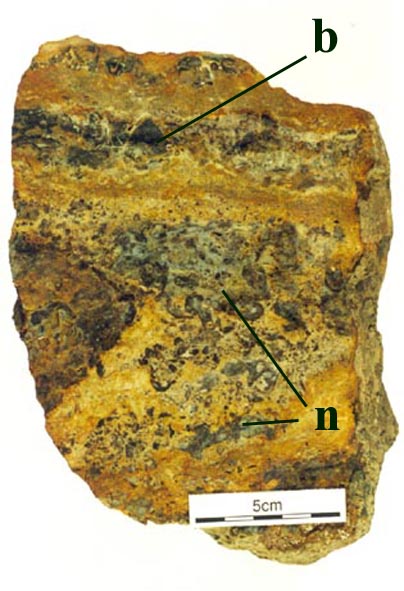
As with the lenticular cherts, this texture appears to be associated with patchy and rather poor silicification, some of which may have been formed at the surface, but much probably occurring just below the sediment surface.
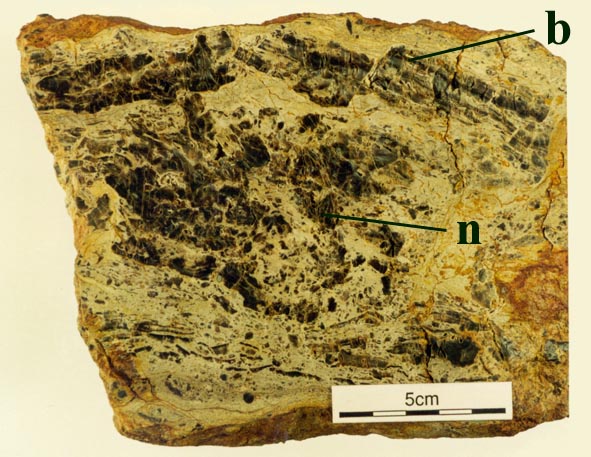
- Brecciated Cherts
-
In this case, cherts of all the textures described above may be extensively fractured and resealed with chert or quartz. In a few instances brecciated chert beds recovered form below the surface weathering zone, fractures are cemented by calcite, baryte and rarely fluorite.
Timing of brecciation appears to vary, some is clearly related to fracturing and faulting at depth in the sediment pile, the fractured chert being cemented by late quartz cements. Other examples occurred at the surface as a result of desiccation and weathering of the sinter, evidenced by the fractures being in-filled with sediment (see inset below) and/or resealed with chert containing later silicified elements of the biota, such as fungi and algae.
Micro-Textures
Apart from the studied large scale morphological features, optical microscope techniques provide a wealth of further information with which, for example, we can deduce the 'way-up' of the beds; and the burial history of the beds (in other words their diagenesis). Textural information can be used to elucidate the palaeoenvironment in which the individual beds were deposited. The following includes examples of micro-textural information that can be used to solve these problems.
- Geopetal Textures
-
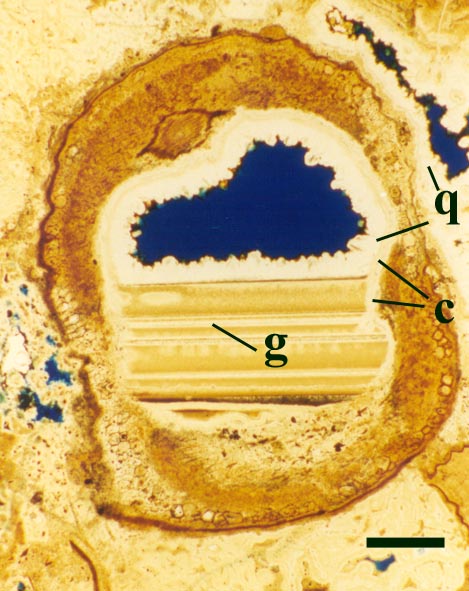
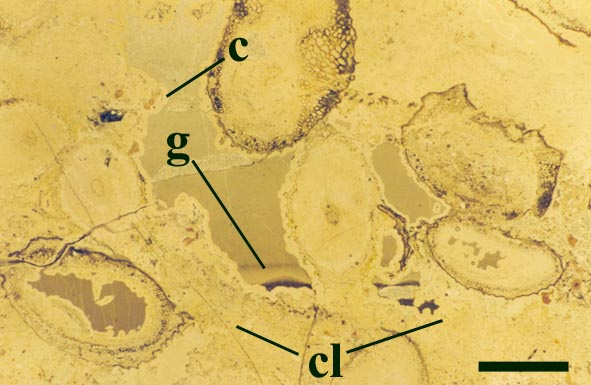
They generally tend to form by the accumulation of very fine infiltrated organic and detrital material as a layer within voids in sediment, such as in the hollow straws of plant stems. Similarly, in the chert beds geopetal layers may also form from successive generations of silica cement. They are perhaps most common in the vuggy to massive cherts described above.
- Cement and Compactional Textures
-
In the image above right (in Geopetal Textures), for example, the pore-lining quartz cement (q) clearly came after the geopetal layers (g) which in turn post-date an earlier generation of chert cement (c) which lines the straw. The straw does not appear to be fractured and has therefore not undergone any significant burial compaction suggesting early silicification of the plant and surrounding matrix prior to burial.
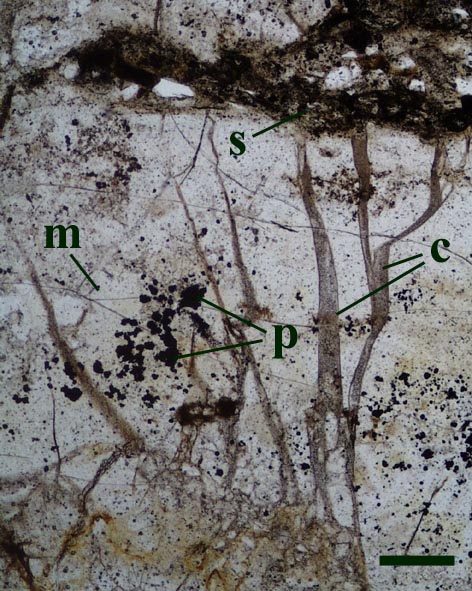
The image on the left is another example. Here is a thin section of a brecciated nodular chert. The chert matrix (m) has been heavily fractured then resealed by later very fine, cryptocrystalline chert (c). The framboidal pyrite (p) is only present within and surrounded by the matrix chert and must therefore predate this or was formed at the same time. Notice how the resealed fractures stop where the nodule meets the sandstone (s), this suggests the sediment was not fully silicified at the time the chert nodules were fractured, being more ductile to compactional deformation than the brittle nodule.
These are just two relatively simple examples of how micro-textures in the cherts can be used to elucidate the diagenetic history.
- Micro-Textures for Determining Palaeoenvironment
-
A number of micro-textures are found in the various chert beds that together with the biota present help to determine the palaeoenvironments in which individual chert beds were deposited. For the purposes of this resource we shall only consider a couple of examples here.
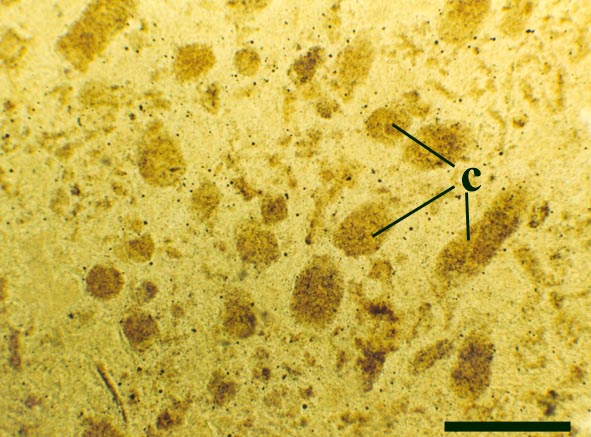
By studying coprolites, in terms of their size, geometry and content it may be possible to determine what type of organism produced them. Thus by understanding coprolites a lot of information can be also gained on the interactions between fauna and flora (see Habgood et al. in press).
An interesting point to note is that the coprolitic micro-texture (inset above right) is often a good 'pathfinder' texture when prospecting for well preserved arthropods in the chert.
This distinctive clotted chert texture is directly comparable to mulm, the amorphous organic material that is often found in modern freshwater ponds (Anderson & Trewin 2003; Trewin et al. 2003; Fayers & Trewin in press). The presence of this texture in some of the chert beds is useful in a number of respects. As mentioned above, it acts as a useful 'pathfinder' texture for finding well-preserved arthropods. It also indicates that silicification in these particular beds took place in an aquatic setting with no desiccation prior to preservation, since desiccation would have led to the collapse and degradation of these fine, open organic mesh-works (Fayers & Trewin 2003; Fayers & Trewin in press).
Very often chert beds displaying these textures and containing some of the most exquisitely preserved plants and arthropods also exhibit finely disseminated pyrite in the chert matrix, occasionally occurring in framboidal clusters (see above). The pyrite appears to be contemporaneous with the earliest stages of silicification. Its presence indicates the waters from which it precipitated were at least mildly reducing, suggesting that some of these small ponds were at times stagnant. Such localised reducing conditions would inhibit the rapid decay of organic matter and may in part explain the fantastic preservation of some of the fossils (Fayers & Trewin 2003).