- The Early Days
-
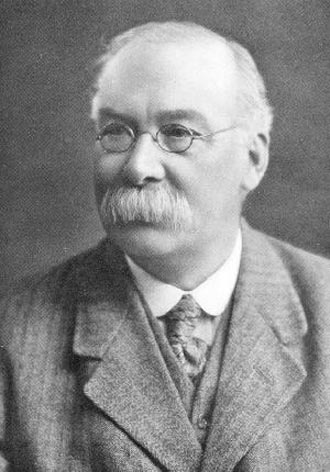
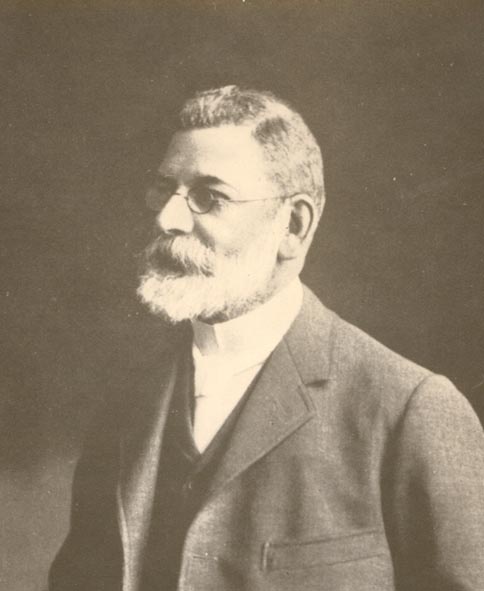
In a series of five classic papers Kidston and Professor William Henry Lang described in detail the plants we now know as Rhynia, Aglaophyton, Horneophyton and Asteroxylon (Kidston & Lang 1917, 1920a,b, 1921a,b). They also described parts of Nothia but included it as part of Asteroxylon. Kidston died in 1924, and although Lang continued to produce papers on Scottish palaeobotany until 1952, he did not add to his Rhynie work.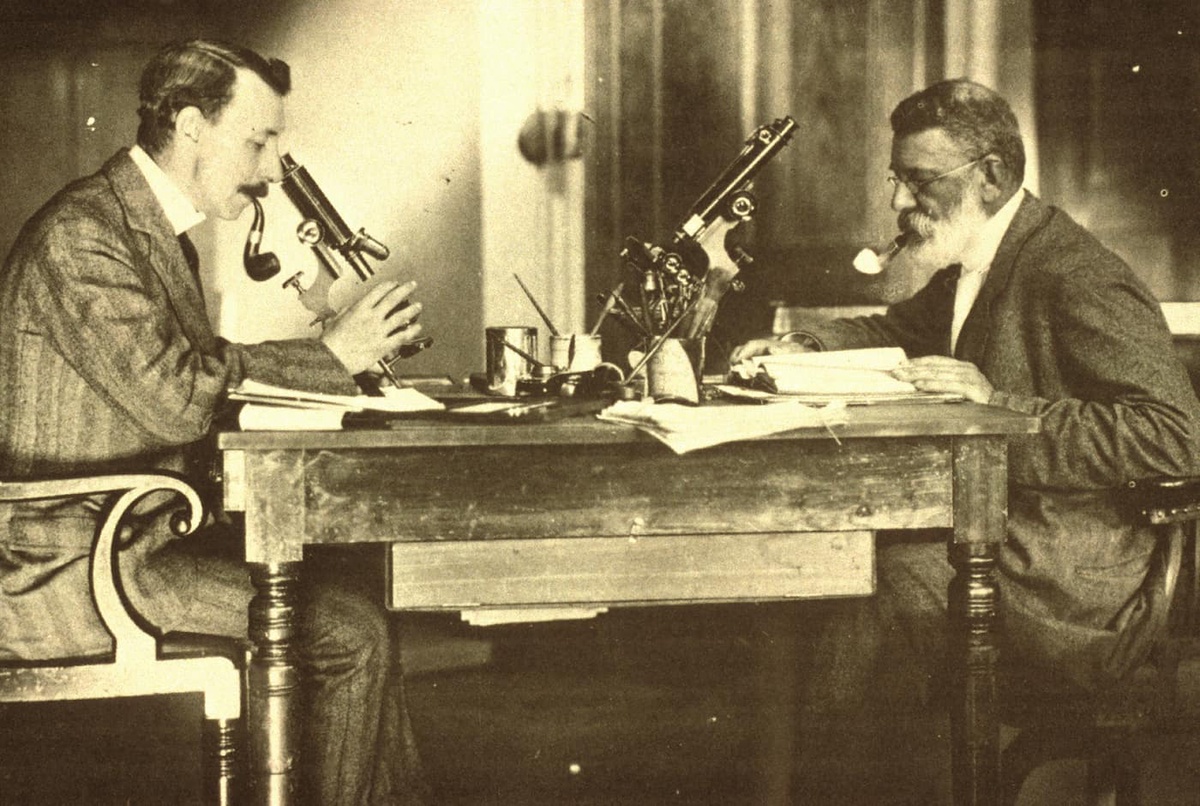
In the 1920's the first arthropods were described from the chert with Hirst (1923) describing the trigonotarbids, Scourfield (1926) the freshwater crustacean Lepidocaris, and Hirst and Maulik (1926) the earliest 'insect', a springtail, Rhyniella.
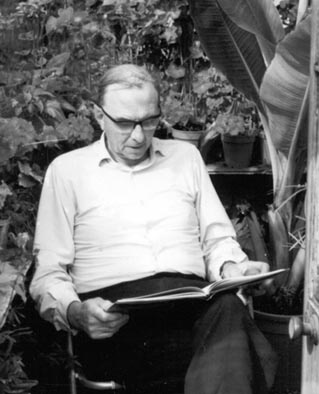
Over the years Geoffrey Lyon gave chert material to many palaeobotanists, but it was the team at the University of Münster, led by the late Professor Remy who had the greatest success finding the small gametophytes of the sexual generation of several of the plants (Remy & Remy 1980; Remy & Hass 1991a,b,c,d).
- Recent Research and Discoveries
-
By the late 1980's there was increasing production of research papers on the Rhynie flora and fauna. During this time and into the 1990's research by the University of Münster, often in collaboration with various specialists from other institutions, saw the advancement of our knowledge of the Rhynie flora. As well as the discovery of the gametophyte stages of several of the plants, they also discovered a number of new flora, including various types of fungi (Hass & Remy 1992; Hass et al. 1994; Remy et al. 1994a & b) and the earliest known fossil lichen. It was also in the early 1990's that the first zosterophyll plant from the chert was discovered, Trichopherophyton (Lyon & Edwards 1991).
However, the basic geology of the Rhynie area had not been revised since Geikie's description in 1878. The British Geological Survey remapped the area with the new map published in 1993 (BGS Alford Sheet 76W) but surface outcrop on this poorly exposed area revealed little to augment existing knowledge.
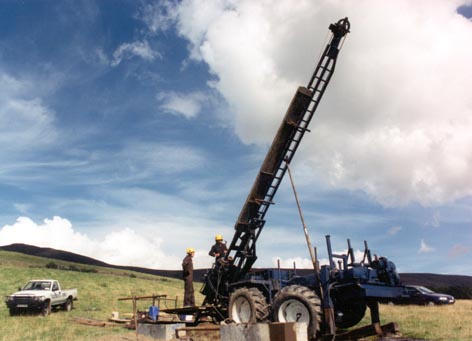
Interest in the area from the University of Aberdeen commenced when Rice and Trewin (1988) demonstrated that the chert and silicified rocks in the area are enriched in gold and arsenic and confirmed the hot spring origin of the cherts. A mineral exploration programme of drilling and trenching ensued, revealing much about the subsurface geology (Trewin & Rice 1992; Rice et al. 1995). The exploration rig used by the mineral exploration company was hired by the university and core was taken through the Rhynie chert sequence. For the first time the unweathered lithologies of sandstone and shale between the chert beds could be examined and the plant sequence and palaeoenvironment interpreted (Trewin 1994; Trewin 1996; Powell et al. 2000 b). A second phase of drilling in 1997 (see inset below), followed by more recent trenching programmes and magnetic surveys in the Rhynie area, has produced more surprises, requiring further revision of the geology of the area (Rice et al. 2002; Rice & Ashcroft in press).
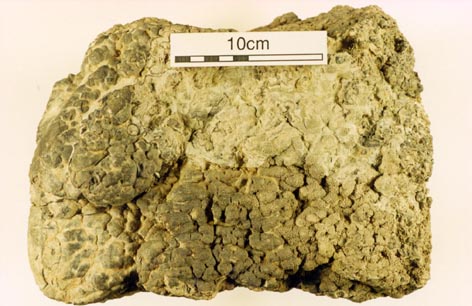
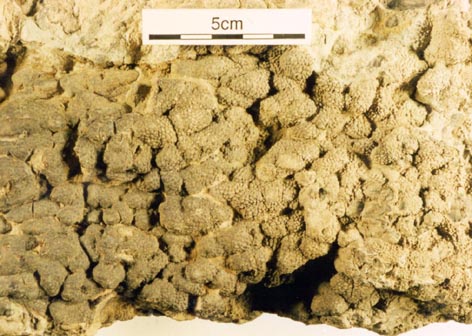
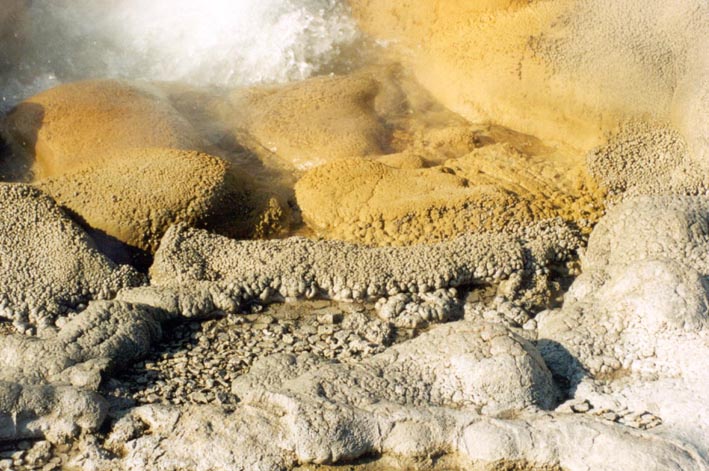
The discovery of a fossiliferous chert (the Windyfield chert) some 700m from the original chert locality (Trewin & Rice 1992; Trewin 1994) resulted in recognition of part of a geyser vent rim with typical splash texture (see insets below). This new chert also yielded Ventarura, a second zosterophyll plant from the area (Powell et al. 2000a) to add to Trichopherophyton from the Rhynie chert (Lyon & Edwards 1991). The Windyfield chert is also rich in arthropods, including trigonotarbid arachnids, centipedes, branchiopod crustaceans and euthycarcinoid remains (Anderson & Trewin 2003). Numerous new arthropods from the Windyfield chert await publication or are currently being described (Fayers & Trewin in press; Fayers et al. in press).
Fieldwork during the autumn of 2000 resulted in the discovery of a concentration of numerous chert float blocks near Castlehill (approximately 1500m east of the Rhynie chert locality) (Rice et al. 2002). It remains uncertain as to whether these are sourced locally from weathered in situ chert bodies beneath the surface or are glacially derived from the Rhynie area. One block of chert from Castlehill has yielded a completely new branchiopod crustacean, Castracollis (Fayers & Trewin 2003), and the attached fertile elements of the charophyte alga Palaeonitella (Kelman et al. in press).
In September 2003 an international meeting entitled "The Rhynie Hot Spring System: Geology, Biota and Mineralisation" was held at the University of Aberdeen. Numerous papers presented at this conference will form the content of a special volume to be published in the Transactions of the Royal Society of Edinburgh: Earth Sciences later in 2004.
A history of research of the Rhynie chert, its palaeontology, and the geology of the Rhynie area is currently awaiting publication (Trewin in press).
- Future Work
-
Research continues in several universities involving specialists on different groups of plants and animals, and new elements of this ancient biota continue to be found. There is clearly still considerable research potential in the description and interpretation of this remarkable community of plants and animals that lived near the hot springs of Rhynie 400 million years ago.
In September 2003 a new trench was excavated through part of the Rhynie chert succession with permission from Scottish Natural Heritage. During the excavation oriented in situ beds of chert were sampled from numerous plant-bearing horizons, each covering an area of at least 1m2. Using this material it is hoped further research will enable the 3-dimensional palaeoecology of the chert to be determined, a study that hitherto has not been attempted. Prof. Dr Nigel Trewin and Dr Stephen Fayers are currently seeking funds to proceed with this research.