

There is a long history of research on impaired eye movements associated with schizophrenia.
Now a new study led by scientists from the University of Aberdeen has reported a model of testing which demonstrated 98% accuracy in distinguishing between those with and without schizophrenia.
Using a series of simple viewing tests, the researchers, whose work is published in a new paper in Biological Psychiatry, explored the ability of eye movement tests to identify schizophrenia cases from healthy control subjects.
Their findings could speed up detection of the condition and they are now examining whether the tests can be used for earlier intervention in major mental illness.
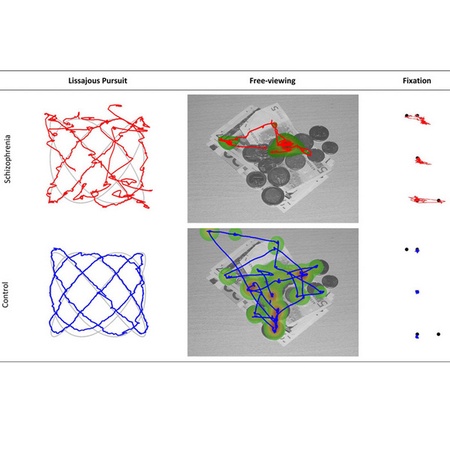
The study was led by Dr Philip Benson and Professor David St Clair and involved a range of eye tests where volunteers were asked to track slow moving objects slowly with their eyes (known as smooth pursuit), inspect a variety of everyday scenes (free viewing) and given instructions to keep a steady gaze on a single unmoving target (fixation tasks).
Dr Benson said: “It has been known for over a hundred years that individuals with psychotic illnesses have a variety of eye movement abnormalities, but until our study, using a novel battery of tests, no one thought the abnormalities were sensitive enough to be used as potential clinical diagnostic biomarkers.
“In smooth pursuit, people with schizophrenia have well-documented deficits in the ability to track slow moving objects smoothly with their eyes. Their eye movements tend to fall behind the moving object and then catch up with the moving object using rapid eye movements called saccades.
“In the free-viewing test, whereas most individuals follow a typical pattern with their gaze as they scan the picture, those with schizophrenia follow an abnormal pattern and in the fixation task individuals with schizophrenia found it more difficult to maintain a steady gaze.”
Several methods were then used to model the data and the accuracy of each of the created algorithms was tested by using eye test data from another group of cases and controls. Combining all the data, one of the models achieved 98% accuracy.
Professor St Clair said: “We are keen to explore how best our findings can be developed for use in routine clinical practice.
“Typical neuropsychological assessments are time-consuming, expensive, and require highly trained individuals to administer. In comparison, these eye tests are simple, cheap, and take only minutes to conduct.
“This means that a predictive model with such precision could potentially be incorporated in clinics and hospitals to aid physicians by augmenting traditional symptom-based diagnostic criteria.
“The next thing we want to know is when the abnormalities are first detectable and can they be used as disease markers for early intervention studies in major mental illness?”
Dr. John Krystal, Editor of Biological Psychiatry, added: “It is encouraging to see the high sensitivity of this model for the diagnosis of schizophrenia. It will be interesting to see the extent to which this approach enables clinical investigators to distinguish people with schizophrenia from individuals with other psychiatric disorders,” commented Dr. John Krystal, Editor of Biological Psychiatry.
The article is “Simple Viewing Tests Can Detect Eye Movement Abnormalities That Distinguish Schizophrenia Cases from Controls with Exceptional Accuracy” by Philip J. Benson, Sara A. Beedie, Elizabeth Shephard, Ina Giegling, Dan Rujescu, and David St. Clair (doi: 10.1016/j.biopsych.2012.04.019). The article appears in Biological Psychiatry, Volume 72, Issue 9 (November 1, 2012), published by Elsevier.