

BSc, PhD(Liv), DSc(Aberd), CChem, FRSC (Emeritus Prof, former HoD)
Emeritus Professor
- About
-
- Email Address
- m.d.ingram@abdn.ac.uk
- School/Department
- School of Natural and Computing Sciences
Biography
- Fellow of the Society of Glass Technology since 2000: since 1999, Editor of “Physics and Chemistry of Glassesâ€: European Journal of Glass Science and Technology, Part B .
 - Fellow of the Royal Society of Arts in 2002 and in the same year awarded a Research Prize by the Alexander von Humboldt Foundation to become Project Leader within Sonderforschungsbereich 458 and Visiting Professor at the University of Münster.
 - Interests include electrochemical energy storage, and the historical aspects of glass science and its impact on society and the environment.
- Research
-
Research Overview
Physical Chemistry of Glasses
Ion Transport Processes
Much research today is concerned with ion transport across a wide range of materials including glasses, molten salts and polymer electrolytes. Optimising ion mobilities in these materials is vital for the development of new electrochemical power sources (including advanced batteries and super-capacitors for use in electrical vehicles or laptop computers), while there is a compelling need for reducing ion mobility in glasses used as electrical insulators or indeed in the storage of nuclear wastes.
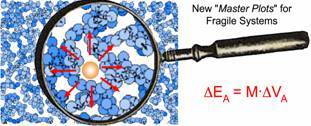
My own research is focused on identifying the microscopic mechanisms of ion transport (see the graphic) using a variety of techniques, including:
- variable-pressure, variable temperature (VPVT) impedance spectroscopy (IS)
 - high-pressure differential scanning calorimetry (HPDSC)
 - VPVT radioactive tracer studies of cation diffusion, with Profs. K Funke and H. Mehrer, Univ. of Münster, Germany
 - positron annihilation lifetime spectroscopy (PALS), with Dr.A.J. Hill, CSIRO, Melbourne, Australia
Economic and environmental factors drive this research forward. These include the need to find ways of storing electricity generated by wind farms, where huge currents are involved, and to find reliable replacements for nickel-cadmium and lead-acid storage batteries, whose disposal is clearly problematic. Our strategy is to focus on basic science and to identify the barriers to ion motion in new materials, which include brittle glasses, rubbery polymers and spongy gels. We report (references 5 and 10) a new equation, EA = M.VA, which enables us to calculate the heights of the above-mentioned barriers in a wide range of materials.
- variable-pressure, variable temperature (VPVT) impedance spectroscopy (IS)
- Publications
-
Page 1 of 3 Results 1 to 10 of 24
A new polymer electrolyte based on a discotic liquid crystal triblock copolymer
Electrochimica Acta, vol. 93, pp. 279-286Contributions to Journals: ArticlesNew insights from variable-temperature and variable-pressure studies into coupling and decoupling processes for ion transport in polymer electrolytes and glasses
Solid State Ionics, vol. 196, no. 1, pp. 9-17Contributions to Journals: Articles- [ONLINE] DOI: https://doi.org/10.1016/j.ssi.2011.05.019
Pressure dependance of the ionic conductivity of Na- and Na-Rb borate glasses
Solid State Ionics, vol. 177, no. 11, pp. 963-969Contributions to Journals: Articles- [ONLINE] DOI: https://doi.org/10.1016/j.ssi.2006.03.009
Evidence from infrared spectroscopy of structural relaxation during field assisted and chemically driven ion exchange in soda-lime-silica glasses
Physics and Chemistry of Glasses, vol. 46, no. 2, pp. 84-89Contributions to Journals: ArticlesFree volume anomalies in mixed-cation glasses revealed by positron annihilation lifetime spectroscopy (PALS)
Physical Chemistry Chemical Physics, vol. 7, no. 8, pp. 1620-1623Contributions to Journals: Articles- [ONLINE] DOI: https://doi.org/10.1039/b419201j
Free volume and conductivity in polymer electrolytes
Electrochimica Acta, vol. 50, pp. 3955-3962Contributions to Journals: Articles- [ONLINE] DOI: https://doi.org/10.1016/j.electacta.2005.02.058
‘Activated’ polypyrrole electrodes for high-power supercapacitor applications.
Solid State Ionics, vol. 169, no. 1-4, pp. 51-57Contributions to Journals: Articles- [ONLINE] DOI: https://doi.org/10.1016/j.ssi.2002.12.003
'Ladder-doped’ polypyrrole: a possible electrode material for inclusion in electrochemical supercapacitors?
Journal of Power Sources, vol. 129, no. 1, pp. 107-112Contributions to Journals: Articles- [ONLINE] DOI: https://doi.org/10.1016/j.jpowsour.2003.11.005
Discotic side group liquid crystal polymer electrolytes
Molecular Crystals and Liquid Crystals, vol. 408, pp. 33-43Contributions to Journals: Articles- [ONLINE] DOI: https://doi.org/10.1080/1542140049025801
Ionic conductivity of a fragile glass-forming molten salt: Modelling it dpendence on frequency, temperature and pressure.
Z. Metallkd, no. 95, pp. 921-927Contributions to Journals: Articles