
Overview
MCP 01
Frigg Transportation System
St Fergus
Personnel
Politics,
Economics & Society

The
Frigg gas field spans the UK and Norwegian sectors of
the North Sea. The initial projection that approximately
40% of the reserves lay in the British sector proved
to be accurate. In 1974, the final agreements were signed
between the Norwegian and UK governments. From Stavanger,
Norway, Elf (now Total E&P Norge A/S) operated all five platforms
in the Frigg Field (two in Norwegian waters and three
in British waters). From Aberdeen, Scotland, Total (now
Total E&P UK Ltd) operated the MCP-01, the 32” pipelines
and the onshore terminal at St Fergus.
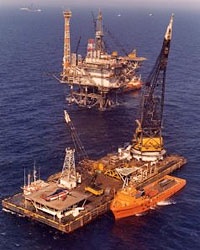
MCP-01
The
Manifold Compression Platform MCP-01 sits 173 kilometres
(104 miles) north-east of Aberdeen, half-way between
the Frigg Field and the Scottish coast. It was built
in Sweden by Doris Engineering and installed in the summer
of 1976, becoming operational the following year. It
is a concrete gravity type, meaning that the platform
is kept on the seabed 94m below the surface by its own
386,000-tonne weight. All but 13,500 tonnes comes from
the concrete gravity base, which is 100 metres (328 feet)
in diameter and 102 metres (335 feet) tall. The perforated
Jarlan wall was designed to protect the central core and
has approximately 1250 holes to reduce wave impact. MCP-01
was used as a pigging station and, later, a compression
platform. Pigs are tools that remove liquid that accumulates
in the pipelines and were also used to check for any internal
damage or corrosion to the pipeline. They are built to
exactly fit the diameter of the pipe, but otherwise differ
depending on their function. Cleaning pigs will have thick,
abrasive brushes whereas inspection pigs contain sensitive
electronic equipment to accurately record the condition
of the pipeline. In the 1970s, it was not possible to pig
a line as long as Frigg in one operation. At MCP-01, the
worn pigs received from the Frigg field were replaced with
undamaged ones or refurbished and sent on down the pipeline
to St Fergus.
 
MCP-01
after becoming not-normally-manned (Click either
image for more detail)
Changes
in the quantity and quality of the gas led to the installation
of compression facilities in 1982. Gas pressure decreased
by two-thirds between leaving the Frigg field and reaching
St Fergus. The compressors increased the capacity of the
pipelines from 31 million standard cubic metres per day
to 42 million cubic metres per day. From 1992, MCP-01 was ‘not
normally manned’, i.e. no permanent presence onboard
but with routine maintenance teams visiting regularly.
Decommissioning of MCP-01 was originally planned to take
place around 2024 once the pipelines passing through the
platform are no longer expected to be in use. However,
studies suggested that it was not possible to guarantee
that an acceptable standard of safety could be maintained
until the platform was fifty years old, even with an appropriate
level of maintenance work. Plans for decommissioning were
brought forward, with assessments indicating that the most
viable strategy was to remove the topside facilities and
as much of the steelwork for recycling as possible, but
leave the concrete substructure in place. In January 2004,
the process began to establish a Decommissioning Programme
to be submitted to the Department of Trade and Industry
(dti) Offshore Decommissioning Unit for approval started.
Programmes of stakeholder and public consultations began
in 2004. Removal of the topside began in 2006.
Frigg
Transportation System
The
twin pipelines transporting gas from the Frigg Field
to the processing plant at St Fergus are 362 kilometres
long (225 miles) and 32 inches (81 centimetres) in diameter.
In places the pipes lie in over 150 metres (492 feet)
of water. At the time of their construction, the pipelines
were the largest ever used at those depths. To withstand
the incredible pressures and prevent corrosion, the steel
walls of the pipes are ¾ inch thick and reinforced
with between 2 and 4.5 inches (5 and 11.5 centimetres)
of concrete. A combination of the great length of pipeline
and short weather window (the period when the North Sea
is calm enough for work to be carried out) meant that the
work began in 1974 and was not completed until 1977. Major
works were carried in the summers of 2004 and 2005 to
bypass MCP-01. The pipelines ran through the base of
the platform but needed to be rerouted by almost 2 kilometres,
as they remain in use after the platform has been decommissioned.
St
Fergus Gas Terminal
The
St Fergus Terminal cost almost £100million
to build and had an initial workforce of 160. Today,
the terminal is much larger, having been extended since
its initial construction in the 1970s. Phase 1 construction
took place in 1977 and Phase 2 a year later; during the
1980s, the discovery of gas in the Alwyn and Bruce fields
necessitated Phase 3.
The
main function of the terminal is to separate the gas
from any condensates before the gas is metered and distributed.
The liquid condensates are then sent to facilities in
Cruden Bay and Mossmorran. Originally, St Fergus supplied
gas to just one customer, British Gas, who had their
own neighbouring facilities where the gas underwent final
treatment before being sent south (such as having the
artificial ‘gas’ odour
added). As of 2007, gas arrives at the terminal from
approximately 20 different offshore fields. On average,
70 million standard cubic metres of gas, about 20% of
the UK’s requirement,
is received and processed there daily. The Phase 2 and
Phase 3 facilities process gas from the Norwegian and UK
pipelines respectively. |