Invented in the 1950s by Nathan Lifson and his research group at the University of Minnesota in the USA, the Doubly-labelled water method is an isotope based technique that allows us to measure CO2 production; hence energy expenditure in completely free-living humans and animals.
It uses the stable isotopes Oxygen18 and Deuterium. Isotopes are administered either orally or injected, and the elimination rate is determined through repeated urine or blood sampling. The enrichment of the samples is measured on a Liquid Isotopic Water analyser.
The difference between the elimination rates of CO2 and H2O allows daily energy expenditure to be calculated.
Summary
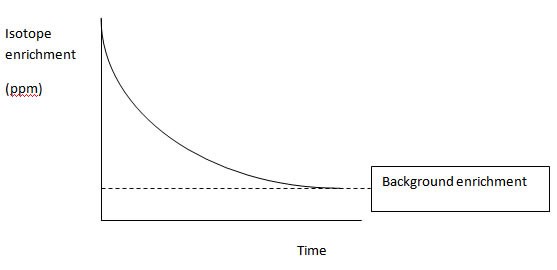
Isotopes introduced into the body get washed out by the flux of materials that carry the elements of those isotopes. The elimination pattern follows an exponential decline as the enrichment of the specific isotope gets more and more depleted and returns to the background enrichment level (Fig. 1).
Figure 1: Isotope elimination
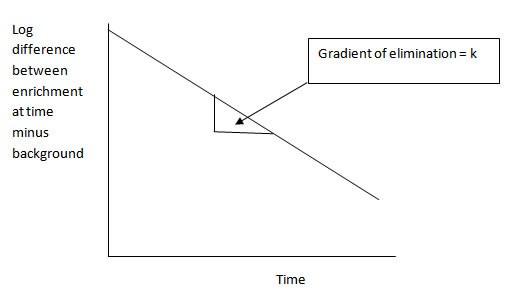
To characterise this elimination pattern a semi-log plot is generated (Fig. 2) of the logged difference between the enrichment and the background enrichment over time. This process linearises the relationship. The gradient of this line (normally represented by k) represents the isotope washout rate. To get the actual rate at which this element is being flushed through the body you simply multiply this gradient by the size of the pool that is being turned over (normally represented by N).
Figure 2: isotope elimination on semi-log plot to linearise the curve
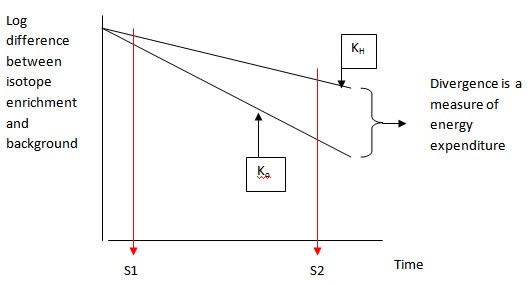
The body water is made up of hydrogen and oxygen. If you introduce an isotope of hydrogen (deuterium or tritium) into the body it will be washed out by the constant inflow of water (preformed in our food, what we drink and metabolic water formed when we metabolise food) and the constant outflow (as urine, sweat, evaporation from our mouths). If you introduce an isotope of oxygen (oxygen-17 or oxygen-18) it is also washed out by all these same routes. However, isotopic oxygen is also flushed out of the system by the constant intake of oxygen and the constant removal of carbon dioxide. So over time the isotope enrichments for hydrogen and oxygen diverge (Fig. 3).
Figure 3: divergence of labels of oxygen and hydrogen over time
The difference between the washout curves ( kH and kO) is then a reflection of the rate at which oxygen and CO2 pass through the body, which is a measure of energy expenditure. The real benefit of the method is that because the log converted elimination lines are linear, one only needs to collect samples at two time points to characterise the two elimination curves (S1 and S2 in Fig 3). Between these time points the subject can go about their daily routines as normal. The technique therefore provides an estimate of free-living energy demands. This has been variously called DEE (daily energy expenditure), TEE (Total energy expenditure) or in animal studies FMR (Field metabolic rate).