In recent years, scientists have come to understand the importance of large meteorite impacts on the Earth and other planets in the solar system. Not only are meteorite impacts implicated in mass extinctions, they may have been important habitats for life in the early history of the Earth and Mars. Under particular scrutiny in this investigation is the role of the impact crater as
a sedimentary basin and the potential of the microfossils preserved within it to record the history of plant life in the immediate vicinity and beyond. The implications of this at a local (ecological) and global (climatological) scale are vast.
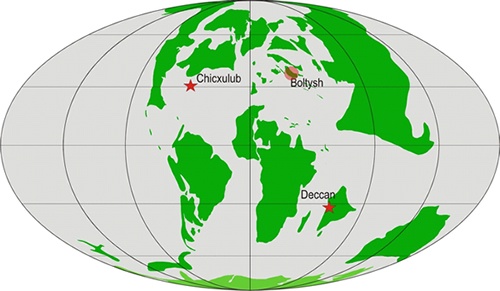
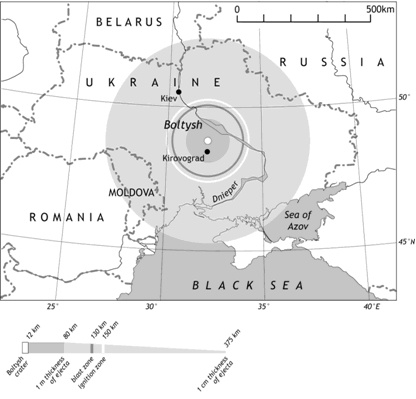
The Boltysh meteorite impact crater in central Ukraine (left) was formed on what would have been an island at the edge of a shallow sea some 65 million years ago. Because of the global greenhouse climate at the time, high sea levels meant that the European landmass as we know it today would have consisted of a large archipelago (below). After the impact the crater became a fresh water lake, filling with fine sediment and the organic remains of the flora and fauna which either lived in the lake or were blown or washed in. The fact that Boltysh remained a large lacustrine basin on the flat continental shelf for so long means that it provides a unique and near continuous record of the Cretaceous – Paleogene (K- Pg) boundary and the earliest Palaeogene (Danian) period.
| Palaeotectonic map circa 65 Ma, showing the site of the Boltysh meteorite impact, the Chicxulub impact site in Mexico and the Deccan Traps large igneous province in India. | ![]() |

We were able to gather some information about the crater prior to drilling from a few scattered pieces of core which were salvaged from boreholes drilled in the 1980s,
and from the sporadic literature that exists on Boltysh, most of which is concerned with its age and/or the chemistry of the impact rocks. These cores have been subsequently lost, but here, with a new, complete core, we have the chance to study the Boltysh lake – fill sediments at the highest possible resolution.
We have drilled a borehole through the deepest crater – fill succession in the trough to the west of the central uplift and recovered a continuous sedimentary section from the crater floor up to the base of the most recent glacial deposits. The drilling of this 596 m core was completed in 2008 and is the first complete drilled section since the 1980s. Core recovery was excellent and it is currently under examination at the University of Aberdeen and Open University in the UK. We have published the findings of our initial investigations (Jolley et al. 2010).
The bottommost 14 m or so of the core comprises impactites, made up of microcrystalline melt rocks, glasses, breccias and a layer of suevite. Above this the lake – fill sediments begin. Approximately 96 m of tubiditic sandstones uncomformably overlie the suevite, indicating initial fluvial input. The remaining 486 m of core is dominantly fine – grained laminated mudstone. These differences in lithology reflect the development of the initial devastation into an actively accumulating lacustrine basin. Macrofossils of fish and gastropod shells are good indicators of the freshwater setting, however desiccation cracks and layers of evaporite minerals such as gypsum attest to arid periods of climatic warmth in which the lake, at least partially, dried out. Most importantly, the sediments contain numerous and well – preserved organic microfossils including marine and freshwater algae and terrestrial sporomorphs (see below). It is these microfossils, along with high resolution geochemical and isotope data, which form the crux of the investigation so far.
Finally, the cores will provide an almost continuous record of the climate in central Europe and Asia. In the future we and other scientists will be able to use it to discover how climate in continental areas relates to the oceanic signal seen elsewhere.
Firstly, we have been able to establish the age of the crater more precisely using Ar-Ar dating of the melt rocks, which places its age at 65.17±0.64 Ma (Kelley & Gurov 2002). We have also established, based on palynological evidence that it formed prior to the K-Pg boundary, predating the Chicxulub crater in Mexico. Our work shows that the Boltysh crater formed within as little as 2 – 5 Ky of the Chicxilub impact, synchronous with the K-Pg boundary (Jolley et al. 2010).
![]() |
The bottom of the Boltysh core showing the rough lithology, palynological changes and d13C over the bottommost 6 m of the crater – fill. (Jolley et al. 2010). The ‘fern spike’ characteristic of aftermath of and initial recovery from the K/Pg extinction event is found just above a 0.9 m ‘barren zone’ devoid of any palynological content. |
2. Analogue for Early Life
Sediments deposited soon after impact can tell us how long the crater lake remained hot. This will be an important result because impact craters may have provided an important habitat for life on early Earth and also possibly on Mars. There were more impacts when the planets were young and warm crater lakes may have been places where early forms of life could survive. A similar study being undertaken in a crater in Africa (Bosumtwi in Ghana) will combine with this work to model crater lakes on early Earth and Mars.
3. Biotic Recovery
Our third aim is to use pollen, spores and algae preserved in the sediments to uncover information about the process of biotic recovery after a significant meteorite impact event. We can do this by recording the species which tell us about the environment surrounding the lake, and by measuring the variations in organic molecules and carbon isotopes which tell us more about the climate at the time. We know very little about biotic reassembly of a wide sterilised and nutrient poor zone such as the Boltysh ejecta blanket. Those that do exist are based on much smaller volcanogenic landscapes which are not directly analogous because they are richer in nutrients. Studying the Boltysh crater will allow us to produce a detailed model for ecosystem recovery following the impact event, creating a comparator for terrestrial meteorite ejecta fields.
![]() |
Palynomorphs from the Boltysh crater sediments. All images were taken at approximately x500 magnification. A – F, H: Reworked from Maastrichtian sediments caught up in the ejecta blanket, all showing higher TAI than the insitu flora. G, I – T: Insitu pollen and spores from the Danian crater sediments. |
4. Climate Record
The core provides an almost continuous record of the climate in central Europe and Asia from the K-Pg boundary throughout the earliest Paleocene (Danian). Climate records for the Danian are scarce and, up till now, have been of low resolution, hence the importance of this data. Palynological data and a high resolution δ13C isotope curve from these sediments go some way towards rectifying this. We will be able to use this to discover how climate in continental areas relates to the oceanic signals seen elsewhere, and to compare climatic events in the Danian to other significant episodes throughout earth history. The ubiquitous palynomorphs (above) and occasional plant mesofossils (below) give us an exceptional view of the floras which inhabited the lake margins, and how these changed over time.
Publications specific to Boltysh
Jolley, D.W., Gilmour, I., Gurov, E., Kelley, S., and Watson, J. (2010) Two large meteorite impacts at the Cretaceous-Paleogene boundary. Geology, 38 (9). 835 – 838.
Valter, A., and Plotnikova, L. (2003) Biostratigraphic indicators of the age of the Boltysh impact crater, Ukraine. In: Koeberl, C. and Martínez-Ruiz, F. (eds.) Impact Markers in the Stratigraphic Record. Springer-Verlag. Berlin.
Kelley, S., and Gurov, E. (2002) Boltysh, another end-Cretaceous impact. Meteoritics & Planetary Science, 37. 1031 – 1043.
Gurov, E.P., Kelley, S.P., and Koeberl, C. (2002) Ejecta of the Boltysh impact crater in the Ukrainian shield. In: Koeberl, C. and Martínez-Ruiz, F. (eds.) Impact Markers in the Stratigraphic Record. Springer-Verlag. Berlin.
Gurov, E.P., Kelley, S.P., and Babina, N.V. (2001) Ejecta of the Boltysh impact crater in the Ukrainian shield [abs.]. 6th ESF – IMPACT Workshop Abstract Book, Grenada, Spain. 44 – 47.
Valter, A.A. (2001) The throwout deposits of Boltysh crater as the probable local K/T impact marker on the Ukrainian Sheild [abs.]. 6th ESF – IMPACT Workshop Abstract Book. Grenada, Spain. 135 – 136.
Valter, A.A. (2000) Ejecta deposits surrounding crater and geological age of Boltysh astrobleme. In: De Graciansky, P-C., Hardenbol, J., Thierry, J., and Vail, P.R. (eds.) Mesozoic and Cenozoic Sequence Chronostratigraphic Framework of European Basin. SEPM Special Publication, 60.
Kashkarov, L.L., Nazarov, M.A., Lorenz, K.A., Kalinina, M.A., and Kononkova, N.N., (1999) Fission-track dating of the Boltysh impact structure. Solar System Research, 33. 291 – 298.
Kashkarov, L.L., Nazarov, M.A., Kalinina, G.V., Lorenz, K.A., and Kononkova, N.N. (1998) Fission-track dating of the Boltysh impact crater, Ukraine. Lunar and Planetary Science, XXIX.
Scmhidt, G. (1997) Clues to the nature of the impacting bodies from platinum group elements (rhenium and gold) in borehole samples from the Clearwater East crater (Canada) and the Boltysh impact crater (Ukraine). Meteroritics & Planetary Science, 32. 761 – 767.
Hölker, Th., and Deutsch, A. (1996) The Boltysh impact structure, Ukraine: Geochemistry of the melt sheet. Lunar and Planetary Science, XXVII. 555 – 556.
Gurov, E.P., and Kheml’nitskii, A.F. (1996) Dissemination and preservation of ejecta from impacta structures: the Boltysh and Acraman craters. Solar System Research, 30. 19 – 24.
Grieve, R.A.F., Reny, G., Gurov, E.P., and Ryabenko. (1987) The melt rocks of the Boltysh impact crater, Ukraine, USSR. Contributions to Mineralogy and Petrology, 96. 56 – 62.
Gurov, E.P., Gurova, H.P., and Kolesov, G.M. (1986) Composition of impactites of the Boltysh astrobleme. Meteoritika, 45. 150 – 155.
Gurov, E.P., and Gurova, H.P. (1985) Boltysh Astrobleme: Impact crater pattern with a central uplift. Lunar and Planetary Science, XVI. 310 – 311.
Bojko, A.K., Valter, A.A., and Vishnyak, M.M. (1985) About the age of Boltysh crater [In Russian]. Geologicheskiy Zhurnal, 45 (4). 89 – 90.
Valter, A.A., and Ryabenko, V.A. (1981) The granulometric and mineral composition of Boltysh meteorite crater throwout on Ukrainian shield [In Russian]. Geologischesky Journal, 41. 29 – 37.
Bryansky, V.P., Zlobenko, V.G., and Rjabtchum, V.K. (1978) The breccia rocks of Paleogen in area of Boltysh depression [In Russian]. Geologicheskii Zhurnal, 2. 135 – 138.
Gurov, E.P., and Valter, A.A. (1977) Ejecta of the Boltyshian meteoritic crater in the Ukrainian shield. Geologicheskiy Zhurnal, 27 (6). 79 – 84.
Yurk, Y.Y., and Yeremko, G.K., and Polkanov, Y. (1975) The Boltysh depression – A fossil meteorite crater [In Russian]. Sovetska Geologiya, 2. 138 – 144.
Stanislavsky, F.A. (1968) The age and stratigraphy of sapropellites from Boltysh depression [In Russian]. Geologicheskiy Zhurnal, 28 (2). 105 – 110.
Bass, YuB., Galka, A.I., Grabovsky, V.I. (1967) The Boltysh combustible shale [In Russian]. Geologia i ohrana nedr (USSR), 9. 9 – 15.