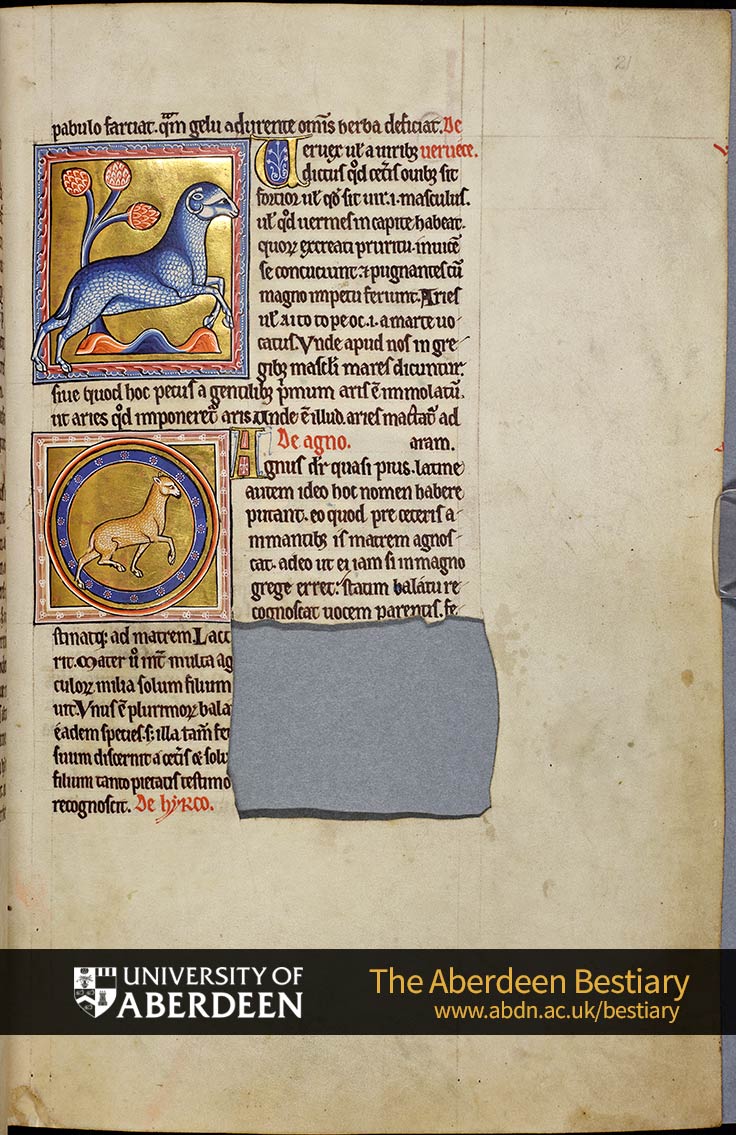
Folio 21r - Sheep, continued. De vervece; the ram. De agno; the lamb. De hyrco; the he-goat
with fodder before the grass fails in the sharp frost.
Of the wether, or ram
The wether gets its name, vervex, either from its strength, vires, because it is stronger than other sheep, or because it is a man, vir, that is, male, or because it has worms, vermes, in its head; irritated by the itching which these cause, wethers strike each other, butting their heads together in combat with great force. It is also called a ram, aries, from the Greek, Ares, that is, the god of war; in Latin, Mars; that is why we call the males in a flock mares. Or because, once upon a time, this animal was offered as a sacrifice by pagans on their altars: thus, aries, because it is laid upon an altar, ara. From which we get: 'the ram is sacrificed at the altar' (see Exodus, 29:18).
Of the lamb
The lamb is called agnus possibly from the Greek word agnos, pious. Some think that it gets the Latin form of its name because, more than any other animal, it recognises, agnoscere, its mother, so much so that, even if it strays in the midst of a large flock, it recognises its mother's voice by her bleat and hurries to her. It seeks out also the sources of mother's milk which are familiar to it. The mother recognises her lamb alone among many thousands of others. Lambs in large numbers make the same baa-ing noise and look the same, yet she picks out her offspring among the others and by her great show of tenderness identifies it as hers alone.
Of the he-goat
- Commentary
-
Commentary
Text
The ram or wether, a virile beast, its etymology. The lamb, a pious creature, its etymology. The he-goat.
Illustration
The virile ram is shown bounding through its frame, the delicate lamb skips within its roundel.
Comment
The excision at the bottom is for the bullock illustration on f.21v. Folio mark of three nested chevrons in top right corner. Margins are visible. Initial indicators in red 'v','a', in right margin. Initial type 2.
- Transcription and Translation
-
Transcription
pabulo farciat, quam gelu adurente omnis herba deficiat. \ De vervece \ Vervex vel a viribus dictus quod ceteris ovibus sit fortior vel quod sit vir, id est masculus, vel quod vermes in capite habeat, quorum excreati pruritu, invicem se concuciunt, et pugnantes cum magno impetu feriunt. Aries vel aito to peoc, id est a marte vocatus. unde apud nos in gregibus masculi mares dicuntur, \sive quod hoc [ecus a gentibus primum aris est immolatum \ut aries quod imponeretur aris. Unde est illud, aries mactatur ad \aram. \ De agno \ Agnus dicitur quasi pius, latine autem ideo hoc nomen habere putant, eo quod pre ceteris animantibus is matrem agnoscat, adeo ut ei iam si in magno grege erret, statim balatu recognoscat vocem parentis, fe\stinatque ad matrem. Lactis quoque materni notos sibi fontes requi\rit. Mater vero inter multa agnic\culorum milia solum filium no\uit. Unus est plurimorum balatus \eadem species, sed illa tamen fetum \suum discernit a ceteris et solum \filium tanto pietatis testimonio \recognoscit. \ De hyrco \Translation
with fodder before the grass fails in the sharp frost. Of the wether, or ram The wether gets its name, vervex, either from its strength, vires, because it is stronger than other sheep, or because it is a man, vir, that is, male, or because it has worms, vermes, in its head; irritated by the itching which these cause, wethers strike each other, butting their heads together in combat with great force. It is also called a ram, aries, from the Greek, Ares, that is, the god of war; in Latin, Mars; that is why we call the males in a flock mares. Or because, once upon a time, this animal was offered as a sacrifice by pagans on their altars: thus, aries, because it is laid upon an altar, ara. From which we get: 'the ram is sacrificed at the altar' (see Exodus, 29:18). Of the lamb The lamb is called agnus possibly from the Greek word agnos, pious. Some think that it gets the Latin form of its name because, more than any other animal, it recognises, agnoscere, its mother, so much so that, even if it strays in the midst of a large flock, it recognises its mother's voice by her bleat and hurries to her. It seeks out also the sources of mother's milk which are familiar to it. The mother recognises her lamb alone among many thousands of others. Lambs in large numbers make the same baa-ing noise and look the same, yet she picks out her offspring among the others and by her great show of tenderness identifies it as hers alone. Of the he-goat