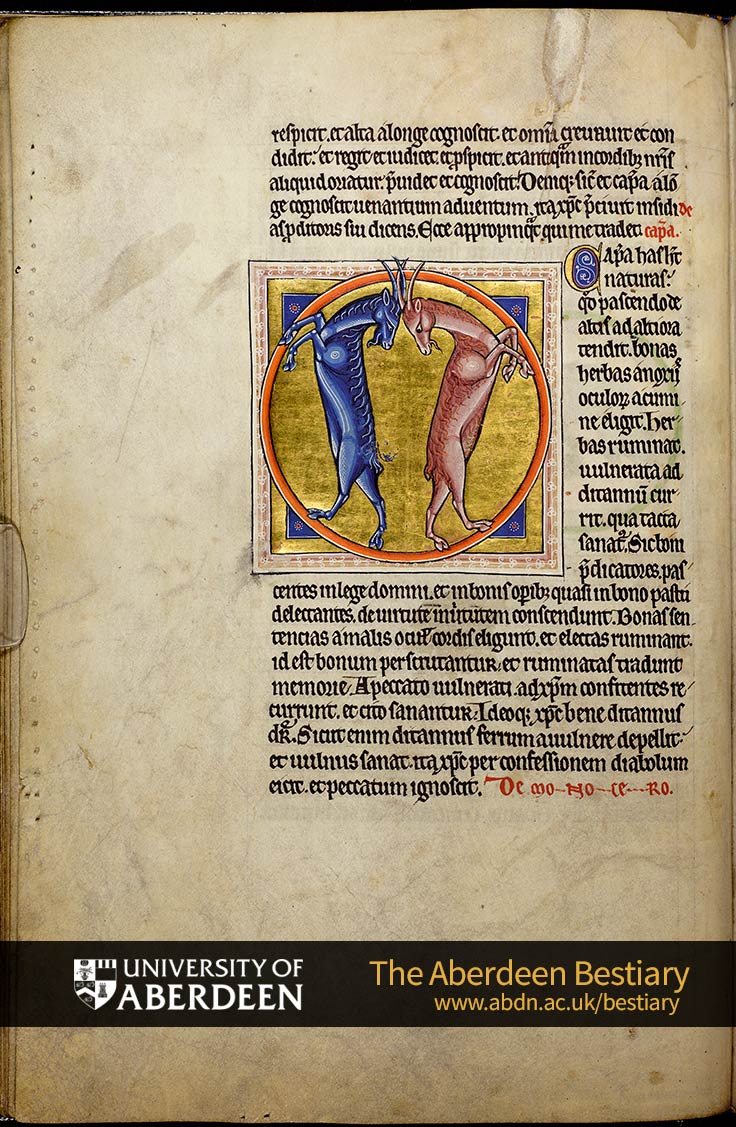
Folio 14v - De caprea; the wild goat
but the proud he knoweth afar off.' (Psalms, 138:6) He created and established all things, and rules and judges and sees; and before anything arises in our hearts he foresees and understands it. Lastly, just as the goat perceives from afar hunters approaching, so Christ knew in advance the plot of his betrayer, saying: 'Behold, he is at hand that doth betray me.' (Matthew, 26:46) Of the wild goat The goat has these characteristics: when grazing, it moves from high to even higher pastures. It picks out good grass from bad by the sharpness of its eyes. It feeds by chewing the grass. When wounded, it hurries to find the herb dittany and, by touching it, is healed. In the same way, good preachers graze on the law of the Lord and take delight in good works as in good pastures, rising from one virtue to another. They choose good writings from bad with the eyes of the heart and meditate upon those they have chosen, that is they examine the good in the views expressed and, having pondered them, commit them to memory. Wounded by sin, they hurry back to Christ by confessing and are quickly healed. For this reason, Christ is rightly said to be like ditanny. For as dittany drives out iron from a wound and heals it, so Christ through confession casts out the devil and pardons sin. Of the monocerus
- Commentary
-
Commentary
Text
The wild goat. The Monoceros.
Illustration
Two agile beasts lock horns in a roundel.
Comment
The illustration is not related to the text which describes the goats eating grass in high pastures. Pricking and ruling are visible. Initial indicator 'e' in right margin. Initial type 2.
Folio Attributes
- Transcription and Translation
-
Transcription
respicit, et alta a longe cognoscit, et omnia crevavit et con\didit, et regit et iudicet, et prospicit, et antequam in cordibus nostris\ aliquid oriatur, previdet et cognoscit. Denique sicut et capra a lon\ge cognoscit venantium adventum, ita Christus precivit [prescivit] insidi\as proditoris sui dicens: Ecce appropinquit qui me tradet.\ De Capra\ Caprea has habet\ naturas,\ quod pascendo de\ altis ad altiora\ tendit. Bonas\ herbas a noxiis\ oculorum acumi\ne eligit. Her\bas ruminat,\ vulnerata ad\ ditannum cur\rit, qua tacta\ sanatur. Sic boni\ predicatores, pas\centes in lege domini, et in bonis operibus quasi in bono pastu\ delectantes, de virtute in virtutem conscendunt. Bonas sen\tencias a malis oculis cordis eligunt, et electas ruminant,\ id est bonum perscrutantur, et ruminatas tradunt\ memorie. A peccato vulnerati, ad Christum confitentes re\currunt, et cito sanantur. Ideoque Christus bene ditannus\ dicitur. Sicut enim ditannus ferrum a vulnere depellit,\ et vulnus sanat, ita Christus per confessionem diabolum\ eicit, et peccatum ignoscit.\ De monocero\Translation
but the proud he knoweth afar off.' (Psalms, 138:6) He created and established all things, and rules and judges and sees; and before anything arises in our hearts he foresees and understands it. Lastly, just as the goat perceives from afar hunters approaching, so Christ knew in advance the plot of his betrayer, saying: 'Behold, he is at hand that doth betray me.' (Matthew, 26:46) Of the wild goat The goat has these characteristics: when grazing, it moves from high to even higher pastures. It picks out good grass from bad by the sharpness of its eyes. It feeds by chewing the grass. When wounded, it hurries to find the herb dittany and, by touching it, is healed. In the same way, good preachers graze on the law of the Lord and take delight in good works as in good pastures, rising from one virtue to another. They choose good writings from bad with the eyes of the heart and meditate upon those they have chosen, that is they examine the good in the views expressed and, having pondered them, commit them to memory. Wounded by sin, they hurry back to Christ by confessing and are quickly healed. For this reason, Christ is rightly said to be like ditanny. For as dittany drives out iron from a wound and heals it, so Christ through confession casts out the devil and pardons sin. Of the monocerus