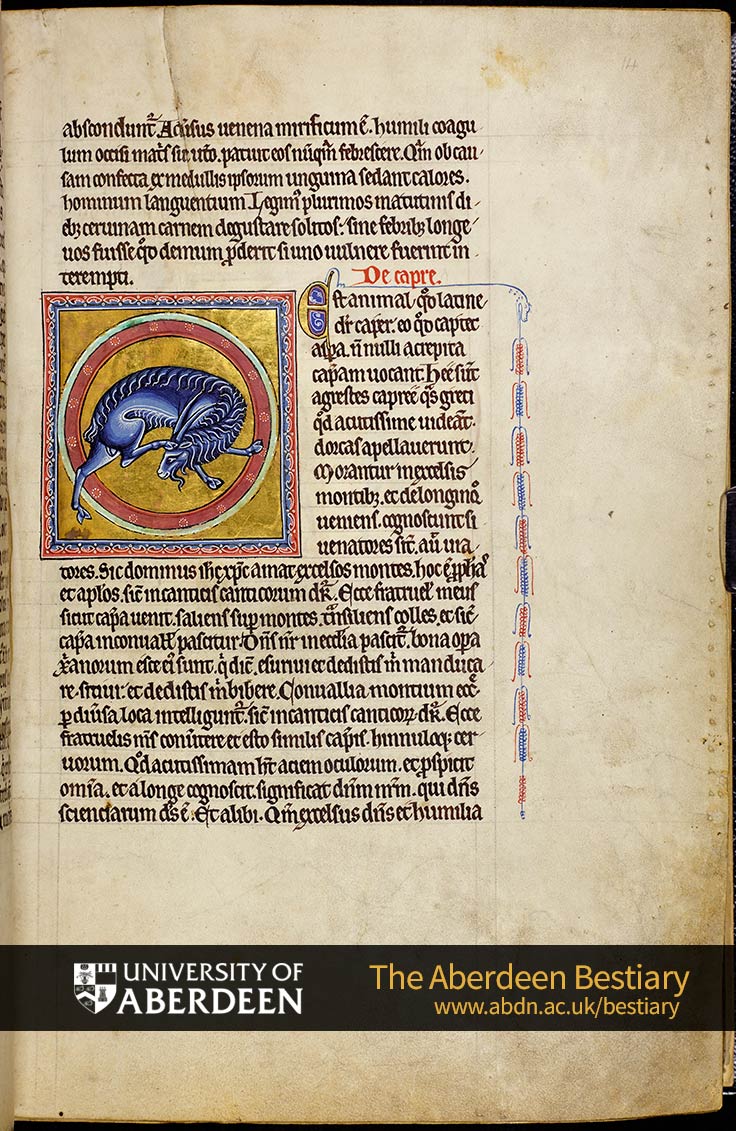
Folio 14r - Deer, continued. De capre; the goat.
The rennet of a fawn killed in its mother's womb is a marvellous remedy against poisons. It is known that deer never grow feverish. For this reason ointments made from their marrow bring down sick men's temperatures. We read that many men who have regularly eaten a small amount of venison since their early days have lived for a long time unaffected by fevers; but ultimately it fails them as a remedy if they are killed by a single blow. Of the goat There is an animal called in Latin caper, goat, because it chooses, capere, to live in rugged places; some call it capra from crepita, 'a rustling noise'. These are the tame goats which the Greeks called dorcas, gazelle, because they have very sharp sight. They live in high mountains and can tell if men approaching a long way off are hunters or travellers. In the same way, our Lord Jesus Christ loves high mountains, that is, the prophets and Apostles, as it says in the Song of Songs: 'Behold, my beloved cometh leaping upon the mountains, skipping upon the hills (see Song of Solomon, 2:8). As a goat grazes in the valleys, our Lord grazes on the church; the good works of Christian people are the food of him who said: 'For I was an hungred, and ye gave me meat; I was thirsty, and ye gave me drink.' (Matthew, 25:35) By the valleys of the mountains are understood the churches spread through different regions, as it says in the Song of Songs: 'My beloved is like a roe or young hart.' (Song of Solomon, 2:9) The fact that the goat has very sharp eyesight, sees everything and recognises things from a long way off, signifies our Lord, who is the lord of all knowing and God. And elsewhere it is written: 'Though the Lord be high yet hath he respect unto the lowly
- Commentary
-
Commentary
Text
Fawn's rennet. The goat.
Illustration
The image of the goat in the roundel, scratching his head with his hind leg, is not related to the attributes given in the text which describe him living in high mountains.
Comment
Pricking and ruling are visible. Initial indicator 'e' in left margin. Initial type 2.
Folio Attributes
- Transcription and Translation
-
Transcription
absconduntur. Adversus venena mirificum est humuli [A: hinnuli] coagu\lum occisi matris sue utero. Patuit eos numquam febrescere. Quam ob cau\sam confecta ex medullis ipsorum unguina sedant calores\ hominum languentium. Legimus plurimos matutinis di\ebus cervinam carnem degustare solitos, sine febribus longe\vos fuisse, quod demum proderit si uno vulnere fuerint in\terempti.\ De capre\ Est animal quod latine\ dicitur caper, eo quod captet\ aspera, nonnulli a crepita \ capream vocant. Hee sunt\ agrestes capree quas greci\ quod acutissime videant,\ dorcas appellaverunt.\ Morantur in excelsis\ montibus, et de longinquo\ veniens [A: venientes], cognoscunt si\ venatores sint, aut via\tores. Sic dominus Iesus Christus amat excelsos montes, hoc est prophetas\ et apostolos, sicut in canticis canticorum dicitur: Ecce fratruelis meus\ sicut caprea venit, saliens super montes, transiliens colles, et sicut\ caprea in convalles pascitur. Dominus noster in ecclesia pascitur, bona opera\ Christianorum esce eius sunt, qui dicit: esurivi et dedistis mihi manduca\re; sitivi, et dedistis mihi bibere. Convallia montium ecclesie\ per diversa loca intelliguntur, sic in canticis canticorum dicitur: Ecce fratruelis meus convertere et esto similis capreis, hinnuloque cer\vorum. Quod acutissimam habet aciem oculorum, et perspicit\ omnia, et a longe cognoscit, significat dominum nostrum, qui dominus\ scienciarum deus est. Et alibi: Quam excelsus dominus et humilia\Translation
The rennet of a fawn killed in its mother's womb is a marvellous remedy against poisons. It is known that deer never grow feverish. For this reason ointments made from their marrow bring down sick men's temperatures. We read that many men who have regularly eaten a small amount of venison since their early days have lived for a long time unaffected by fevers; but ultimately it fails them as a remedy if they are killed by a single blow. Of the goat There is an animal called in Latin caper, goat, because it chooses, capere, to live in rugged places; some call it capra from crepita, 'a rustling noise'. These are the tame goats which the Greeks called dorcas, gazelle, because they have very sharp sight. They live in high mountains and can tell if men approaching a long way off are hunters or travellers. In the same way, our Lord Jesus Christ loves high mountains, that is, the prophets and Apostles, as it says in the Song of Songs: 'Behold, my beloved cometh leaping upon the mountains, skipping upon the hills (see Song of Solomon, 2:8). As a goat grazes in the valleys, our Lord grazes on the church; the good works of Christian people are the food of him who said: 'For I was an hungred, and ye gave me meat; I was thirsty, and ye gave me drink.' (Matthew, 25:35) By the valleys of the mountains are understood the churches spread through different regions, as it says in the Song of Songs: 'My beloved is like a roe or young hart.' (Song of Solomon, 2:9) The fact that the goat has very sharp eyesight, sees everything and recognises things from a long way off, signifies our Lord, who is the lord of all knowing and God. And elsewhere it is written: 'Though the Lord be high yet hath he respect unto the lowly